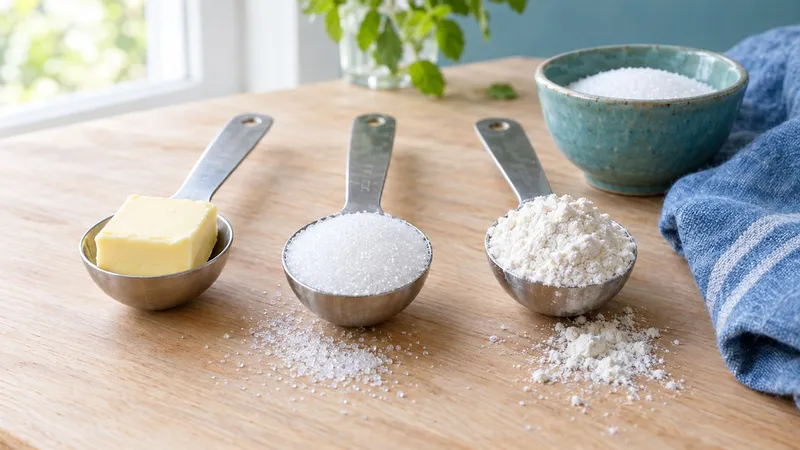
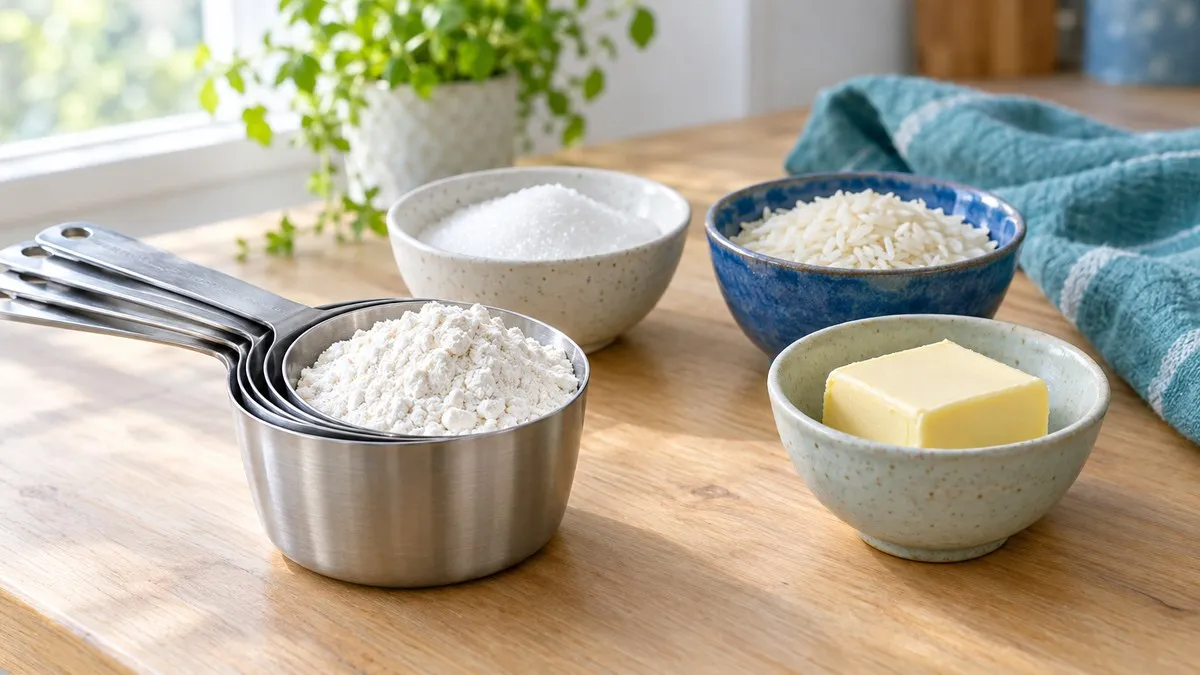
To convert grams to cups, divide the grams by what one cup of that ingredient weighs. 100 g of all-purpose flour is about 0.8 cup, 100 g of granulated sugar is half a cup, and 100 g of butter is about 7 tablespoons. There is no single grams to cups number, because a cup measures volume and every ingredient packs into it differently.
If you have a recipe written in grams and only measuring cups in the drawer, the charts below give you the cup figure for 24 common ingredients, plus the measuring spoons for small amounts. Each figure comes from USDA FoodData Central, with King Arthur Baking's chart beside it where the two disagree, so you can see how wide the honest answer is.
Why Grams to Cups Depends on the Ingredient
A gram is a unit of mass and a cup is a unit of volume. A cup of honey and a cup of cocoa powder fill the same space, yet USDA lists the honey at 339 g and the cocoa at 86 g. Converting one into the other always needs a third number: the weight of one cup of that specific ingredient.
That number is a density figure, and for liquids it is steady. Water, milk and oil pour into a cup the same way every time. Dry ingredients are different. Flour, powdered sugar and cocoa settle, trap air and compress, so the weight of a cup depends on how it was filled.
The formula
The calculation is one division:
cups = grams ÷ grams per cup
For all-purpose flour, USDA lists one cup at 125 g in its flour record, so 250 g of flour is 250 ÷ 125 = 2 cups. King Arthur's ingredient weight chart lists the same cup at 120 g, which makes 250 g about 2.08 cups. Both answers are reasonable, and the gap between them is the uncertainty built into measuring flour by volume.
Grams to Cups for Flour, Sugar and Powders
These are the ingredients where the two sources disagree most, so each row shows a range. The lower cups figure comes from the heavier cup weight, and the higher one from the lighter.
| Ingredient | 1 cup in grams | 100 g in cups | 250 g in cups |
|---|---|---|---|
| All-purpose flour | 120 to 125 | 0.80 to 0.83 | 2.00 to 2.08 |
| Bread flour | 120 to 137 | 0.73 to 0.83 | 1.82 to 2.08 |
| Whole wheat flour | 113 to 120 | 0.83 to 0.88 | 2.08 to 2.21 |
| Cake flour | 120 to 137 | 0.73 to 0.83 | 1.82 to 2.08 |
| Cornstarch | 112 to 128 | 0.78 to 0.89 | 1.95 to 2.23 |
| Cocoa powder, unsweetened | 84 to 86 | 1.16 to 1.19 | 2.91 to 2.98 |
| Granulated sugar | 198 to 200 | 0.50 to 0.51 | 1.25 to 1.26 |
| Brown sugar, packed | 213 to 220 | 0.45 to 0.47 | 1.14 to 1.17 |
| Powdered sugar, unsifted | 113 to 120 | 0.83 to 0.88 | 2.08 to 2.21 |
Why the flour rows spread the most
Granulated sugar barely moves between sources, because its crystals pour and settle the same way in any cup. Bread flour and cake flour move the most: USDA's cake flour figure is for a cup that was dipped into the bag without sifting, while King Arthur gives 120 g for both.
For a closer look at why flour readings differ so much, our guide to a cup of flour in grams compares the filling methods side by side. Sugar has its own breakdown in grams in a cup of sugar, including brown and powdered.
Butter, Liquids and Sweeteners in Cups
Liquids and soft fats give a single figure, since filling the cup leaves little room for interpretation. All values below are USDA FoodData Central, except peanut butter, where King Arthur's chart is heavier.
| Ingredient | 1 cup in grams | 100 g in cups | 250 g in cups |
|---|---|---|---|
| Butter | 227 | 0.44 | 1.10 |
| Water | 237 | 0.42 | 1.05 |
| Whole milk | 244 | 0.41 | 1.02 |
| Heavy cream | 238 | 0.42 | 1.05 |
| Plain whole milk yogurt | 245 | 0.41 | 1.02 |
| Olive oil | 216 | 0.46 | 1.16 |
| Canola oil | 218 | 0.46 | 1.15 |
| Honey | 339 | 0.29 | 0.74 |
| Maple syrup | 315 | 0.32 | 0.79 |
| Peanut butter, smooth | 258 to 270 | 0.37 to 0.39 | 0.93 to 0.97 |
Two patterns are worth remembering. Water, milk, cream and yogurt all sit close to 240 g a cup, so 100 g of any of them is a little over 0.4 cup. Oils are lighter than water, about 216 to 218 g a cup, and syrups are much heavier, so 250 g of honey does not even fill a cup.
Butter in tablespoons
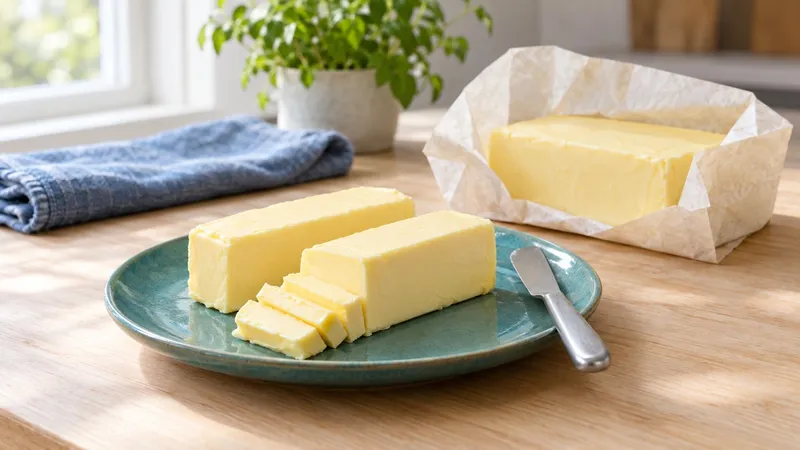
Butter is the one most recipes need in spoons rather than cups. At 227 g a cup and 16 tablespoons to the cup, a tablespoon of butter is about 14.2 g, and a US stick of half a cup is about 113 g.
Rice, Oats, Nuts and Cheese
Grains, nuts and grated cheese sit between powders and liquids. Their pieces leave gaps in the cup, so the shape of the grain or flake matters as much as what it is made of.
| Ingredient | 1 cup in grams | 100 g in cups | 250 g in cups |
|---|---|---|---|
| White rice, long-grain, uncooked | 185 | 0.54 | 1.35 |
| Rolled oats, dry | 81 to 89 | 1.12 to 1.23 | 2.81 to 3.09 |
| Almonds, whole | 142 to 143 | 0.70 | 1.75 to 1.76 |
| Parmesan, grated | 100 | 1.00 | 2.50 |
| Table salt | 288 to 292 | 0.34 to 0.35 | 0.86 to 0.87 |
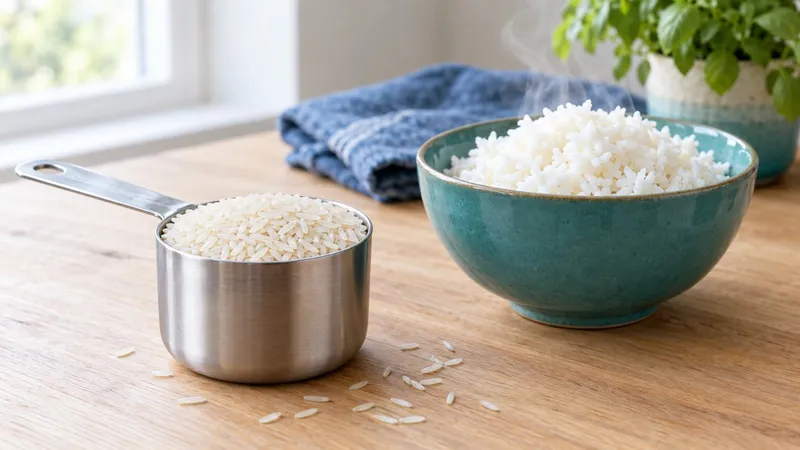
Rolled oats are the surprise for most people: 100 g fills more than a cup, because the flakes are thin and stack loosely. Uncooked rice is the opposite, dense enough that 100 g is just over half a cup. Cooked rice weighs differently again, since the grains absorb water, so use these figures only for dry rice going into the pot.
Table salt is on the list mostly as a warning. At about 290 g a cup, a small error in a salt measurement is a large error in grams, which is why recipes almost always give salt in teaspoons.
How to Turn Decimal Cups Into Measuring Cups
A chart that says 0.83 cup is only useful if you can find 0.83 in your drawer. Standard US measuring sets come in 1/4, 1/3, 1/2, 2/3, 3/4 and 1 cup, and a tablespoon is 1/16 of a cup. That gives you everything you need to build an awkward amount:
- 0.25 is 1/4 cup, 0.33 is 1/3 cup, 0.5 is 1/2 cup, 0.67 is 2/3 cup and 0.75 is 3/4 cup.
- Every extra 0.06 of a cup is about one tablespoon, and 0.03 is about half a tablespoon.
- A teaspoon is a third of a tablespoon, or 1/48 of a cup, for the smallest corrections.
Rounding to the nearest tablespoon keeps any single measurement within about 0.03 cup, which for flour is roughly 4 g.
100 grams to cups
For 100 g of all-purpose flour, the chart gives 0.80 to 0.83 cup. That is 3/4 cup plus one tablespoon. For 100 g of butter, divide by 14.2 g a tablespoon and you get about 7 tablespoons, one less than a stick.
200 grams to cups
200 g of granulated sugar is a full cup, give or take a teaspoon. 200 g of packed brown sugar is 0.91 to 0.94 cup, or about 14 1/2 to 15 tablespoons, so fill a cup and leave roughly a tablespoon of space at the top. 200 g of rolled oats is about 2 1/4 to 2 1/2 cups, because the flakes are so light.
250 grams to cups
250 g of all-purpose flour is 2 cups by USDA's figure and 2 cups plus about 1 1/3 tablespoons by King Arthur's. 250 g of whole milk is just over a cup, close enough that the difference is a splash.
If you would rather not do the division at all, our free grams to cups converter runs the same figures for each ingredient and shows the nearest kitchen measure.
Which Cup Are You Using?
A cup is not one fixed size worldwide, which matters if you follow recipes from more than one country. Three are in common use:
| Cup | Volume | Where you see it |
|---|---|---|
| US customary cup | 236.6 mL | US recipes and US measuring sets |
| US nutrition label cup | 240 mL | Nutrition Facts panels |
| Metric cup | 250 mL | Australia, New Zealand and many Canadian recipes |
The 240 mL figure is set by the US nutrition labeling rule in 21 CFR 101.9, which also fixes a tablespoon at 15 mL and a teaspoon at 5 mL. NIST's Metric Kitchen uses the same rounded 240 mL cup as an approximate equivalent for home cooking.
All the charts above use the US customary cup. A metric cup holds about 5.7 percent more, so divide the grams by a figure about 5.7 percent higher. A metric cup of all-purpose flour comes to roughly 127 to 132 g, and a metric cup of granulated sugar to roughly 209 to 211 g. For water, a 250 mL cup holds about 250 g, which makes liquid conversions in metric kitchens almost one to one.
Australian recipes add one more wrinkle: the Australian tablespoon is 20 mL rather than 15 mL. When a recipe lists both grams and Australian spoons, trust the grams.
Small Amounts: Use Teaspoons, Not Cups
Leavening and spices come in amounts too small for a cup to handle well. USDA gives these per spoon rather than per cup, and they are worth knowing for the last lines of a recipe:
| Ingredient | USDA measure | 5 g is about | 10 g is about |
|---|---|---|---|
| Baking soda | 1 tsp = 4.6 g | 1 tsp | a little over 2 tsp |
| Baking powder | 1 tsp = 4.6 g | 1 tsp | a little over 2 tsp |
| Ground cinnamon | 1 tbsp = 7.8 g | 2 tsp | 1 1/4 tbsp |
| Ground ginger | 1 tbsp = 5.2 g | 1 tbsp | 2 tbsp |
| Table salt | 1 cup = 292 g | a scant 1 tsp | 1 2/3 tsp |
Baking soda and baking powder change a bake more per gram than any other ingredient, so round these down rather than up when a conversion falls between spoons.
How to Fill a Cup So the Chart Holds
Every grams to cups figure assumes the cup was filled the way the source filled it. The FDA's household measures guidance tells manufacturers that fine solids such as flours and sugars may be levelled with a knife or other straight edge, after they go into the measure. The same habits make your own cup match a chart:
- Stir flour in the bag first, spoon it into the cup without pressing, then sweep the top level with a knife.
- Pack brown sugar firmly, since both sources list it packed, and level it.
- Pour liquids into a clear measuring jug at eye level, rather than a dry measuring cup filled to the brim.
Scooping the cup straight through the flour presses it down and puts more flour in the cup than either source assumed. If a cake comes out dry and dense from a converted recipe, the scoop is the first thing to check.
When the Ingredient Does Not Fit in a Cup
Some recipes written in grams ask for things that never go in a measuring cup: 200 g of apples, a 150 g piece of chicken, 300 g of potatoes. A cup chart cannot help there, and the usual fallback is a typical weight per item from a reference table.
That is the job Primo Scale was built for. The Weight Estimator identifies a whole food from one photo and gives a typical figure with a likely range, such as about 182 g, likely 165 to 200 g, for a green apple, with its reasoning shown beside the result. Primo Scale does not weigh objects or use phone sensors. It estimates a likely range from visual analysis and reference data, so when a recipe depends on the exact amount, a real kitchen scale is still the tool.
Loose ingredients are the opposite case. A photo cannot see how tightly flour or sugar was packed into a cup, so for anything measured by the cup, the charts in this post are the better reference than any camera, Primo Scale included.
Conclusion
Grams to cups is a division by the weight of one cup of that ingredient, and that weight changes a lot from one ingredient to the next. Water, milk and yogurt are close to 240 g a cup, granulated sugar about 200 g, all-purpose flour 120 to 125 g and rolled oats only 81 to 89 g.
Dry ingredients carry a range because the cup can be filled more or less tightly, so spoon and level flour and pack brown sugar to match the sources. Use tablespoons for anything under a quarter cup and teaspoons for leavening and salt. If a recipe comes from Australia or New Zealand, or often Canada, remember its cup is 250 mL, about 5.7 percent larger than the US cup the charts use.