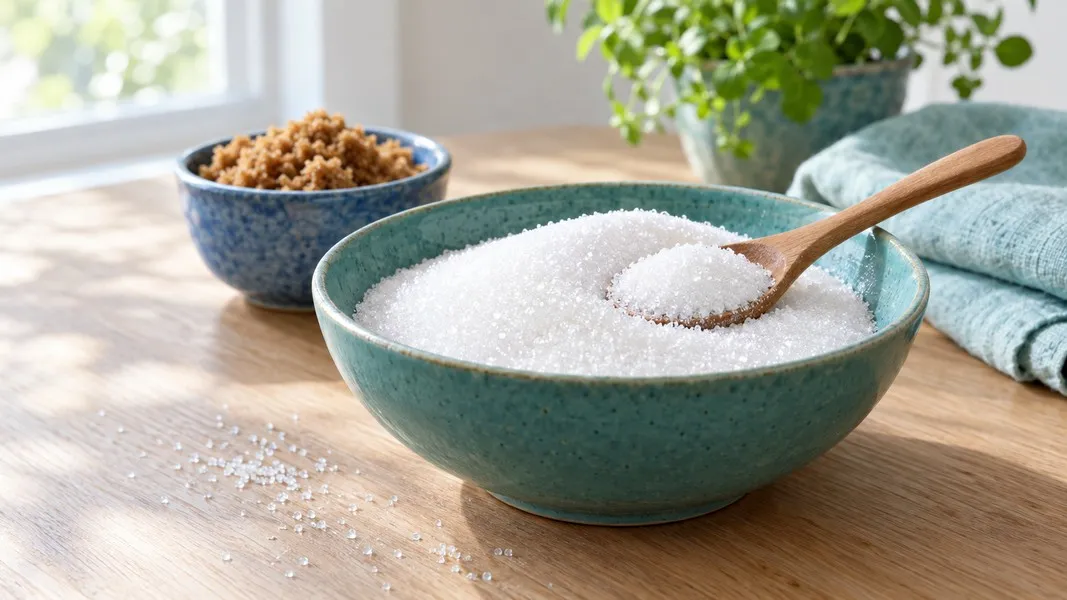
One US cup of granulated white sugar is 200 grams, according to the household measures in USDA FoodData Central. So when you ask how many grams in a cup of sugar, the answer is 200 g for white sugar, 220 g for packed brown sugar and 120 g for powdered sugar that has not been sifted.
Those three numbers cover most recipes, but they are not interchangeable. Sugar is the ingredient where the type, the packing and even the country your cup comes from move the result by 20 g or more. This guide gives you the gram figures for every common sugar, the fractions recipes actually use, and a short method for converting any cup measure to grams without guessing.
How Many Grams in a Cup of Sugar, by Type
Two references are worth knowing. USDA publishes a gram weight for a standard household cup of each sugar, and King Arthur Baking publishes the weights its own test kitchen uses in recipes. They agree closely on white sugar and drift apart on the softer sugars.
| Sugar | 1 cup, USDA | 1 cup, King Arthur | What changes it |
|---|---|---|---|
| Granulated white | 200 g | 198 g | Very little |
| Brown, packed | 220 g | 213 g | How firmly you press it |
| Brown, unpacked | 145 g | not listed | Loose crystals trap air |
| Powdered, unsifted | 120 g | about 113 g | Settling in the bag |
| Powdered, sifted | 100 g | not listed | Sifting adds air |
| Superfine or caster | not listed | 190 g | Finer crystals |
The King Arthur figures come from its ingredient weight chart, which lists confectioners' sugar as 227 g for 2 cups, so about 113 g per cup.
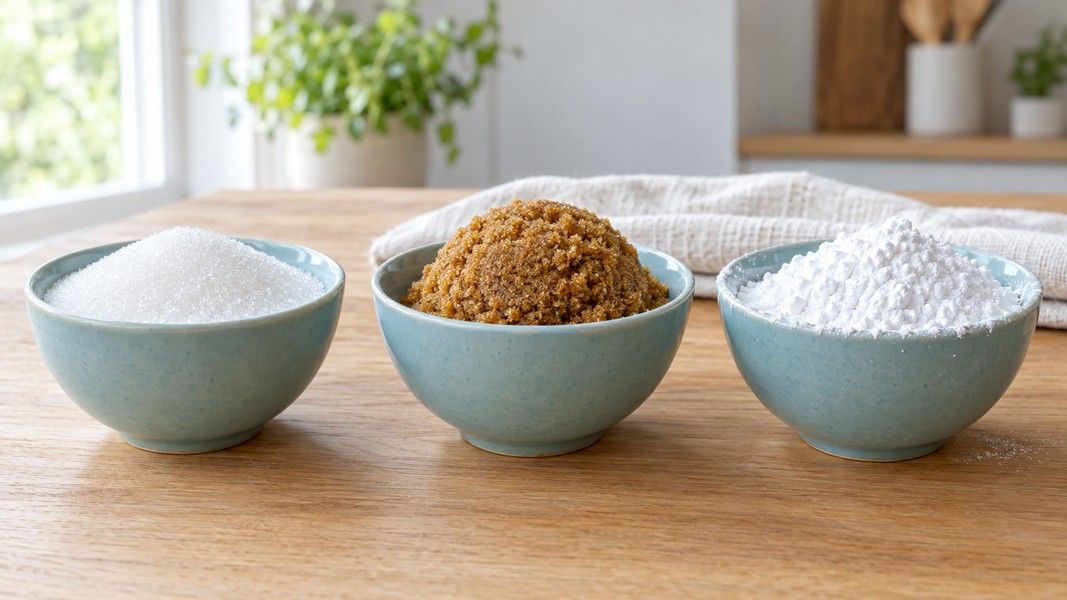
If a recipe just says "1 cup sugar", it means granulated white sugar, and 200 g is the number to use. The 2 g gap between USDA and King Arthur is smaller than the difference between two people filling the same cup.
Why Brown and Powdered Sugar Vary So Much
White sugar crystals are hard, dry and roughly the same size, so they settle into a cup the same way every time. Brown and powdered sugar behave differently.
Brown sugar today is white granulated sugar with molasses added back in, up to 10% molasses by weight, as King Arthur explains in its guide to light and dark brown sugar. That molasses makes the crystals sticky, so they hold whatever shape you press them into. USDA lists a packed cup at 220 g and an unpacked cup at 145 g. The same sugar in the same cup can differ by 75 g depending only on your hand.
That is why American recipes almost always say "packed" or "firmly packed" brown sugar. If yours does not say, packed is still the safer reading, because it is the convention.
Powdered sugar goes the other way. It is ground so fine that it compacts in the bag and fluffs up when sifted. USDA puts an unsifted cup at 120 g and a sifted cup at 100 g. When a recipe says "1 cup powdered sugar, sifted", check whether it means sift then measure, or measure then sift, because those are 100 g and 120 g respectively.
3/4 Cup of Sugar in Grams, and Other Fractions
Most recipes call for part of a cup. These figures scale the USDA cup weights in proportion, rounded to the nearest gram.
| Measure | Granulated white | Brown, packed | Powdered, unsifted |
|---|---|---|---|
| 1 cup | 200 g | 220 g | 120 g |
| 3/4 cup | 150 g | 165 g | 90 g |
| 2/3 cup | 133 g | 147 g | 80 g |
| 1/2 cup | 100 g | 110 g | 60 g |
| 1/3 cup | 67 g | 73 g | 40 g |
| 1/4 cup | 50 g | 55 g | 30 g |
So 3/4 cup of sugar in grams is 150 g for white, 165 g for packed brown and 90 g for powdered. Half a cup of white sugar is a clean 100 g, which makes it a handy mental anchor when you scale a recipe up or down.
Tablespoons and Teaspoons of Sugar in Grams
A US cup holds 16 tablespoons and 48 teaspoons. USDA lists its own teaspoon weights, which are a little heavier than a strict 1/48 of the cup because small spoons tend to mound.
| Spoon | Granulated white | Brown, packed | Powdered |
|---|---|---|---|
| 1 tablespoon | 12.5 g | 13.8 g | 8 g |
| 1 teaspoon | 4.2 g | 4.6 g | 2.5 g |
The teaspoon figures and the powdered sugar tablespoon are USDA's own portions. The tablespoon figures for white and brown sugar are one sixteenth of the USDA cup. For coffee, tea or a sauce, rounding a teaspoon of white sugar to 4 g is close enough.
How Many Cups in a Pound of Sugar
Sugar in the US is sold by the pound, so the reverse question comes up whenever you plan a big bake. Domino Sugar publishes package equivalents in its conversion chart.
| Domino package | Cups |
|---|---|
| 1 lb granulated | 2 1/4 cups |
| 4 lb granulated | 9 cups |
| 1 lb powdered, unsifted | 3 3/4 cups |
| 1 lb brown, firmly packed | about 2 1/3 cups |
A pound is 453.6 g, so Domino's figures work out to about 202 g per cup of granulated sugar and about 121 g per cup of powdered sugar, both within a couple of grams of USDA. Brown sugar comes out lighter, about 194 g per packed cup, which shows how much "firmly packed" depends on who is doing the packing.
Which Cup Does Your Recipe Mean?
The gram figures above assume a US customary cup, which is 236.6 ml. That is not the only cup in use. US nutrition labels round a cup to 240 ml, and the NIST kitchen table of equivalents also pairs 1 cup with 240 ml, alongside 15 ml for a tablespoon and 5 ml for a teaspoon.
Australia, and most Canadian recipes today, use a metric cup of 250 ml. That cup holds about 6% more, so the same sugar scales up:
| Sugar | US cup (236.6 ml) | Metric cup (250 ml) |
|---|---|---|
| Granulated white | 200 g | about 211 g |
| Brown, packed | 220 g | about 232 g |
| Powdered, unsifted | 120 g | about 127 g |
UK and European recipes usually give sugar in grams already, which avoids the problem entirely. If you are converting an Australian recipe in an American kitchen, the difference is about one level tablespoon of sugar per cup. That rarely matters in a cake, but it can show in candy, meringue or caramel.
How to Convert Cups of Sugar to Grams, Step by Step
The tables give you the numbers. This method makes sure you pick the right one.
What You'll Need
The recipe, a set of dry measuring cups if you are working by volume, and a kitchen scale if you want grams you can repeat. A liquid measuring jug with a spout is the wrong tool for sugar, because you cannot level it.
- Identify the sugar. "Sugar" alone means granulated white. Brown, powdered, caster and raw sugars each need their own row.
- Check the packing word. "Packed" or "firmly packed" brown sugar uses 220 g per cup. "Sifted" powdered sugar uses 100 g, unsifted 120 g.
- Check the cup's country. An American recipe uses the 236.6 ml cup. An Australian one uses 250 ml, so add about 6%.
- Read the fraction from the table. For anything the table does not list, multiply the cup weight by the fraction, so 1 1/2 cups of white sugar is 1.5 × 200 = 300 g.
- Round sensibly. For most baking, the nearest 5 g is plenty. Candy and macarons are the exceptions where you want the nearest gram.
- Measure by weight if you can. Put the bowl on the scale, zero it, and pour sugar in until you reach the number.
Tips for Better Results
Spoon sugar into a dry measuring cup and sweep the top level with a straight edge, the method King Arthur recommends for dry ingredients. Scooping straight from the bag presses the sugar down, and powdered sugar is the one that compacts most.
For brown sugar, press it into the cup with the back of a spoon until it holds the shape of the cup when you turn it out. That is what recipe writers mean by packed, and it lands you near the 213 to 220 g range.
Write the gram weight next to the cup measure in recipes you make often. Once you have weighed it once, every later bake starts from the same amount, whoever is measuring.
If you track what you eat, the gram figure also gives you the calories. USDA lists granulated sugar at 387 kcal per 100 g, so a full cup of white sugar carries about 774 kcal, and a teaspoon about 16 kcal.
Troubleshooting Common Issues
Your cup of white sugar comes out well over 200 g. You probably scooped and shook the cup, which settles the crystals. Spoon it in and level it instead.
Your packed brown sugar is far below 213 g. It has likely dried out and formed lumps that leave air gaps. Break up the lumps or soften the sugar before measuring, or simply measure by weight.
Your powdered sugar frosting is too stiff. An unsifted cup can be 20 g heavier than the sifted cup the recipe assumed. Add sugar by weight, or sift first and then measure.
A converted recipe tastes sweeter than the original. You may have used metric cup figures for an American recipe. A US cup holds about 6% less than a 250 ml cup, so an American recipe takes the US column, and an Australian or Canadian one the metric column.
Flour has the same problem in a bigger way, because it packs even more than sugar. The same logic applies in our guide to 1 cup of flour in grams.
Estimating Sugar Without a Scale or a Measuring Cup
Sometimes you have neither: a half-used bag of sugar, a sugar bowl, or a jar of brown sugar with no label. A rough figure is still useful for deciding whether you have enough for a recipe.
Primo Scale's Weight Estimator identifies the item from one photo and gives a typical figure with a likely range in grams, with its reasoning shown beside the result. Primo Scale does not weigh objects or use phone sensors. It estimates a likely range from visual analysis and reference data. Its food estimates draw on USDA reference data, the same source behind the tables in this guide.
That kind of estimate answers "is this roughly 500 g or roughly 1 kg?". For a recipe where a few grams change the texture, an exact amount still needs a real kitchen scale. For more ways to judge an amount by eye, see how to estimate grams without a kitchen scale.
The Short Version
A US cup of granulated white sugar is 200 g by USDA's measure, or 198 g in King Arthur's recipes. Packed brown sugar is 220 g, unpacked brown sugar 145 g, unsifted powdered sugar 120 g and sifted powdered sugar 100 g.
Fractions scale in proportion: 3/4 cup of white sugar is 150 g, half a cup is 100 g and a quarter cup is 50 g. A pound of granulated sugar holds about 2 1/4 cups. A metric 250 ml cup holds about 6% more than a US cup, so an Australian cup of white sugar is about 211 g.
The type of sugar, the packing word and the country of the cup decide which number applies. Once you have checked those three, the gram figure is straightforward, and measuring by weight keeps it the same every time.