1 stick of butter in grams is about 113 g. A standard US stick holds 4 ounces of butter, which is half a cup or 8 tablespoons, and 4 ounces converts to 113.4 g, so most charts round it to 113 g. Two sticks make a cup at about 227 g, and four sticks make a pound at about 454 g.
If you have a recipe written in grams and a fridge full of sticks, or a recipe that asks for sticks and a 250 g block from a European or Australian shop, the numbers rarely line up on their own. This guide gives one stick of butter in grams, the partial sticks recipes ask for, multiples up to a pound, the block sizes sold outside the US, and how to judge a chunk of butter that has lost its wrapper.
1 Stick of Butter in Grams: Where 113 g Comes From
The figure comes from the stick's size by weight, not by volume. A US stick is sold as a quarter pound, 4 ounces, and one ounce is 28.35 g. Four of them make 113.4 g.
The reference sources agree. The USDA FoodData Central record for unsalted butter lists 1 stick as 113 g, 1 cup as 227 g, 1 tablespoon as 14 g and a pat as 5 g. The King Arthur chart, the conversion table many American bakers use, gives butter as 8 tablespoons, 1/2 cup, 4 ounces and 113 g.
You will sometimes see 115 g instead. KitchenAid Canada's butter chart uses 115 g for one stick and 58 g for half a stick, while keeping 227 g for two sticks and 454 g for four. That is rounding, not a different stick: 113 g is closer to 4 ounces, and 115 g is easier to remember. The 2 g gap between them is less than a seventh of a tablespoon, which matters to nobody outside a pastry lab.
Sticks of Butter to Grams, Cups and Tablespoons
Recipes ask for butter in fractions of a stick, whole sticks or cups, and the conversions all hang off the same 113.4 g. The chart below uses that figure and rounds to the nearest gram.
| Sticks | Grams | Cups | Tablespoons | Ounces |
|---|---|---|---|---|
| 1/8 stick | 14 g | 1/16 cup | 1 tbsp | 1/2 oz |
| 1/4 stick | 28 g | 1/8 cup | 2 tbsp | 1 oz |
| 1/2 stick | 57 g | 1/4 cup | 4 tbsp | 2 oz |
| 2/3 stick | 76 g | 1/3 cup | 5 tbsp + 1 tsp | 2 2/3 oz |
| 3/4 stick | 85 g | 3/8 cup | 6 tbsp | 3 oz |
| 1 stick | 113 g | 1/2 cup | 8 tbsp | 4 oz |
| 1 1/2 sticks | 170 g | 3/4 cup | 12 tbsp | 6 oz |
| 2 sticks | 227 g | 1 cup | 16 tbsp | 8 oz |
| 3 sticks | 340 g | 1 1/2 cups | 24 tbsp | 12 oz |
| 4 sticks | 454 g | 2 cups | 32 tbsp | 16 oz (1 lb) |
So 2 sticks of butter in grams is about 227 g, the same as a cup, and a recipe that asks for "1 cup butter, softened" wants two full sticks. If you need the spoon side of this in more detail, the guide to grams per tablespoon covers butter beside sugar, flour and salt.
Half a Stick of Butter and Other Partial Sticks
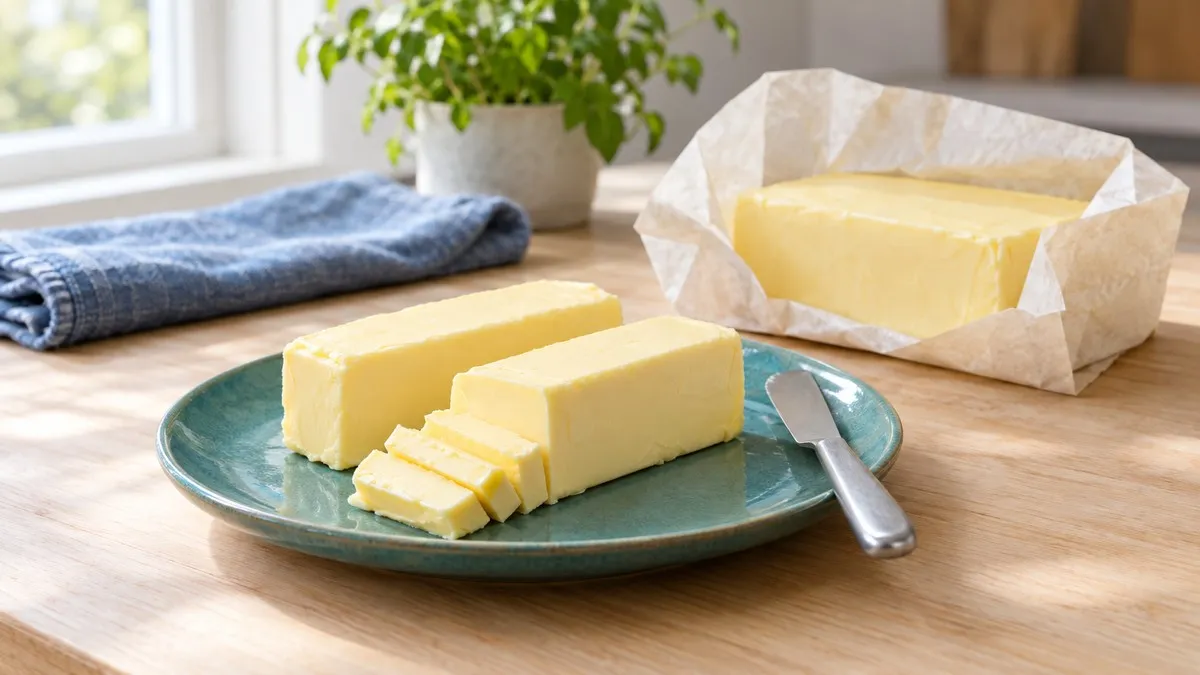
Half a stick of butter is about 57 g, which is 4 tablespoons or a quarter cup. It shows up constantly in sauces, cookies and pan sauces, and it is the easiest partial stick to cut, because the tablespoon lines printed on most US wrappers put the halfway mark at the fourth line.
A third of a stick is the awkward one. It works out to about 38 g, or 2 2/3 tablespoons, which no wrapper marks. Recipes rarely ask for it directly; they ask for 1/3 cup, which is two thirds of a stick, about 76 g or 5 tablespoons plus 1 teaspoon. Cut at the fifth line and add a thin sliver.
Using the wrapper lines well
The printed lines assume the wrapper sits centered on the stick. If the paper has slid toward one end, every line moves with it. Before you cut, check that the first line sits one eighth of the way from the end, and cut with a knife held straight down rather than at an angle, so the slice is the same depth all the way through.
For a single tablespoon the lines are good enough for almost any recipe. For pastry, shortbread or anything laminated, where the butter to flour ratio carries the result, a kitchen scale reading in grams beats any line on a wrapper.
East Coast and West Coast Sticks Hold the Same Butter
US butter comes in two stick shapes, and people who move across the country often assume the stubbier one holds less. It does not. Both are 4 ounce sticks of 8 tablespoons.
According to the Wikipedia entry on butter, the long, narrow Elgin shape that dominates east of the Rocky Mountains measures about 121 by 32 by 32 mm, while the western-pack shape used west of the Rockies is about 83 by 38 by 38 mm. The Elgin takes its name from Elgin, Illinois. A Food Network explainer adds that brands such as Land O'Lakes and Challenge Dairy still make both, and that many national brands now produce only the Elgin style.
What changes is the spacing of the tablespoon lines. On a western stubby each line sits closer to the next, so a cook used to Elgin sticks who cuts "about an inch" will take more butter than intended. Count lines, not inches.
What the stick dimensions tell you
Those two shapes also give a useful number. Multiply the Elgin dimensions and you get about 124 cubic centimetres; the western stick comes to about 120. Both hold 113 g, so butter comes to a little over 0.9 g per cubic centimetre. The USDA's 5 g pat, a square 1 inch across and 1/3 inch high, lands on the same figure. That density is what makes it possible to estimate a chunk of butter from its size, which comes up again below.
Butter Blocks Outside the US: 250 g, 500 g and 454 g
Most of the world does not sell butter in sticks. Wikipedia notes that in most countries butter is sold by weight, often in 250 g and 500 g packages, which is what you will find in the UK, Europe and Australia. Canada sits in between: KitchenAid Canada's chart treats one block as 454 g, two cups or four sticks' worth, with no individual sticks inside.
| Block | Sticks | Tablespoons | Cups |
|---|---|---|---|
| 250 g | about 2.2 | about 17 1/2 | about 1.1 |
| 500 g | about 4.4 | about 35 | about 2.2 |
| 454 g (1 lb) | 4 | 32 | 2 |
A 250 g block is therefore a little more than two sticks. If an American recipe asks for 2 sticks of butter and you have a 250 g block, use all but a slice about one tenth of the block's length; the 23 g left over is roughly a tablespoon and a half.
Cutting a stick's worth from a 250 g block
To get one stick of butter from a 250 g block, cut a little under half of it, about 45 percent of the length. Fold the wrapper in half to find the middle, then cut slightly short of the fold, about a twentieth of the block back toward your end. If the wrapper carries printed gram marks, use those instead.
The same logic runs in reverse. A British recipe asking for 125 g of butter, half a 250 g block, is one US stick plus one tablespoon, about 127 g. A recipe asking for 100 g is 7 tablespoons, about 99 g.
Salted, Unsalted and European-Style Butter
Salt barely changes the weight. Kerrygold lists the same 14 g tablespoon on its salted and unsalted sticks, and a stick of either is still about 113 g. What salt changes is the recipe: if a baking recipe was written for unsalted butter and you only have salted, the extra salt is in the dough whether you planned for it or not.
Imported and European-style butter sold in the US often comes in the same stick format as American butter. Kerrygold, for example, sells unsalted butter sticks in a one pound format and lists a serving as 1 tablespoon, 14 grams, half an ounce. A pound split into the usual four sticks puts each at the same 113 g as any other US stick.
Calories in a stick of butter
The same USDA record gives 102 calories for a 14 g tablespoon of unsalted butter, and Kerrygold's label rounds its tablespoon to 100. Eight tablespoons put a stick at roughly 800 to 820 calories, and a cup at about twice that. Butter is close to pure fat, so the calories follow the grams very closely: half a stick is about 400, a single pat about 35.
Converting a Recipe Between Sticks and Grams
Most conversions fall into three cases, and each takes a few seconds once you know the 113 g anchor.
- Grams to sticks. Divide the grams by 113. A recipe asking for 225 g wants two sticks, 227 g, which is close enough for any cake or cookie. A recipe asking for 170 g wants one and a half sticks.
- Sticks to grams. Multiply by 113. Three sticks is 340 g; half a stick is 57 g. If you are cutting from a 250 g block, divide the target by 250 to get the share of the block to cut.
- Small amounts. Below about 50 g, tablespoons are easier than fractions of a stick. Divide the grams by 14: 30 g is about 2 tablespoons, 45 g about 3.
The free tablespoons to grams converter on this site does the spoon arithmetic for butter and about thirty ingredients in all if you would rather not divide by 14 in your head.
When a recipe mixes systems, such as cups of flour and grams of butter, convert everything to grams once and work from there. Mixing rounded figures from two different charts is how a dough ends up slightly too dry or too greasy without any single number looking wrong.
Estimating a Chunk of Butter Without Markings
Not every piece of butter comes in a labelled wrapper. The end of a block, a slab cut at the table, butter from a tub, or a portion already on a plate all leave you guessing.
The density from the stick dimensions gives a workable rule: a cube of butter one inch on each side, about 16 cubic centimetres, comes to roughly 15 g, close to a tablespoon. Measure the chunk roughly, compare it to that cube, and you have a starting figure. The guide to estimating grams without a scale walks through the same approach for other foods.
If you would rather not measure, Primo Scale identifies the butter from one photo and gives an estimated weight as a typical figure with a likely range, with its reasoning shown beside the result. It can also estimate the calories of a plate where butter is part of the meal, which is where butter is hardest to account for, since nobody sees how much went into a sauce or onto toast. Primo Scale does not weigh objects or use phone sensors. It estimates a likely range from visual analysis and reference data. For baking, where a few grams change the result, a real kitchen scale is still the tool to use.
Conclusion
One stick of butter is about 113 g, half a cup and 8 tablespoons, whether it is a long Elgin stick, a western stubby, salted, unsalted or European-style. Half a stick is about 57 g, two sticks are a cup at about 227 g, and four sticks are a pound at about 454 g.
Outside the US, a 250 g block is a little more than two sticks and 125 g is one stick plus a tablespoon. For an unmarked chunk, butter comes to a little over 0.9 g per cubic centimetre, so a one inch cube is roughly a tablespoon. For everyday cooking, the wrapper lines and these charts are enough; for pastry, grams on a scale settle it.