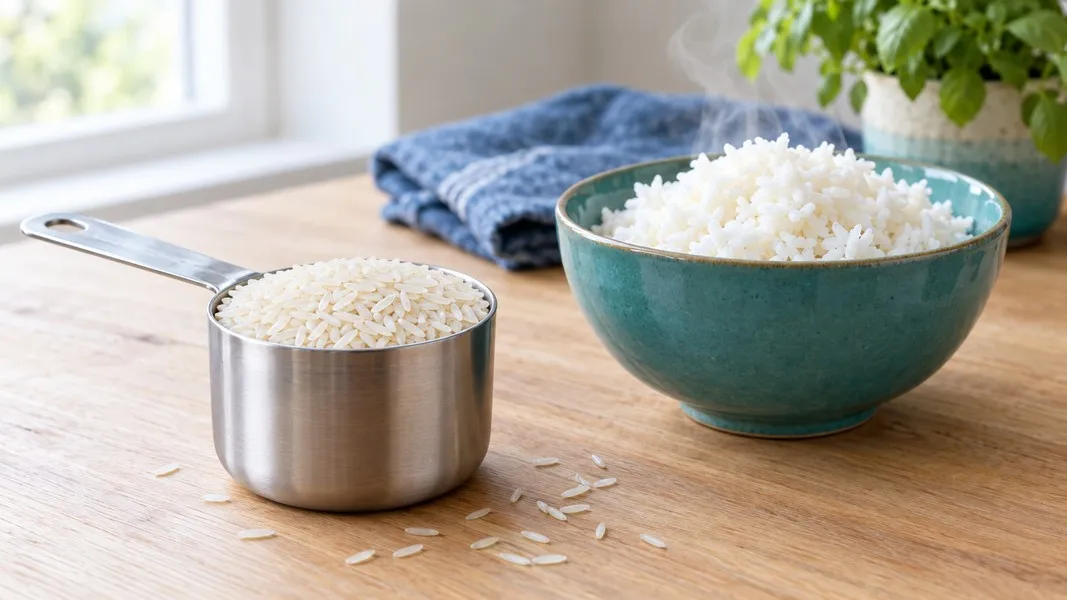
One US cup of uncooked long-grain white rice is about 185 grams, and one cup of cooked long-grain white rice is about 158 grams, according to USDA FoodData Central. So 1 cup of rice in grams depends first on whether the rice is dry or cooked, then on the type of grain, then on how you fill the cup.
That is why recipes, nutrition labels and cooking sites seem to disagree. A recipe written in grams and a pantry full of cups do not have to be a problem, though. Below you will find the USDA figure for each common rice type, the part cups in grams, a way to convert dry rice to cooked rice, and a step-by-step method for filling a cup so it lands close to the reference figures.
1 Cup of Rice in Grams by Type
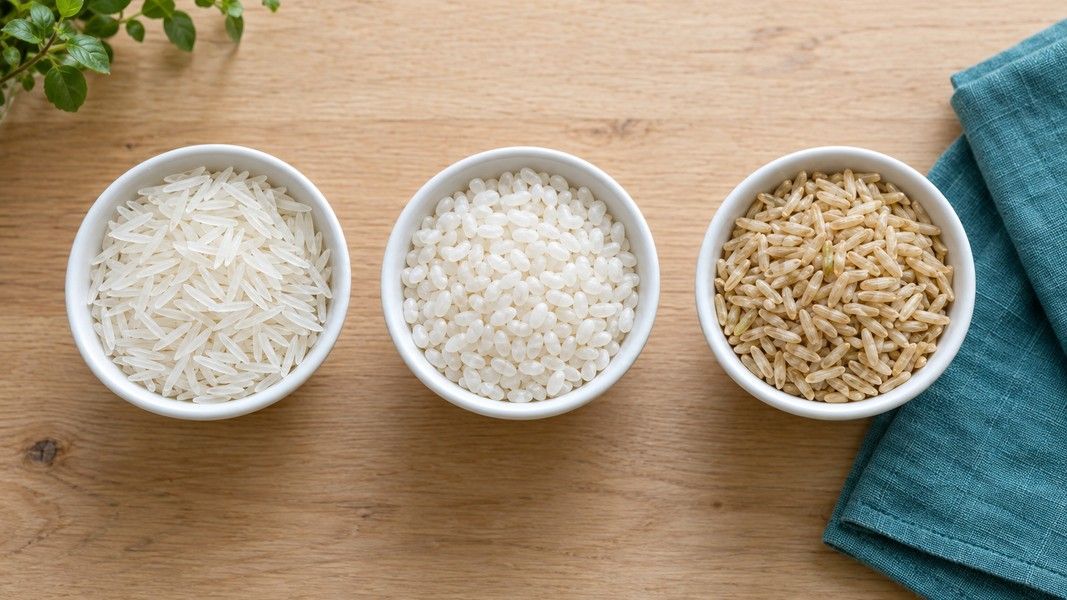
Uncooked rice runs from about 160 g to 200 g per cup, and cooked rice from about 158 g to 202 g, depending on the grain. These are the cup weights USDA FoodData Central lists in its standard reference data:
| Rice type | 1 cup uncooked | 1 cup cooked |
|---|---|---|
| Long-grain white | 185 g | 158 g |
| Medium-grain white | 195 g | 186 g |
| Short-grain white | 200 g | 186 g |
| Long-grain brown | 185 g | 202 g |
| Long-grain white, parboiled | not listed | 158 g |
| Wild rice | 160 g | not listed |
Jasmine and basmati are not separate rows in that data. The USA Rice Federation describes both as aromatic long grain rice and says either can be swapped into any recipe that calls for long grain, so the long-grain white row is the closest reference for them.
The pattern is easy to remember: in this data, the shorter the grain, the more grams fit into the same cup. Short-grain rice packs the most, long-grain rice less, and wild rice the least.
Why a Cup of Cooked Rice Weighs Less Than Dry Rice
It sounds backwards. Cooked rice has absorbed water, so it should be heavier. And the pot is heavier: the USA Rice Federation notes that dry rice more than doubles in weight during cooking, while it roughly triples in volume.
The weight of the whole batch goes up, but each cup of it holds fewer grains. One cup of dry long-grain rice becomes about three cups of cooked rice. Spread across those three cups, the original 185 g of grain plus the absorbed water comes to about 158 g per cup in the USDA data.
Brown rice is the exception in the table. A cup of cooked long-grain brown rice comes in at 202 g, heavier than the 185 g of dry brown rice in the same cup.
Why Different Sources Give Different Numbers
If you have checked a few charts, you have probably seen more than one answer. The sources do not agree perfectly, and the gap tells you something useful about measuring rice by volume.
For dry rice, USDA lists 185 g per cup of long-grain white rice. The King Arthur Baking ingredient weight chart lists half a cup of dry long-grain rice at 99 g, which works out to about 198 g a cup. The USA Rice Federation rounds a cup of dry rice to about 7 ounces, close to the King Arthur figure. Those three numbers sit within about 7 percent of each other.
For cooked rice, the spread is wider. USDA lists 158 g per cup of cooked long-grain white rice, while USA Rice rounds a cup of cooked rice to about 8 ounces, which is roughly 227 g. King Arthur puts a cup of cooked brown rice at 170 g, where USDA says 202 g.
The difference is mostly packing. Cooked grains are soft and squash together, so a cup that is gently spooned full and a cup that is pressed down can differ by tens of grams. Dry rice is far more consistent because hard grains barely compress. When accuracy matters, the dry measurement before cooking is the more reliable one to trust.
Part Cups of Rice in Grams
Recipes often ask for half a cup, a third or two cups. These figures scale the USDA long-grain white rice values and round to the nearest gram:
| Amount | Uncooked long-grain white | Cooked long-grain white |
|---|---|---|
| 1/4 cup | 46 g | 40 g |
| 1/3 cup | 62 g | 53 g |
| 1/2 cup | 93 g | 79 g |
| 2/3 cup | 123 g | 105 g |
| 3/4 cup | 139 g | 119 g |
| 1 cup | 185 g | 158 g |
| 2 cups | 370 g | 316 g |
So 1/2 cup of rice in grams is about 93 g dry and about 79 g cooked. For other ingredients, or for a different amount, the free cups to grams converter uses the same USDA reference values.
One more wrinkle for readers outside the US: a US cup holds about 237 ml, while an Australian metric cup holds 250 ml. A full metric cup of dry long-grain white rice therefore comes to roughly 195 g, and a metric cup of cooked rice to roughly 167 g, simply because the cup is about 6 percent bigger.
How to Measure a Cup of Rice Step by Step
Rice is one of the easier ingredients to measure by volume, because dry grains pour freely and do not settle the way flour does. If you have read about a cup of flour in grams, you know how much the method can matter there. With rice it matters less, but a few habits still keep you close to the reference figures.
What you will need is simple: a dry measuring cup in the size the recipe uses, a straight edge such as the back of a knife, and the rice in a container wide enough to dip or pour from.
Measuring Uncooked Rice
- Use a dry measuring cup, not a liquid jug. A jug's fill line sits below the rim, so it is hard to read with grains.
- Pour or scoop the rice into the cup until it heaps slightly above the rim.
- Do not shake or tap the cup. Tapping settles the grains and adds weight.
- Sweep the straight edge across the rim to level it.
- Note the type of rice you used, so you can read the right row in the table above.
Measuring Cooked Rice
Fluff the rice with a fork first, so clumps break up. Spoon it into the cup loosely and level the top without pressing down. Pressing is what turns a 158 g cup into something much heavier, and it is the main reason cooked rice figures vary so much from kitchen to kitchen.
Converting Dry Rice to Cooked Rice by Weight
Many recipes give rice in cooked grams, while the packet in your cupboard is dry. A rule of thumb from the sources above gets you close.
The USA Rice Federation says one cup of dry rice makes about three cups of cooked rice. Three cups of cooked long-grain white rice at 158 g each comes to about 474 g, from 185 g of dry rice, so cooked white rice weighs roughly 2.5 times its dry weight. The USDA Food Buying Guide gives yields for school kitchens that land in the same area, and it notes that its figures represent the lower range of the average yield, because rice yields depend on how it is cooked.
A Worked Example
Say a recipe calls for 500 g of cooked long-grain white rice. Divide by about 2.5, and you need roughly 200 g of dry rice. Using the dry figure of 185 g per cup, that is a little over one cup: one cup plus a heaped tablespoon.
Going the other way, if you cook one cup of dry rice, expect somewhere around 450 to 480 g cooked, enough for about three cups.
Brown rice works differently. USA Rice gives a yield of about four cups of cooked brown rice per cup of dry rice in one of its foodservice guides, and its cooking chart uses more water for brown rice than for white, two and a quarter parts liquid instead of two.
Calories in a Cup of Rice, by the Same Measures
Because the cup weights differ so much between dry and cooked rice, the calories per cup differ too. Using the USDA energy values per 100 g with the cup weights above:
- A cup of uncooked long-grain white rice, at 365 kcal per 100 g, comes to about 675 kcal.
- A cup of cooked long-grain white rice, at 130 kcal per 100 g, comes to about 205 kcal.
- A cup of cooked long-grain brown rice, at 123 kcal per 100 g, comes to about 248 kcal.
The cooked figure is the one that matches what ends up on a plate. If a food diary asks for cooked rice and you log the dry figure, the entry will be more than three times too high for the same cup.
Estimating Rice That Is Already on a Plate
Measuring cups only help before the rice is served. Once it is in a bowl next to curry or under a stir-fry, nobody is going to scoop it back out. That is the situation where a photo estimate is useful as a starting point.
Primo Scale is an app that identifies food from one camera photo and gives an estimated weight as a typical figure with a likely range in grams, using USDA reference data for food. The reasoning is shown beside the result, so you can see what an estimate for a bowl of rice was based on. Primo Scale does not weigh objects or use phone sensors. It estimates a likely range from visual analysis and reference data.
Its Calorie Estimator mode gives estimated calories and macros for a whole plate. For an exact gram figure, a kitchen scale is still the tool to reach for. If you do not have one at hand, our guide to estimating grams without a scale covers other household references.
Troubleshooting Common Rice Measuring Problems
If your rice comes out dry or crunchy, check the water ratio before the rice measurement. Long-grain white rice cooks with two parts liquid to one part rice by volume, medium grain with one and a half and short grain with one and a quarter, according to the USA Rice cooking chart. Cooking every type with the same ratio is a common reason one batch turns out soft and the next too firm.
If a recipe gives rice in grams but does not say dry or cooked, look at where it appears. Rice listed with the raw ingredients, cooked in the dish itself, is almost always dry. Rice listed as an addition to a salad or bowl is usually cooked.
If your cooked rice cup weighs far more than the table suggests, check for packing. A firmly pressed cup can land well above the USDA figure, closer to the USA Rice estimate of about 8 ounces a cup.
Conclusion
One US cup of uncooked long-grain white rice is about 185 g, and one cup of cooked long-grain white rice is about 158 g, according to USDA data. Medium and short grains pack more grams into the cup, wild rice packs fewer, and cooked brown rice is heavier per cup than cooked white rice.
Dry rice is the more consistent thing to measure by volume, because hard grains barely compress, while cooked rice can vary by tens of grams depending on how firmly it is pressed. Cooked white rice weighs roughly two and a half times its dry weight, so 200 g of dry rice makes about 500 g cooked. Level the cup, do not tap or press it, and match the row in the table to the rice you actually have.