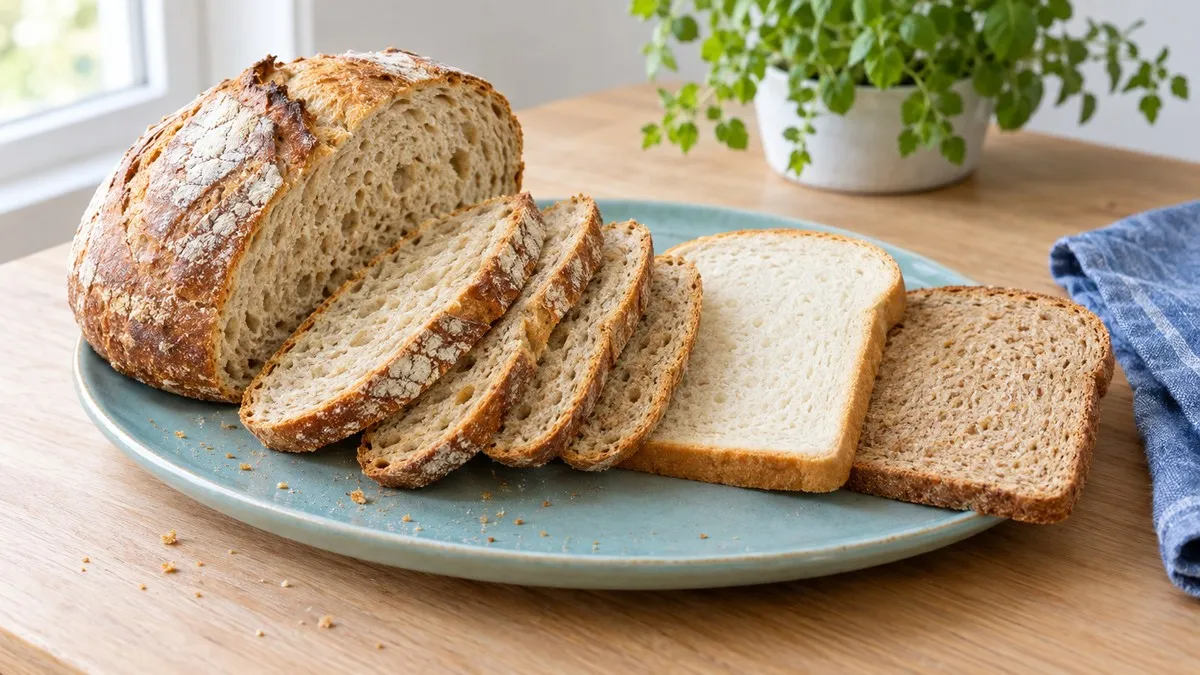
A regular slice of white sandwich bread has about 67 to 77 calories, a slice of whole wheat about 81, and a thick slice of sourdough about 117. Those are the calories in bread as USDA FoodData Central lists them, and the spread between them has less to do with the flour than with how heavy the slice is.
Most breads land between 250 and 310 calories per 100 grams, so the slice weight decides the number far more than the bread type does. This guide gives the figure per slice for the common breads, shows how much a slice can vary, and explains why the number on a bag often differs from the slice on your plate.
Calories in Bread per Slice, by Type
Every figure below comes from a USDA FoodData Central record, using the slice or piece weight USDA attaches to that record. Where USDA gives no slice weight, the row uses 1 ounce (28 g), the example slice size the FDA itself uses on bread labels.
| Bread | Portion | Grams | Calories | Per 100 g |
|---|---|---|---|---|
| White, sandwich | 1 regular slice | 25 to 29 g | 67 to 77 | 266 |
| Whole wheat | 1 slice | 32 g | 81 | 252 |
| Wheat (not whole wheat) | 1 slice | 29 g | 79 | 274 |
| Sourdough | 1 large or thick slice | 43 g | 117 | 272 |
| Rye | 1 regular slice | 32 g | 83 | 259 |
| Multigrain | 1 oz slice | 28 g | 75 | 265 |
| Pita, white | 1 large pita, 6.5 inch | 60 g | 165 | 275 |
| Naan | 1 piece | 44 to 106 g | 137 to 303 | 286 to 311 |
Read across the last column first. White, wheat, sourdough, rye and multigrain all sit within about 20 calories of each other per 100 g. Read down the grams column next, and the range widens: a slice can be under half the weight of another slice of the same loaf.
What these figures do not include
The numbers are for plain bread. Butter, oil, jam, seeds on the crust and anything brushed on before baking all add calories that the bread records do not count. A sandwich is the bread plus everything inside it.
Why Slice Weight Matters More Than Bread Type
The USDA record for commercial white bread shows the effect clearly, because it lists six slice sizes for the same bread. At 266 calories per 100 g, the slice is the only thing that changes.
| White bread slice | Grams | Calories |
|---|---|---|
| Very thin | 15 g | 40 |
| Thin | 20 g | 53 |
| Regular | 25 g | 67 |
| Regular, heavier loaf | 29 g | 77 |
| Large | 30 g | 80 |
| Crust not eaten | 12 g | 32 |
A very thin slice and a large slice of the same white bread differ by 40 calories, which is more than the difference between white and whole wheat at any normal slice size. That is why a calorie count that names only the bread type, and not the slice, can be off by half.
Pre-sliced loaves versus bakery bread
Pre-sliced sandwich loaves are cut by machine to a fixed thickness, so slices from one bag stay close to each other. A loaf you slice yourself, or a bakery sourdough cut at the counter, has no fixed slice at all. The thick sourdough slice in the USDA record is 43 g, and a slice from the middle of a large round loaf is often wider than one from the end.
Calories in Sourdough Bread
USDA lists sourdough at 272 calories per 100 g in its sourdough record, which puts a large or thick 43 g slice at about 117 calories. Its older standard reference record groups sourdough with French and Vienna bread, at the same 272 calories per 100 g.
So per gram, sourdough is in the same place as white sandwich bread. What makes a slice of sourdough read higher is the way it is usually cut: thicker, from a wider loaf, and often by hand. A slice from a sandwich-style sourdough loaf, cut to the same thickness as white bread, lands close to the white bread figures above.
A worked example
Say you cut a slice from a bakery sourdough boule and a kitchen scale shows 55 g. The arithmetic is the record's figure per 100 g, scaled to the slice: 272 multiplied by 0.55 is about 150 calories. Cut the next slice thinner, to 35 g, and the same bread comes to about 95. The bread did not change; the knife did.
Whole Wheat vs White Bread Calories
A slice of whole wheat bread has about 81 calories in the USDA whole wheat record, at 32 g a slice and 252 calories per 100 g. A regular slice of white bread at 25 g has about 67, and a heavier 29 g white slice about 77, from the white bread record at 266 per 100 g.
Per 100 g, whole wheat is the lower of the two. Per slice, it often comes out higher, because whole wheat slices in the USDA data are heavier. Choosing whole wheat over white is not a calorie decision so much as a fiber one, and the slice weight still matters more than the label on the bag.
Wheat bread is not always whole wheat
USDA keeps a separate record for bread sold simply as "wheat bread", at 274 calories per 100 g and 79 calories for a 29 g slice. That bread is not the same as whole wheat, and per 100 g it is slightly higher than both white and whole wheat. If the bag says "wheat" without "whole", treat it as its own bread when you look up the number.
Rye and Multigrain Bread
Rye bread comes to 259 calories per 100 g in USDA's record. A thin 25 g slice is about 65 calories and a regular 32 g slice about 83.
Multigrain bread sits at 265 calories per 100 g. USDA gives no fixed slice weight for it, so the 1 ounce slice in the table, about 75 calories, is a reference point rather than a typical slice. Seeds pressed into the crust count toward the weight of the slice, so the figure per 100 g is the safer one to scale.
Pita, Naan and Bagels: When One Piece Is Not a Slice
Flatbreads and bagels are counted per piece, and pieces vary much more than slices do.
A large white pita, 6.5 inches across, is 60 g in USDA's record and about 165 calories, at 275 per 100 g. That is roughly two regular slices of white bread in one pocket.
Naan has the widest range of anything here. USDA's dietary survey record lists a 44 g piece at about 137 calories, at 311 per 100 g. Its record for whole wheat refrigerated naan lists a 106 g piece at about 303 calories, at 286 per 100 g. The difference between those two pieces is more than two slices of white bread, so a restaurant naan and a small packaged one are not the same entry in a food diary.
Bagels follow the same pattern. A multigrain bagel in USDA's record weighs 81 g and comes to about 195 calories, at 241 per 100 g. A larger bagel scales the same way: grams times 2.41.
Does Toasting Bread Change the Calories?
Toasting does not add or remove calories in any amount that matters. It drives water out of the slice, so the bread gets lighter and the calories per gram go up, while the calories in the slice stay where they were.
USDA's records show it. Untoasted commercial white bread is 266 calories per 100 g; the toasted record is 290 per 100 g. A regular untoasted slice is 25 g and about 67 calories, and a toasted slice in that record is 22 g and about 64 calories. The slice lost water and a few grams, and the calorie count barely moved.
If you look up toast, use the toasted figure with the toasted slice weight, or the untoasted figure with the untoasted weight, but never mix the two. Multiplying the toasted 290 per 100 g by the weight of a fresh slice would overcount.
How to Read the Calories on a Bread Label
Packaged bread in the US often lists two slices as the serving, and there is a rule behind it. The FDA's reference amounts set 50 g as the amount of bread people customarily eat at once. Under the serving size rules in 21 CFR 101.9, a sliced product whose slice weighs half that reference amount or less must declare the number of whole slices that comes closest to 50 g, which for a 25 g slice is two. A slice between half and two thirds of 50 g may be declared as one slice or two.
So before comparing two loaves, check whether the label counts one slice or two. A "110 calories" loaf with a two slice serving is lighter per slice than a "90 calories" loaf with a one slice serving.
Labels are rounded
The same labeling rule rounds calories to the nearest 5 up to 50 calories, and to the nearest 10 above 50. A two slice serving of 134 calories is printed as 130. That is close enough for most purposes, and it explains why a label and a USDA lookup for a similar bread can disagree by a few calories without either being wrong.
Estimating Bread Without a Label
Most of the time the bread you eat has no label in front of you: a basket at a restaurant, a slice from a bakery loaf, a sandwich someone else made. Two things get you close. Know roughly what the bread is, and know roughly how much of it there is.
The first is easy. The second is where estimates go wrong, because a slice gives few visual clues to its weight. Comparing it with a slice of known size, such as a regular sandwich slice, gets you closer than guessing the grams outright. Our guide to estimating grams without a scale covers the comparisons that work for food in general.
Estimating from a photo
Primo Scale's Calorie Estimator gives estimated calories and macros for a plate from one photo, using USDA reference data, and shows its reasoning beside the result. For bread on its own, its Weight Estimator returns a typical figure and a likely range in grams, which you can multiply by the figures per 100 g above. Primo Scale does not weigh objects or use phone sensors. It estimates a likely range from visual analysis and reference data. When the exact gram count matters, a real kitchen scale is the tool for it.
Photos have limits with bread in particular. Butter soaked into toast, oil in a focaccia, or a filling hidden inside a sandwich is hard to see, which is why photo calorie estimates treat hidden fats as the biggest source of uncertainty. The app shows how it reached a figure, so you can see what it assumed and adjust for what it could not see.
Key Takeaways
Most breads are 250 to 310 calories per 100 g, so the weight of the slice decides the count more than the bread type does. A regular slice of white bread is about 67 to 77 calories, whole wheat about 81, rye about 83, and a thick 43 g slice of sourdough about 117.
Flatbreads and bagels are counted per piece and vary widely: a large pita is about 165 calories and a naan anywhere from about 137 to 303. Toasting removes water, not calories. Bread labels in the US often count two slices as a serving and round calories to the nearest 10, so check the serving line before comparing loaves.