Without a kitchen scale, the fastest way to estimate grams is to start from a reference weight you know and compare. A level teaspoon of sugar is about 4 grams, a slice of sandwich bread about 25 grams, a cup of cooked rice about 158 grams. Once you know a handful of these, most foods in your kitchen can be placed within a sensible range.
This guide collects the reference weights that are most useful day to day, explains why the same spoon holds different grams of different foods, and shows how to turn a visual comparison into an honest estimate.
Reference weights worth knowing
The figures below come from USDA FoodData Central and USDA's own definitions. Each is a typical value for a level, not heaped, measure.
| Food | Measure | About |
|---|---|---|
| Granulated sugar | 1 teaspoon | 4.2 g |
| Olive oil | 1 tablespoon | 13.5 g |
| White bread | 1 regular slice | 25 g |
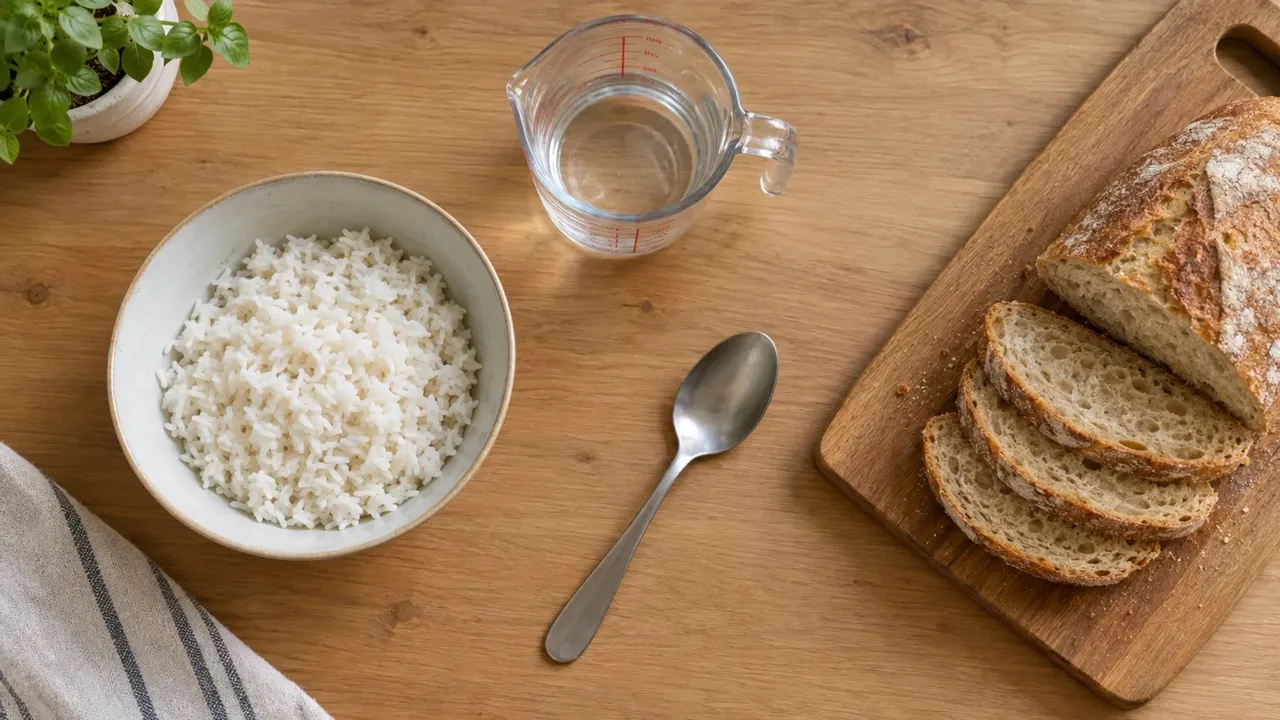
| Cooked white rice | 1 cup | 158 g |
| Cooked spaghetti | 1 cup | 125 to 140 g |
| Cooked meat, chicken or fish | a piece the size of a deck of cards | 85 g (3 oz) |
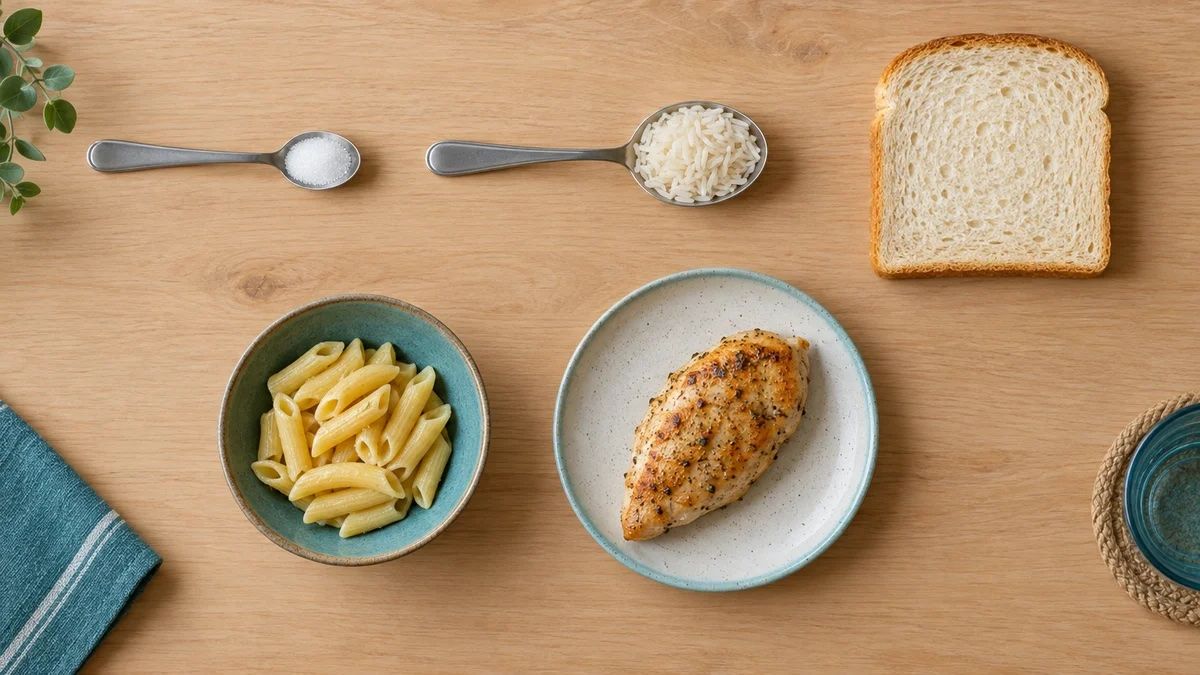
The deck of cards comes from the portion guides of the US National Institute of Diabetes and Digestive and Kidney Diseases, which use it to show a 3 ounce serving of cooked meat. It is one of the few visual references that holds up well, because a deck is a size almost everyone has seen.
Why a spoon of one food is not a spoon of another
A spoon or a cup measures volume. Grams measure mass. The two are linked by density, and density changes from food to food.
Density
A tablespoon of oil is about 13.5 grams; a tablespoon of water is close to 15. A tablespoon of flour is far lighter than either, because it is full of air. That is why a recipe that lists flour in cups can come out differently in two kitchens. For 30 baking and cooking ingredients, the cups to grams converter gives the USDA figure per cup, tablespoon or teaspoon, with a second source where the way a cup is filled changes the result.
Packing
Cooked spaghetti twirled loosely into a cup and spaghetti pressed down into it are different amounts of food. The USDA range of 125 to 140 grams for one cup is mostly that difference. The same goes for rice, grated cheese and leafy greens.
Level or heaped
A heaped teaspoon of sugar can hold half as much again as a level one. If you are estimating, level the spoon with the back of a knife, then count spoons.
Turning a comparison into an estimate
Three steps get you from "about this much" to a number you can use.
Pick the closest reference. A portion of chicken a little bigger than a deck of cards is a little more than 85 grams. Two slices of bread are about 50 grams.
Scale by size, not by eye alone. If a piece is about twice as long, twice as wide and just as thick as your reference, it is about four times the weight, not twice. Weight follows volume.
Say it as a range. "About 100 grams, between 90 and 115" is an honest description of a chicken portion you have only looked at. A single figure to the gram suggests more certainty than any visual estimate has.
Estimating grams from a photo
Primo Scale does the same comparison with AI. You take one photo; the app identifies the food, estimates its size from the image, using LiDAR depth on iPhones that have it, and matches it against USDA reference data. The result is a typical figure with a likely range, and the reasoning beside it.
It does not put the food on a scale, and the phone does not sense weight. Primo Scale does not weigh objects or use phone sensors. It estimates a likely range from visual analysis and reference data, which is why a weight result always comes as a range.
When an estimate is enough, and when it is not
An estimate covers most cooking and most food tracking. A stew, a stir fry or a salad dressing forgives being 10 percent out. A food diary is already full of estimates, and a few grams either way change little.
It is not enough for baking, where flour, sugar and leavening work in proportion and a few grams change the result, or for any diet a doctor has set gram by gram. For an exact weight, use a calibrated scale.
Quick answers
How many grams is a teaspoon? It depends on the food: about 4.2 g of granulated sugar, about 5 g of water, less of flour.
How many grams is a tablespoon of oil? About 13.5 g of olive oil, or roughly 119 calories.
How much is 100 grams of cooked rice? A little under two thirds of a cup.
How can I estimate 85 grams of meat? A cooked piece about the size of a deck of cards.