Watermelon calories come to 30 per 100 g of flesh, about 46 in a cup of diced watermelon and about 86 in a standard wedge, according to USDA data. A whole melon is where the numbers stop agreeing, because roughly two fifths of what you carry home is rind. Once you know how much flesh a melon holds, every other figure follows from that one rate.
If you have seen "80 calories", "about 90 calories" and "over 1,000 calories" quoted for the same fruit, none of them is wrong. They measure different things: a label serving, two measured cups, the flesh of one reference melon. This guide shows where each figure comes from, gives a table for every common portion, and walks through how to work out the calories in a whole watermelon from its size.
Watermelon calories at a glance
All figures below come from the USDA entry for raw watermelon in FoodData Central, which lists 30 calories per 100 g of edible flesh and gram weights for each household portion. The calories are that rate applied to each weight, rounded to the nearest whole number.
| Portion | Flesh weight | Calories |
|---|---|---|
| 100 g | 100 g | 30 |
| 1/2 cup diced | 76 g | 23 |
| 10 melon balls | 122 g | 37 |
| 1 cup diced | 152 g | 46 |
| 1 cup of balls | 154 g | 46 |
| Label serving | 280 g | 84 |
| 1 wedge, about 1/16 of a melon | 286 g | 86 |
| 2 cups diced | 304 g | 91 |
| Flesh of a melon 15 in long, 7.5 in across | 4,518 g | 1,355 |
Every row is the same 30 calories per 100 g; only the amount of flesh changes. That is the one number worth remembering, because it lets you check any figure you see quoted against the portion it describes.
Why watermelon calorie counts disagree
Most fruit is easy: one medium apple, one banana. Watermelon is sold whole, eaten in pieces, and described in cups, wedges, slices and servings that rarely match each other. Three things cause most of the confusion.
The rind is about two fifths of the melon
The USDA Food Buying Guide, which school kitchens use to plan purchases, says 1 lb of whole watermelon as purchased yields 0.61 lb of diced flesh without rind. So about 61 percent of a melon is the part people usually eat, and about 39 percent is rind and trimmings.
A calorie figure for "a watermelon" means little until you know whether it counts the rind. Apply 30 calories per 100 g to the whole fruit and the total comes out about 60 percent too high for the flesh you actually eat.
Slices have no standard size
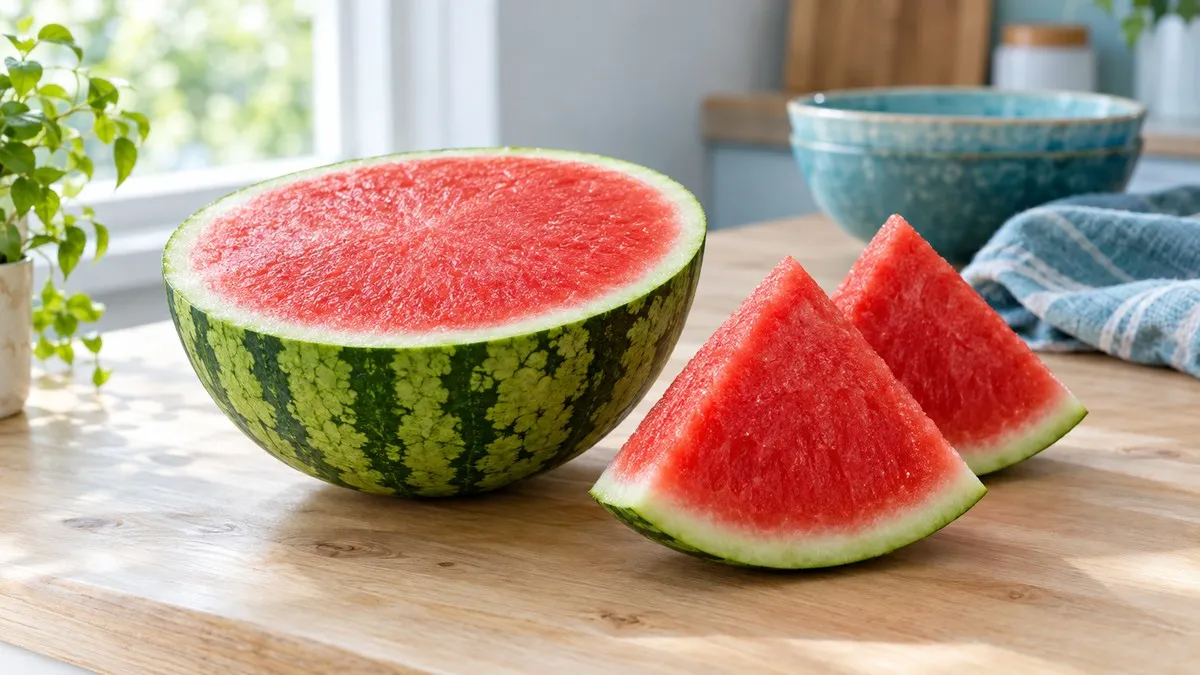
USDA defines a wedge as roughly one sixteenth of a melon 15 inches long and 7.5 inches across. A slice from a melon twice that size is twice the flesh, and a slice from a mini melon is far less. A "slice" in a recipe or a food diary carries no fixed weight at all.
Labels round, cups vary
The Watermelon Board's nutrient profile gives two cups of watermelon as 80 calories, based on the USDA entry. The label serving behind it is 280 g, which works out to 84 calories, and the board quotes that figure rounded to 80. Two cups measured with USDA's own diced-cup weight are 304 g and 91 calories. Neither figure is a mistake; they simply describe slightly different amounts of fruit.
Calories in a cup of watermelon
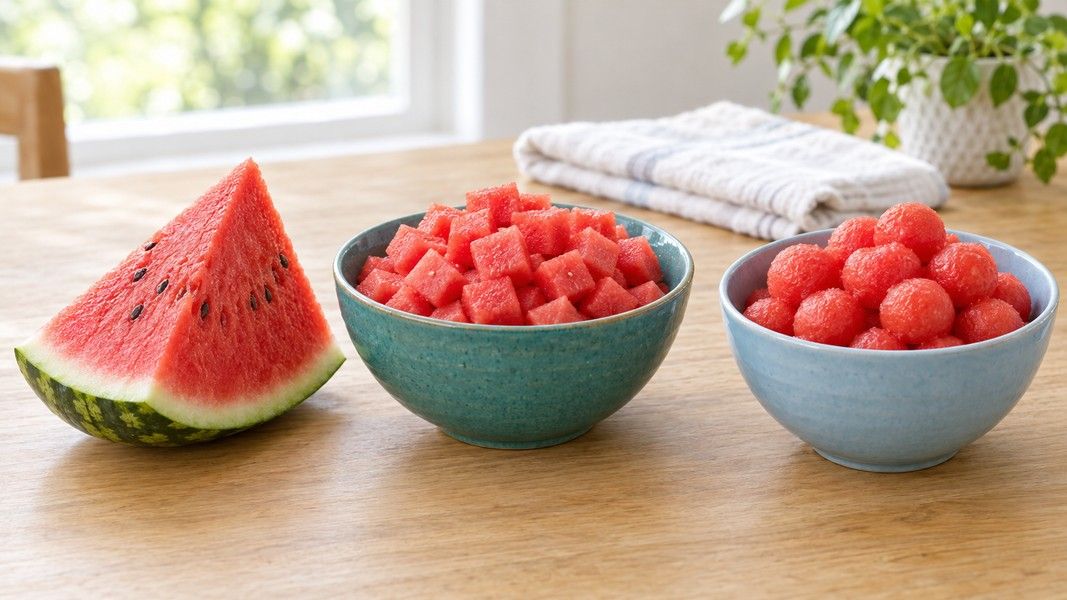
One cup of diced watermelon is 152 g of flesh and about 46 calories. A cup of melon balls packs almost the same, 154 g and about 46 calories, so the shape of the pieces barely matters at this scale. Half a cup diced is about 23 calories, and ten melon balls, at 122 g, are about 37.
A cup is a measure of volume, so the figure holds best for evenly cut cubes that fill the cup the way diced fruit normally does. Big uneven chunks with wide gaps hold less flesh per cup, and pressing pieces down to fit more in holds more. When you want the table to apply, cut the flesh into small even cubes before you measure it.
If you count larger amounts, multiply rather than round. Three cups diced are about 456 g and about 137 calories, which is a fair picture of a generous fruit bowl.
Calories in a watermelon wedge or slice
The USDA wedge is 286 g of flesh and about 86 calories. That wedge assumes a reference melon about 15 inches long, which holds 4,518 g of flesh. At the Food Buying Guide's 61 percent yield, that points to a whole fruit of roughly 16 lb.
Your melon may be bigger or smaller, and the wedge scales with it. Cut a 25 lb melon into 16 wedges and each holds about 430 g of flesh, close to 130 calories. Cut a 7 lb mini melon into 16 and each holds about 120 g, close to 36 calories.
For a wedge, count how many pieces the melon was cut into and start from the melon, not from the wedge. A party platter of thin triangles from a big melon and a thick quarter of a small one can carry the same calories while looking nothing alike.
A round slice cut across the melon behaves the same way. The thickness and the diameter of the melon set the flesh weight, and only the flesh counts.
Calories in a whole watermelon, by melon weight
Here the rind matters most. The table applies the Food Buying Guide's 61 percent flesh yield and the USDA rate of 30 calories per 100 g of flesh to whole melons as you would buy them, rind on. Calories are rounded to the nearest 10.
| Whole melon, rind on | Edible flesh | Calories in the flesh |
|---|---|---|
| 3 lb (1.4 kg) | 0.83 kg | about 250 |
| 5 lb (2.3 kg) | 1.38 kg | about 420 |
| 7 lb (3.2 kg) | 1.94 kg | about 580 |
| 10 lb (4.5 kg) | 2.77 kg | about 830 |
| 15 lb (6.8 kg) | 4.15 kg | about 1,250 |
| 20 lb (9.1 kg) | 5.53 kg | about 1,660 |
| 25 lb (11.3 kg) | 6.92 kg | about 2,080 |
The shortcut behind the table is about 83 calories for every pound of whole melon, or about 183 calories per kilogram. The Food Buying Guide's own purchase unit is a melon of about 27 lb, which by the same arithmetic holds roughly 16.5 lb of flesh and about 2,240 calories.
Yield varies from melon to melon, since rind thickness differs from one melon to the next, so treat the whole-melon figures as a reasonable middle rather than a fixed value.
A worked example
Say you bought a seedless melon and the produce scale at the store read 14 lb. Multiply 14 by 83 and you get about 1,160 calories for all of its flesh. Cut it into 12 equal wedges and each one carries about 97 calories.
If you then ate three wedges, you had about 290 calories of watermelon. The arithmetic needs only the melon's weight and the number of pieces, and both are easier to know than the weight of one slice.
Seedless, mini, seeded and yellow watermelons
The Watermelon Board's guide to watermelon types gives these size ranges for what reaches US stores. Seeded melons run from 5 to 45 pounds. Seedless melons reach up to about 25 pounds and make up about 90 percent of the cultivars grown for US consumption. Mini melons are seedless and come in at 1 to 7 pounds. Yellow and orange flesh melons run from 10 to 30 pounds.
That spread is the whole story for calories. A 5 lb mini melon holds a fifth of the flesh of a 25 lb seeded one, so "one watermelon" can mean anything from about 80 calories to well over 2,000.
The rate per gram of flesh stays close across types. USDA publishes a separate Foundation entry for seedless flesh, and its measured sugar, 7.2 g per 100 g, sits close to the 6.2 g in the standard entry. If you eat a seedless melon, the 30 calories per 100 g rate remains a reasonable figure to use.
Rind, seeds and juice
The pale inner rind is edible, and the USDA added an entry for seedless watermelon rind to its Foundation data. It lists about 19 calories per 100 g, with 94.7 percent water and 1.5 g of fiber per 100 g. That is fewer calories than the flesh and nearly four times the fiber. Rind pickles and relish recipes add sugar, so the finished dish carries more than the rind alone.
Roasted watermelon seeds are a different food altogether. USDA lists dried watermelon seed kernels at 557 calories per 100 g, about 158 per ounce, with 28 g of protein and 47 g of fat per 100 g. The soft white seed coats in a seedless melon are undeveloped seeds, and the Watermelon Board notes they are safe to eat with the flesh.
Juice is simpler than it looks. Watermelon blended with nothing added carries the calories of the flesh that went in. Count the cups of cubes you put in the blender rather than the glass that comes out, since a glass of juice can hold more fruit than it appears to.
What the calories in watermelon are made of
Watermelon flesh is 91.45 percent water by the USDA entry, which is why its calorie density is so low. Per 100 g it carries 7.55 g of carbohydrate, 6.2 g of it sugar, 0.4 g of fiber, 0.61 g of protein and 0.15 g of fat.
For one cup of diced watermelon, that works out to:
- about 11.5 g of carbohydrate, including about 9.4 g of natural sugar
- about 0.6 g of fiber and 0.9 g of protein
- about 0.2 g of fat and about 139 g of water
Nearly all of the calories therefore come from sugar. The same cup also supplies about 12 mg of vitamin C, about 170 mg of potassium and about 6.9 mg of lycopene, the red pigment watermelon is known for, by the same USDA entry.
If you are comparing fruit for a food diary, it helps to put watermelon beside denser options. Our guide to calories in grapes uses the same per cup and per 100 g layout, so the two read side by side.
Estimating watermelon calories from a photo
Watermelon is a forgiving food for a photo estimate in one respect. A 2026 test of four photo-based calorie apps on 102 meals, presented at NUTRITION 2026 and covered in a ScienceDaily report, found they underestimated meals by about 250 to 345 calories on average, with much of the gap in fat the camera could not see. The researchers called the results preliminary, as the work had not yet been peer reviewed. Watermelon has almost no fat to hide.
The hard part for a photo is the portion: how thick the wedge is, how much of it is rind, and how big the melon was. That is the same problem the tables above solve with weights.
Primo Scale's Calorie Estimator identifies the food in one photo and estimates its calories and macros, drawing on USDA reference data and showing its reasoning beside the result. Its Weight Estimator gives a typical figure with a likely range for a piece like a wedge. Primo Scale does not weigh objects or use phone sensors. It estimates a likely range from visual analysis and reference data. When the number matters, a real kitchen scale and the 30 calories per 100 g rate will always be closer.
For more on where photo estimates land and why, see how photo calorie estimates work. Primo Scale also helps when you only want a rough figure for a bowl you did not portion yourself, such as a buffet plate or a shared fruit tray.
Key points to remember
Watermelon flesh carries 30 calories per 100 g, and every portion figure is that rate applied to the amount of flesh. A cup of diced watermelon is about 46 calories, a USDA wedge about 86, and the label serving behind the familiar "80 calories" figure is 280 g.
For a whole melon, leave the rind out. About 61 percent of a watermelon is flesh, so a whole melon carries about 83 calories per pound of its full weight, from about 250 for a 3 lb mini to over 2,000 for a large seeded fruit. For wedges, start from the melon and divide by the number of pieces.
The rind is lower in calories than the flesh, roasted seeds are far higher, and juice carries whatever fruit went into it.