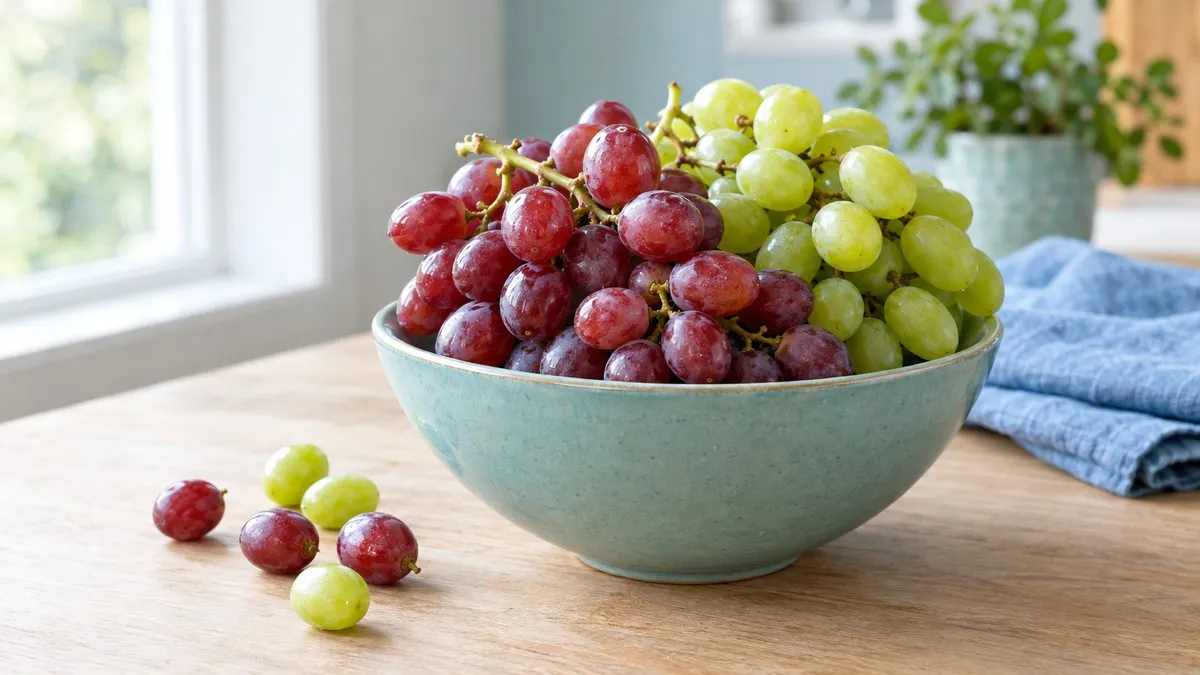
Grapes carry about 69 calories per 100 g, which works out to about 3.5 calories for a typical seedless grape of about 5 g and 104 calories for a cup of about 151 g. That is the standard USDA figure for red or green table grapes, and it answers how many calories are in grapes for most bowls you will ever eat.
The number moves more than you might expect, though. A large Red Globe grape has more than twice the calories of a small seedless one, newer USDA samples put seedless grapes higher than the old reference figure, and a cup of raisins carries about four times the calories of a cup of fresh fruit. The sections below give each portion with the grams behind it, so you can match the figure to the grapes in front of you.
Calories in Grapes at a Glance
All figures are for raw grapes from USDA's entry for red or green grapes of the European type, such as Thompson Seedless, the common seedless table grape.
| Portion | Grams | Calories |
|---|---|---|
| 1 grape, seedless | about 5 g | about 3.5 |
| 10 grapes | about 49 g | about 34 |
| 1/2 cup | about 76 g | about 52 |
| 1 cup | about 151 g | 104 |
| 100 g | 100 g | 69 |
| 1 pound | about 454 g | about 313 |
The rate behind every row is the European grape entry in USDA FoodData Central, which lists 69 calories per 100 g along with the gram weight of a cup and of 10 grapes. The other rows apply that rate to the grams, rounded.
The short version: count about 3.5 calories per grape, about 100 per cup and 69 per 100 g. The rest of this post explains when those shortcuts drift and by how much.
How Many Calories in One Grape, by Size
One grape has anywhere from about 2 to about 9 calories, and almost all of that spread comes from the size of the berry rather than its color or sweetness. A grape is mostly water and sugar, about 80 percent water by weight in the USDA data, so a bigger berry simply holds more of both.
Researchers at the University of California measured this directly. Their berry size study found that Flame Seedless, Thompson Seedless and Crimson Seedless berries usually come in at about 4 to 6 g, Fantasy Seedless at about 6 to 8 g, and Red Globe at about 10 to 13 g. Applying 69 calories per 100 g gives this:
| Variety group | Typical berry | Calories per grape |
|---|---|---|
| Small seedless (Flame, Thompson, Crimson) | about 4 to 6 g | about 2.8 to 4.1 |
| Large seedless (Fantasy) | about 6 to 8 g | about 4.1 to 5.5 |
| Extra large (Red Globe) | about 10 to 13 g | about 6.9 to 9.0 |
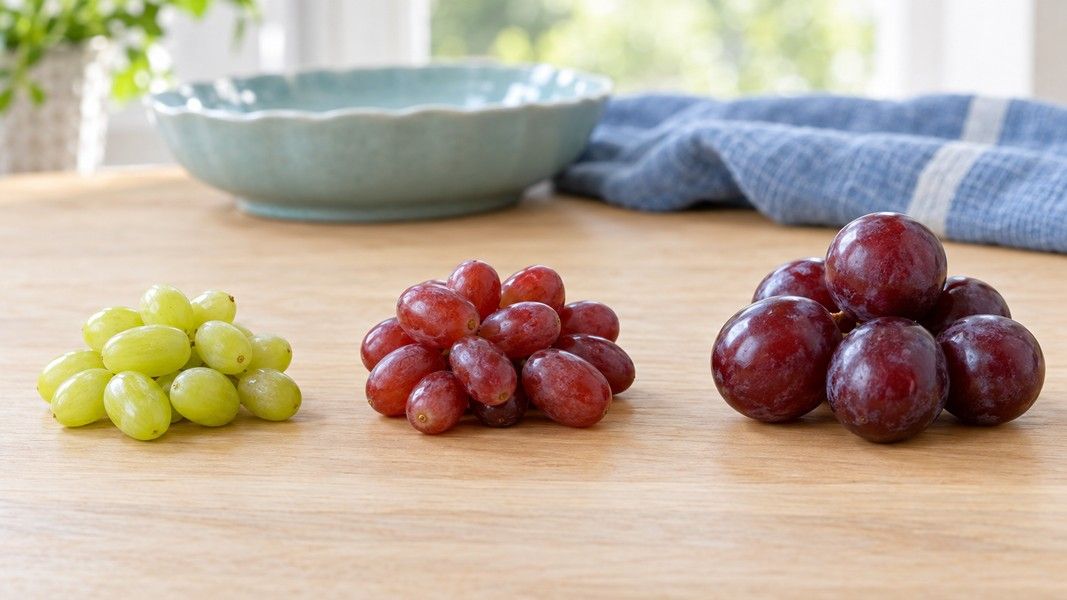
Older USDA measures list a seedless grape at about 5.0 g and a grape with seeds at about 5.8 g, which lands right in the middle of the small seedless range. That is why 3.5 calories per grape is a sound default for an everyday bunch.
How to place a grape you are holding
The UC study also notes that growers and retailers describe grapes by diameter rather than by grams. A box of Thompson Seedless is typically described as berries mostly 11/16 inch across, which the study pairs with berries of about 5 g. Its equations put a Red Globe of about 10 to 13 g at roughly 24 to 27 mm, about an inch across. So a grape near 11/16 inch belongs in the small seedless group, and one near an inch carries about twice the per-grape figure.
Calories in Grapes per Cup and per 100 g
Per 100 g is the most stable way to log grapes, because it does not depend on how tightly the fruit sits in a measuring cup. A cup is the more common kitchen measure, and it hides more variation than it looks.
USDA lists a cup of European grapes at about 151 g, or 104 calories. An older USDA measure lists a cup of seedless grapes at about 160 g, or about 110 calories, and a cup of grapes with seeds at about 154 g. The difference is how full the cup gets. Grapes are round, so a cup is part fruit and part air, and how much fruit fits depends on the berries.
Grape nutrition per cup
Here is what one cup holds by the numbers, from the same USDA entry:
| Nutrient | Per cup (151 g) | Per 100 g |
|---|---|---|
| Calories | 104 | 69 |
| Carbohydrate | 27.3 g | 18.1 g |
| Sugars | 23.4 g | 15.5 g |
| Fiber | 1.4 g | 0.9 g |
| Protein | 1.1 g | 0.7 g |
| Fat | 0.24 g | 0.2 g |
Almost every calorie in a grape comes from carbohydrate, about 95 percent of the total in the USDA breakdown, and most of that carbohydrate is natural sugar. Protein and fat are close to zero.
If you measure in cups, a half cup of about 76 g comes to about 52 calories and two cups of about 302 g to about 208. If you measure by count, 10 grapes at about 49 g give about 34 calories, so 20 grapes are about 68 and 30 grapes about 101.
Calories in Green Grapes vs Red Grapes
Red and green grapes are close enough that the color rarely matters for a food log. The classic USDA reference figure covers both in one entry, red or green, at 69 calories per 100 g.
Newer USDA samples split them. The entry for red seedless grapes works out to about 86 calories per 100 g, and the matching entry for green seedless grapes to about 80 calories per 100 g. At those rates a 151 g cup comes to about 130 calories for red and about 121 for green.
| Grape | Per 100 g | Per 5 g grape | Per 151 g cup |
|---|---|---|---|
| Red or green, classic USDA figure | 69 | about 3.5 | 104 |
| Green seedless, newer sample | about 80 | about 4.0 | about 121 |
| Red seedless, newer sample | about 86 | about 4.3 | about 130 |
Which grape figure to use
So which number is right? Both are real measurements of real grapes. The newer entries come from a different set of samples than the long-standing reference, and fruit varies from one batch to the next. The gap between red and green, about 6 calories per 100 g, is smaller than the gap between the old and new figures for the same grape. If you want a single number, 69 per 100 g is the long-standing reference and the one behind the tables in this post; if you prefer to round up, the newer figures give you a ceiling.
Concord and Other Slip Skin Grapes
Concord grapes belong to a different group, which USDA calls American type, or slip skin, after the way the skin slips off the pulp. Their berries are much smaller than a typical seedless table grape.
The USDA entry for slip skin grapes lists 67 calories per 100 g, close to the European figure. The portions differ more than the rate does: USDA lists one slip skin grape at about 2.4 g, so about 1.6 calories, and a cup at about 92 g, so 62 calories. A cup of Concords holds fewer grams than a cup of supermarket seedless grapes, which is why its calorie count looks so much lower even though gram for gram the two are nearly the same.
Muscadines sit at the other end. USDA lists a muscadine grape at about 6 g and about 3 calories each.
Raisins vs Fresh Grapes
Drying a grape removes most of its water and keeps nearly all of its sugar, so the calories concentrate. USDA lists seedless raisins at about 299 calories per 100 g, a little over four times the rate of fresh grapes.
| Raisin portion | Grams | Calories |
|---|---|---|
| 1 raisin | about 0.5 g | about 1.6 |
| 50 raisins | about 26 g | about 78 |
| 1 oz (about 60 raisins) | about 28 g | about 84 |
| 1 small box (1.5 oz) | about 43 g | about 129 |
| 1 cup, not packed | about 145 g | about 434 |
The comparison that surprises people is by the cup. A cup of fresh grapes is about 104 calories; a cup of raisins is about 434. Gram for gram, a raisin and a fresh grape are different foods for calorie purposes, so a log entry for one should never stand in for the other.
Frozen grapes are another matter. Freezing removes no water and adds nothing, so a frozen grape carries the same calories as the fresh grape it came from.
Estimating a Bowl of Grapes Without Counting
Most grapes are eaten by the handful or straight from the bowl, which is where the per-portion figures get hard to use. There are two quick ways to get to a sensible estimate.
The first is by count. Count the grapes, or a sample of them, then multiply by the per-grape figure for their size. Twenty small seedless grapes at about 3.5 calories each come to about 70 calories. Ten Red Globes at about 8 calories each come to about 80, even though the bowl holds half as many grapes.
The second is by volume. If the bowl holds roughly a cup of loose grapes, start from about 100 calories and adjust for berry size: smaller berries pack more fruit into the cup, very large ones leave more air.
Using a photo instead
A photo can do the counting and the size judgment for you. Primo Scale's Object Counter gives an estimated count of the grapes in the frame, which you can multiply by the per-grape figures above; our guide on counting small items covers the lighting and angle that help. The Calorie Estimator identifies the fruit from one photo and returns estimated calories for the plate, using USDA reference data for food, with its reasoning shown beside the result.
If you want grams instead, Primo Scale's Weight Estimator returns a typical figure and a likely range for the bunch. Primo Scale does not weigh objects or use phone sensors. It estimates a likely range from visual analysis and reference data, so a real kitchen scale is still the tool when you need a reading.
Where the Grape Figures Drift
Three things move a grape estimate more than anything else. Knowing them tells you when the shortcut is fine and when to adjust.
- Berry size. A Red Globe can carry more than twice the calories of a Thompson Seedless, so a count is only as good as the size behind it.
- Which USDA figure you start from. The classic 69 per 100 g and the newer 80 to 86 per 100 g differ by up to a quarter, more than red versus green.
- Fresh versus dried. Raisins are about four times as dense in calories, so a small box of raisins carries more calories than a full cup of fresh grapes.
Stems and seeds matter much less. Seeds add a little mass that you may or may not eat, which is why USDA lists a seeded grape slightly heavier than a seedless one, and the stem is removed in every figure here. For a related fruit with the same per-berry approach, see our breakdown of strawberry calories by size.
Conclusion
Grapes come to about 69 calories per 100 g in the standard USDA reference, which makes a typical seedless grape about 3.5 calories, 10 grapes about 34 and a cup about 104. Size is the biggest variable: small seedless berries run about 3 to 4 calories each, and Red Globes about 7 to 9.
Red and green differ by only a few calories per 100 g, while the newer USDA samples run higher than the classic figure for both. Concord and other slip skin grapes match table grapes gram for gram but fill a cup with less fruit. Raisins are the outlier, at about 299 calories per 100 g, so they need their own entry rather than the fresh grape figure.