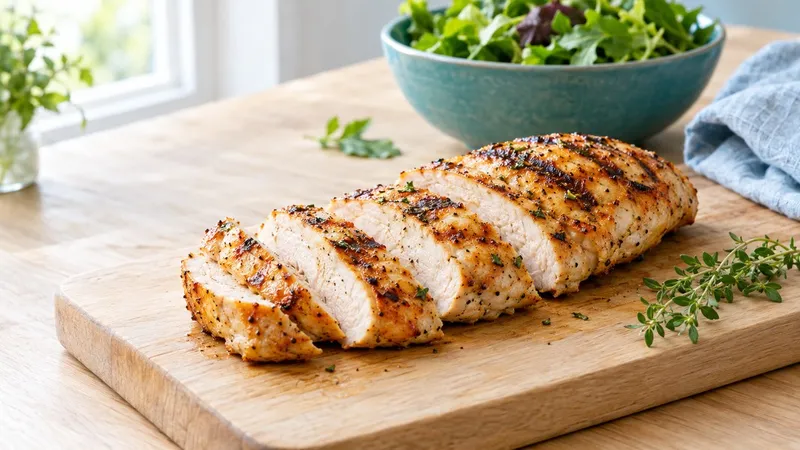
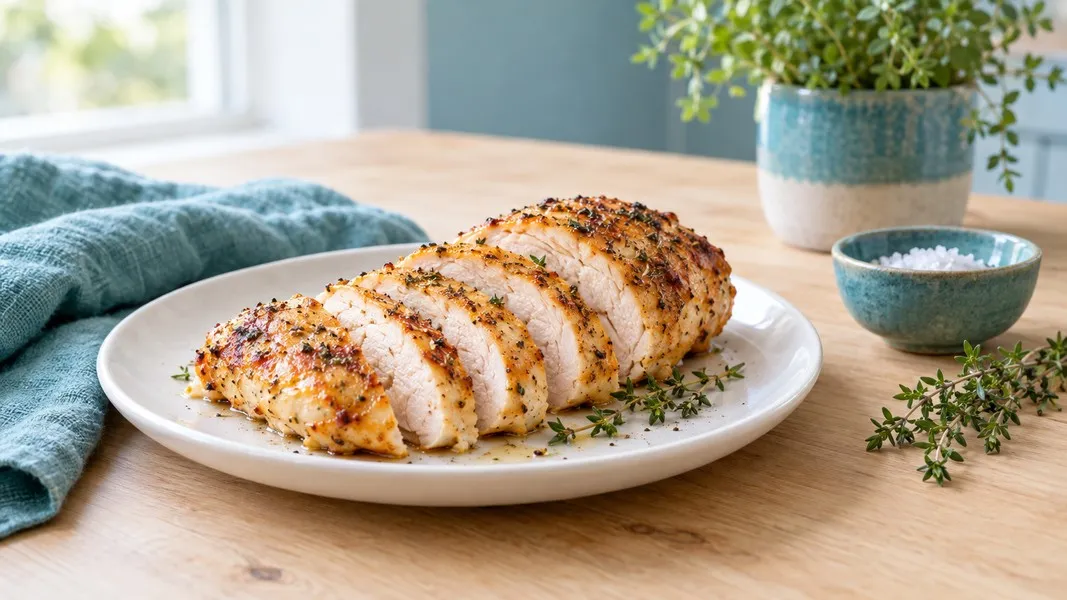
The average weight of a chicken breast sold in a supermarket today is about 170 to 300 grams raw, and USDA's own reference piece is 272 grams, a little under 10 ounces. Cooking takes about a quarter of that away as water, so the same breast comes off the pan at roughly 200 grams.
If a recipe says "two chicken breasts" or a food diary wants grams, that range is wider than most people expect. Meat chickens have more than doubled in size since 1950, older tables describe half a breast, and raw and cooked figures get mixed up constantly.
This guide gives the weight of a chicken breast by size, raw and cooked, explains why some references show a breast at under 100 grams, and turns each size into calories, protein and portions. It ends with how to estimate a breast you have no label for.
Average weight of a chicken breast today
The most useful single figure comes from USDA's FoodData Central entry for boneless, skinless chicken breast. Its record for the raw meat lists one piece at 272 grams, a 4 ounce portion at 113 grams, and one package at 926 grams. You can read those portion weights yourself in the USDA raw entry.
That 272 gram piece is a whole boneless fillet from one side of the bird, the thing you lift out of a supermarket tray. Divide the package weight by the piece weight and you get about 3.4 pieces, which matches the three or four breasts most trays hold.
Measured fillets land in the same band. A study of 90 fillets from six week old, high breast yield broilers found that normal fillets averaged about 194 grams raw. Fillets with the woody breast condition, which shows up most in the largest birds, averaged 252 grams when mild and 298 grams when severe, according to the woody breast study.
So a reasonable answer to "how much does one chicken breast weigh" is about 200 grams for a modest fillet and 250 to 300 grams for a large one. Anything under 150 grams raw is a small breast by current standards.
Why "one breast" means two different things
Some nutrition tables make a breast look tiny, and the reason is a word. USDA's legacy records describe portions as "1/2 breast", because to a butcher the breast is the whole front of the bird, both sides together. What a shop sells as one chicken breast is that half.
USDA's roasted breast entry, for example, lists half a breast with bone and skin removed at 86 grams cooked. Read without the "1/2", that looks like a whole breast of 86 grams, which no modern pack would match. When a source gives a breast weight, check whether it means a half or both sides before using it.
Chicken breast weight by size
The table puts the measured sizes side by side. Raw figures come from the sources above; the cooked column uses the cook loss each source measured, or about 25 percent where none was given.
| Size | Raw weight | Raw ounces | Cooked weight | Cooked ounces |
|---|---|---|---|---|
| USDA legacy half breast | about 120 g | 4.2 oz | 86 g | 3.0 oz |
| Normal modern fillet | 194 g | 6.8 oz | about 152 g | 5.4 oz |
| Large fillet, mild woody breast | 252 g | 8.9 oz | about 189 g | 6.7 oz |
| USDA reference piece | 272 g | 9.6 oz | about 204 g | 7.2 oz |
| Very large fillet, severe woody breast | 298 g | 10.5 oz | about 213 g | 7.5 oz |
The first row works backwards from USDA's measured 86 gram cooked half breast at USDA's roasting yield of 72 percent. The fillet rows use the study's own cook losses of 21.9, 25.0 and 28.6 percent. The USDA piece uses 25 percent, between USDA's roasted and poached yields.
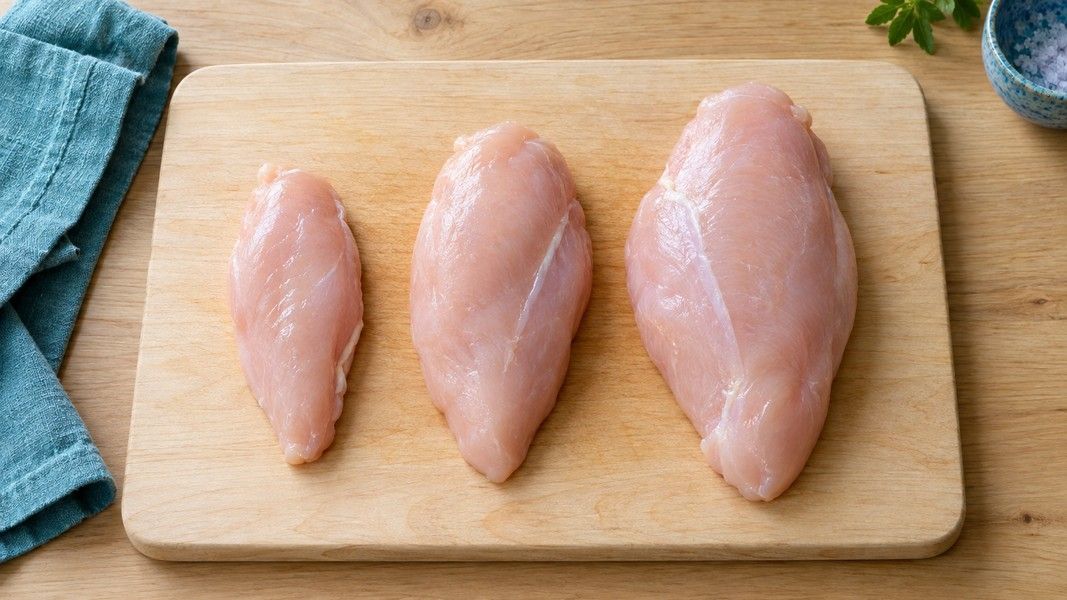
The spread between a small and a large breast is close to 2.5 times. That is why "one chicken breast" in a recipe is a loose instruction, and why a calorie figure for "a chicken breast" without a weight next to it tells you little.
What the label on the pack tells you
The most reliable figure you will usually have is the net weight printed on the tray. Divide it by the number of breasts and you have the average for that pack, raw. A 900 gram tray with four breasts averages 225 grams each, even if one of them is visibly bigger than the rest.
USDA also keeps a separate record for chicken breast "with added solution", meaning meat injected with a salt and water mix. If the label mentions a solution or a percentage of broth, part of the weight on the tray is that liquid, and more of it will run off in the pan.
Raw vs cooked chicken breast weight
Raw chicken breast is about three quarters water, 73.9 grams per 100 by USDA's raw entry, and heat pushes a share of it out. The meat shrinks, the protein and calories stay, and the grams per breast drop.
How much weight a chicken breast loses when cooked
USDA's cooking yields table puts chicken breast at a 72 percent yield when baked or roasted, meaning 100 grams raw becomes 72 grams cooked. Its measured range runs from 61 to 82 percent. Poached, simmered or stewed breast keeps more, a 77 percent yield, with a range of 70 to 88.
The fillet study saw the same pattern from a different angle. Cooked in sealed pouches in a water bath, normal fillets lost 21.9 percent of their weight. Woody fillets lost more, 25.0 percent when mild and 28.6 percent when severe, because that meat holds its water less well.
Put together, a fair rule is that a chicken breast loses about a quarter of its raw weight, a little less when poached and a little more when roasted hard or cut thin. A 200 gram raw breast ends up at about 150 grams; a 272 gram one at about 200.
Which figure to use
Either works, as long as the nutrition figure matches. Raw boneless, skinless breast has 120 calories and 22.5 grams of protein per 100 grams. Roasted breast has 165 calories and 31 grams of protein per 100 grams, as the USDA roasted entry lists.
The higher cooked figure is the same food with less water. Using the raw per 100 gram value on a cooked weight undercounts by about a quarter, and the reverse overcounts by more than a third. Pick one state, note which, and keep to it.
Cooked weight has one more catch: it depends on how long the pan stayed on. Raw weight does not, which is why the figure on the tray is the steadier one to log when you cook for yourself.
Why chicken breasts got so big
The small breast in some tables is not only a wording problem. Chickens raised for meat are much larger than they were, and the breast has grown with them.
The National Chicken Council's broiler performance figures show the change. In 1950 an average US broiler went to market at 70 days and 3.08 pounds live weight. In 2025 it went at 47.5 days and 6.63 pounds, more than twice as heavy in about two thirds of the time.
| Year | Market age | Average live weight |
|---|---|---|
| 1925 | 112 days | 2.5 lb |
| 1950 | 70 days | 3.08 lb |
| 1975 | 56 days | 3.76 lb |
| 2000 | 47 days | 5.03 lb |
| 2025 | 47.5 days | 6.63 lb |
The industry has also bred birds for more breast meat, and the fillet study above used high breast yield birds for that reason. USDA's cooking yields for chicken breast still rest on studies from 1975, so a figure from an older reference is best checked against the size of the breast in front of you.
Woody breast and the largest fillets
The biggest fillets come with a texture problem. Woody breast makes the meat hard and rigid, and white striping shows as pale lines running along the grain. Both are linked to fast growth and heavy fillets.
A 2023 study of 300 fillets from 56 day old commercial broilers in the Czech Journal of Animal Science found that 88 percent had at least one of these conditions, and that the odds of woody breast rose with fillet weight. The fillet study above found the same direction: the heavier the fillet, the more severe the condition and the more weight it lost in cooking.
For estimating weight, the practical point is simple. An unusually thick, firm breast is likely to be one of the heavy ones, often near 300 grams raw, and it will shrink more than a soft, thin one.
Calories and protein in one chicken breast
With a weight in hand, the nutrition follows from USDA's per 100 gram values. The raw figures below use 120 calories, 22.5 grams of protein and 2.6 grams of fat per 100 grams of boneless, skinless breast.
| Breast | Raw weight | Calories | Protein | Fat |
|---|---|---|---|---|
| USDA legacy half breast | about 120 g | about 144 | about 27 g | about 3 g |
| Normal modern fillet | 194 g | about 233 | about 44 g | about 5 g |
| Large fillet | 252 g | about 303 | about 57 g | about 7 g |
| USDA reference piece | 272 g | about 326 | about 61 g | about 7 g |
| Very large fillet | 298 g | about 358 | about 67 g | about 8 g |
A worked example
Take the USDA reference piece of 272 grams. Raw, it carries about 326 calories and 61 grams of protein. Roasted at USDA's 72 percent yield, it comes out at about 196 grams, and 196 grams at the roasted value of 165 calories per 100 grams is about 323 calories.
The two routes agree to within a few calories, which is the point: cooking changes the grams, not the calories in the meat. What it can add is fat from the pan. A tablespoon of oil brushed on before roasting adds its own calories on top, and some of it stays on the meat.
The same logic carries into a full plate. Our guide to restaurant meal calories walks through splitting a dish into parts, chicken included, and adding back the cooking fat you cannot see.
Bone-in, skin-on and other cuts
Not every breast arrives boneless and skinless, and the extra parts change both the weight on the tray and what you eat.
Skin adds weight and most of the fat. USDA's raw breast with skin has 172 calories and 9.3 grams of fat per 100 grams, against 120 calories and 2.6 grams for the meat alone. Its legacy record puts half a breast with skin, bone removed, at 145 grams.
Bone adds weight you do not eat. A bone-in split breast weighs more on the tray than the meat you end up with, so estimate the meat without the bone rather than using the tray weight.
Tenderloins are separate. The small strip under the breast is often sold on its own as tenders. If your breasts have had the tenderloin removed, they will sit at the lower end of the ranges above.
Three habits keep the numbers straight when the cut is not plain fillet:
- Use the skinless figures only for meat you eat without the skin.
- Take the bone out of the estimate before converting grams to calories.
- Treat "with added solution" breasts as a little heavier raw than the meat they hold.
How many chicken breasts are in a pound
Recipes in the US often ask for a pound of chicken, and portion guidance often speaks in ounces. A pound is 454 grams, so at USDA's 272 gram reference piece one pound is about 1.7 breasts. With smaller fillets near 194 grams, it is about 2.3.
A 4 ounce raw portion, the 113 gram serving in USDA's raw entry, means one 272 gram breast holds about 2.4 portions. The 3 ounce cooked portion many guides use, 85 grams, is roughly the cooked meat from a 113 gram raw piece.
| Raw amount | Grams | USDA reference breasts | Normal fillets |
|---|---|---|---|
| 1 pound | 454 g | about 1.7 | about 2.3 |
| 2 pounds | 907 g | about 3.3 | about 4.7 |
| One 926 g package | 926 g | about 3.4 | about 4.8 |
At the size of USDA's legacy half breast, four breasts come to about 480 grams of raw meat. Four large fillets of 252 grams pass a kilogram. When a recipe gives a count rather than a weight, it is worth asking which era of chicken it had in mind.
How to estimate a chicken breast's weight without a scale
Without a label or a kitchen scale, you can still get within a sensible range by comparing the breast with things you know.
Use the references you have
A cooked portion the size of a deck of cards is about 85 grams, the same reference our guide to estimating grams by eye uses for meat and fish. A 200 gram raw fillet cooks down to about 150 grams, a little under two of those decks.
Shape helps too. A thin, flat fillet that covers your palm sits toward the lower rows of the size table. A thick one that bulges at one end is likely in the 250 to 300 gram band. Say the result as a range: "about 250 grams, likely 220 to 280" is an honest description of a breast you have only looked at.
Estimating from a photo
Primo Scale's Weight Estimator works on the same idea from one photo. It identifies the food, draws on USDA reference data, and returns a typical figure with a likely range, with its reasoning shown beside the result. On iPhones that have LiDAR it also uses depth information.
Primo Scale does not weigh objects or use phone sensors. It estimates a likely range from visual analysis and reference data. When the grams matter, for a recipe that has to come out right or a food diary you follow closely, a real kitchen scale is the way to get an exact figure.
Its Calorie Estimator takes the next step for a cooked plate, estimating calories and macros for the whole meal rather than the chicken alone.
Key takeaways on chicken breast weight
A boneless, skinless chicken breast from a supermarket today is about 170 to 300 grams raw, with USDA's reference piece at 272 grams. USDA records that show 86 grams describe half a breast, cooked, and meat chickens have more than doubled in size since 1950.
Cooking removes about a quarter of the weight as water: USDA measures a 72 percent yield for roasted breast and 77 percent for poached, and the heaviest woody fillets lose the most. The calories in the meat stay the same, so match raw figures with raw weights and cooked with cooked.
Skin, bone and added solution all change the weight on the tray without matching what you eat. When the size matters, the tray's net weight divided by the number of breasts is the best figure you have short of a kitchen scale, and a visual estimate is best stated as a range.