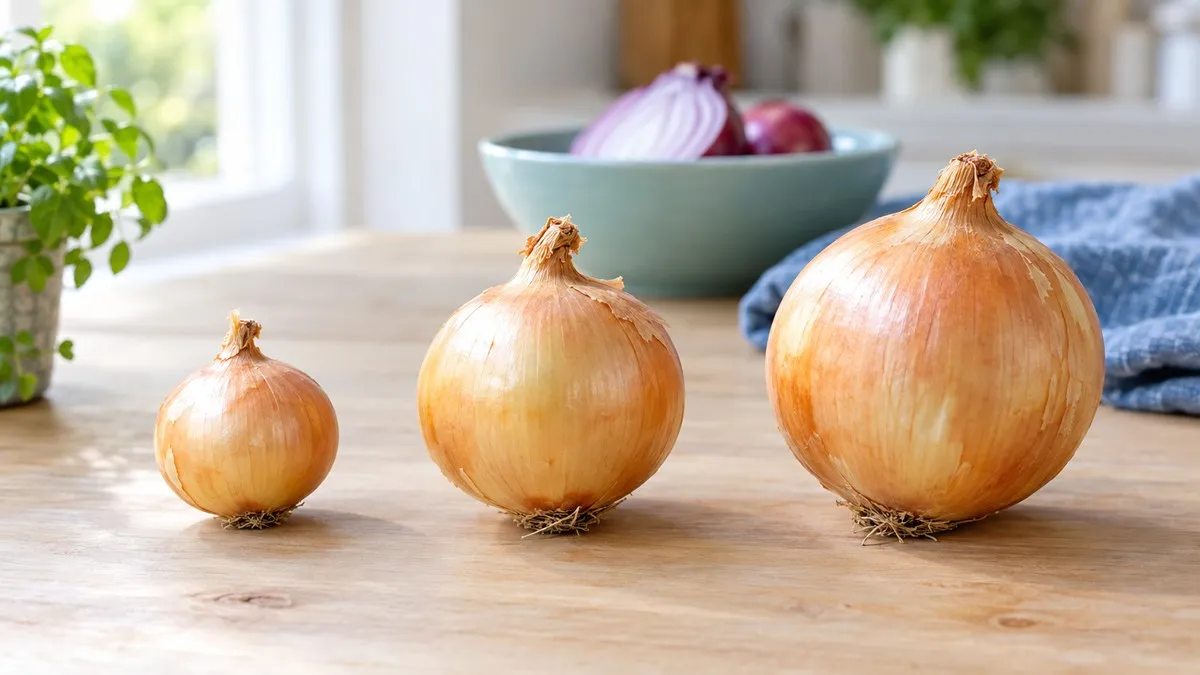
A medium onion weighs about 110 to 150 grams, roughly 4 to 5 ounces, with the skin on. The medium onion weight you find depends on whose "medium" you read: the USDA nutrient database puts it at 110 g, the FDA labeling chart at 148 g, and onion industry yield data finds an average of 123 g for a 2.5 inch bulb.
That spread is why recipes that say "1 medium onion" turn out differently from one kitchen to the next. Below you will find the reference figures side by side, a grams table by diameter, the weight of a cup of chopped or sliced onion, and a six step method for estimating the onion on your own counter.
Medium Onion Weight: Three Sources, Three Numbers
All three figures are correct. They measure slightly different things.
The USDA's FoodData Central lists raw onions with a medium bulb of 2.5 inches across at 110 g. That is a portion for nutrient calculations, not a shopping size.
The FDA's raw vegetable labeling chart uses 1 medium onion at 148 g, or 5.3 ounces, as the serving size behind the nutrition posters grocers can display beside raw produce. It describes the raw, edible portion.
The National Onion Association publishes an onion yield chart built on Idaho and Eastern Oregon yield data. Its 2.5 inch onions averaged 4.34 ounces, about 123 g, and ranged from 105 to 151 g.
If a recipe just says "1 medium onion", 110 to 150 g of whole onion is the honest answer, and anything in that range will cook the same. The difference matters only when a recipe was written in grams in the first place.
Average Onion Weight by Diameter
Diameter predicts onion weight far better than a size word does. The yield chart measured onions at five diameters, and the table converts its ounces to grams.
| Diameter | Average whole weight | Typical range | Usable after peeling |
|---|---|---|---|
| 2.5 in (6.3 cm) | 123 g (4.3 oz) | 105 to 151 g | 73.5%, about 90 g |
| 3 in (7.6 cm) | 206 g (7.3 oz) | 177 to 262 g | 77.7%, about 160 g |
| 3.5 in (8.9 cm) | 314 g (11.1 oz) | 285 to 349 g | 78.5%, about 247 g |
| 4 in (10.2 cm) | 458 g (16.2 oz) | 425 to 512 g | 80.8%, about 370 g |
| 4.5 in (11.4 cm) | 613 g (21.6 oz) | 591 to 626 g | 81.6%, about 500 g |
Two patterns stand out. Weight climbs much faster than width: going from 2.5 to 3.5 inches, less than half again as wide, more than doubles the onion. And bigger onions lose a smaller share to peeling, because the papery skin and the trimmed ends are a thinner slice of a large bulb.
How US grades name onion sizes
The size words on a sack come from the USDA's onion grade standards, which define them by diameter alone. Small runs from 1 to 2.25 inches, medium from 2 to 3.25 inches, large or jumbo from 3 inches up, and colossal from 3.75 inches up. The National Onion Association adds super colossal at 4.5 inches and up, and says the sizes most often sold in US stores are medium and large or jumbo.
A medium grade onion can therefore be anything from a 2 inch bulb to a 3.25 inch one. On the chart above, that is roughly 100 g at the small end and well past 250 g at the large end. The word "medium" on a bag tells you very little about the onion inside.
Small, Large and Jumbo Onion Weight in Grams
For the other size words, the two references disagree in the same direction as they do for medium.
FoodData Central lists a small onion at 70 g and a large onion at 150 g. Those are recipe and nutrient portions, and they sit at the light end of what the grade names cover.
The yield chart describes what the grades look like in a store. A 3 inch onion, the smallest that counts as large or jumbo, averages 206 g. A 4 inch colossal bulb averages 458 g, close to a pound, and a 4.5 inch super colossal onion averages 613 g.
So when a recipe from a nutrition source says "1 large onion", it probably means about 150 g. When you buy a jumbo onion from a supermarket bin, you are more likely holding 200 to 300 g. If your onion is 3.5 inches or wider, plan on using about half of it for a "large onion" recipe.
UK, Canadian and Australian recipes use the same words without a shared standard, so the diameter table is the safer guide wherever you cook.
Onion Weight in Cups, Slices and Spoons
Many recipes skip the whole onion and ask for a cup or a spoonful. FoodData Central gives a portion weight for each common cut of raw onion:
- 1 cup chopped: 160 g
- 1 cup sliced: 115 g
- 1 tablespoon chopped: 10 g
- 1 thin slice: 9 g; 1 medium slice, 1/8 inch thick: 14 g; 1 large slice, 1/4 inch thick: 38 g
- 10 rings: 60 g
Sliced onion weighs less per cup than chopped because the curved slices leave more air between them. The finer the cut, the more onion packs into the cup.
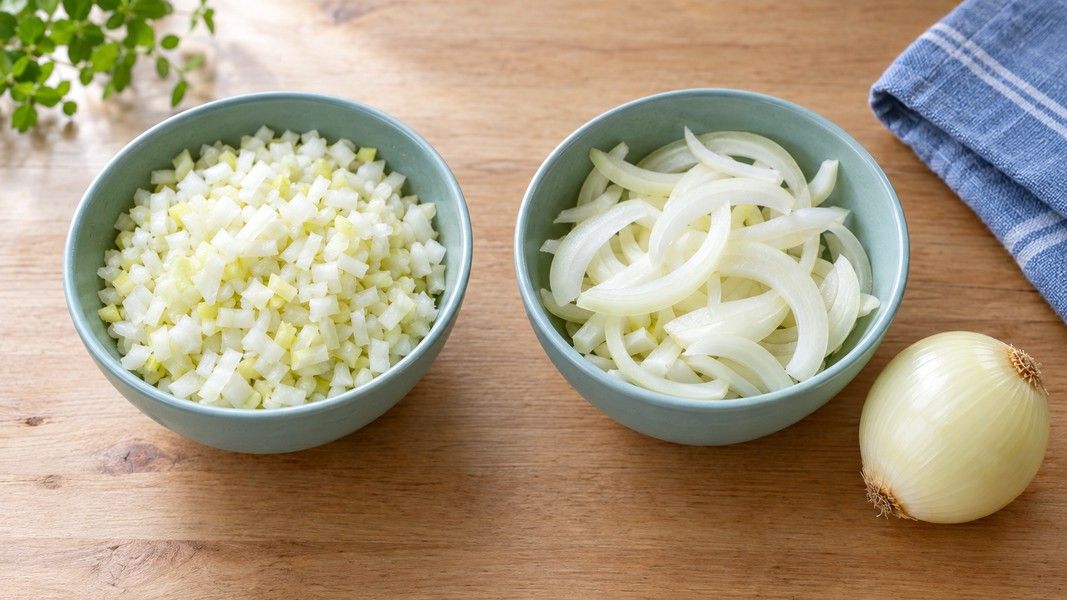
The yield chart measures from the other direction, starting with a pound of whole onions. At 2.5 inches, a pound gave 2.47 cups of 3/8 inch dice and 4.38 cups of fine 1/8 inch mince. Peeling losses are already counted, so a pound of whole onions gives fewer cups than a pound of peeled onion would.
From a whole onion to a cup
Put the two sources together and a 2.5 inch onion of about 123 g, around 90 g once peeled, fills a bit more than half a cup when chopped. A 3 inch onion at about 160 g peeled gives roughly one cup. If a recipe asks for a cup of chopped onion, one 3 inch onion or two 2.5 inch ones is a fair starting point. Our guide to grams per tablespoon covers the same spoon-to-gram problem for butter, sugar and flour.
Red, White, Yellow and Green Onions
The grade standards and the National Onion Association apply the same diameter classes to yellow, red and white onions, so the diameter table works for all three. Neither source sets a different weight for red onions, so read a 3 inch red onion from the same row as a yellow one.
Green onions are a different plant part and need their own numbers. FoodData Central's scallion entry, tops and bulb included, puts a small 3 inch scallion at 5 g, a medium one about 4 inches long at 15 g, and a large one at 25 g. A cup of chopped scallions is 100 g and a tablespoon is 6 g. The FDA chart uses a quarter cup of chopped green onion, 25 g, as its serving.
Shallots get only one portion in FoodData Central: a tablespoon chopped is 10 g, the same as onion. For a whole shallot, the reference data publishes no standard figure, so treat any single number you see online as someone's guess.
How to Estimate Your Onion's Weight in 6 Steps
Everyday cooking works from a good estimate. You need the onion, something to judge its width against, such as a ruler or a known object, and the tables above.
- Find the widest point. Look at the onion from the side and judge the width at its fattest part, ignoring the papery tail and the root.
- Match the diameter to the table. Take the nearest row; between two rows, pick a figure between their averages.
- Pick a figure inside the range. Start from the row's average. A dense, heavy-feeling onion sits toward the top of the range, a light, papery one toward the bottom.
- Subtract the peel. Multiply by the usable share in the last column, about 74% for small onions and about 80% for big ones.
- Convert to the cut your recipe asks for. Divide peeled grams by 160 for cups chopped, or by 115 for cups sliced.
- Check against the bag. A mesh bag labeled 3 pounds holds about 1,360 g. Count the onions inside and divide, and you get the average for that bag, often the most reliable estimate you will have at home.
The bag check is the step people skip, and it is the one that catches a bag of large onions sold under a "medium" sign. For other ingredients, our guide on how to estimate grams without a kitchen scale walks through the same reasoning with cups, spoons and package sizes.
When a Photo Estimate Is Enough, and When It Is Not
A photo can identify an onion, judge its size against the things around it, and look up a typical weight, which is the same process as the six steps above done faster. Primo Scale's Weight Estimator does this from one photo, showing a typical figure, a likely range in grams and the reasoning behind both.
That reasoning matters for onions because the range is wide. An estimate along the lines of about 205 g, likely 175 to 260 g, tells you that you are holding a 3 inch onion and that one is enough for a cup of chopped onion. Primo Scale does not weigh objects or use phone sensors. It estimates a likely range from visual analysis and reference data.
For a soup, a stir-fry or a sauce, a range like that is plenty, because onion quantities in savory cooking are forgiving. Some jobs need more: a pickling or baking recipe written in grams, or a nutrition diary that is only as good as the gram figure you enter. For those, an exact weight needs a real kitchen scale.
Primo Scale can also return a calorie estimate for a whole plate, where onion is one of several ingredients.
Troubleshooting Common Onion Weight Mix-Ups
The recipe says "1 onion" with no size. Read it as a medium onion, one of the two sizes most sold in US stores, so 110 to 150 g whole, or about half to three quarters of a cup chopped. If your onions are large, use part of one.
Your chopped cup came out light. Coarse chunks and slices hold more air than a fine dice. Chop a little smaller or add a few more pieces until the cup is full.
The recipe gives grams of chopped or sliced onion. Those grams are prepared onion, peeled and trimmed, so start from a whole onion about a quarter heavier than the figure.
Key Takeaways
A medium onion is about 110 to 150 g with its skin on. FoodData Central uses 110 g, the FDA labeling chart 148 g, and measured 2.5 inch onions average about 123 g.
Size words on a store sign cover a wide band of diameters, so width is the better predictor: about 123 g at 2.5 inches, 206 g at 3 inches and 314 g at 3.5 inches. Peeling removes roughly a fifth to a quarter of the weight.
For cuts, a cup of chopped onion is about 160 g and a cup of sliced onion about 115 g, while a tablespoon chopped is about 10 g. Those figures, a look at the onion's width and a glance at the bag label are enough for everyday cooking, and a real scale is worth reaching for only when a recipe is built on weight.