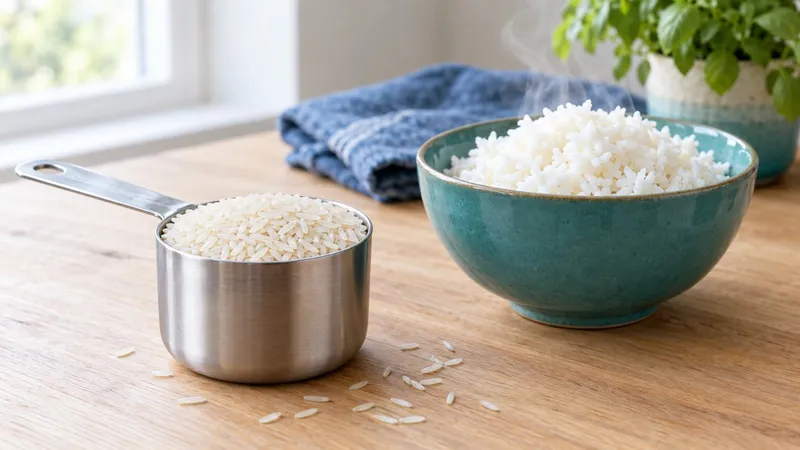
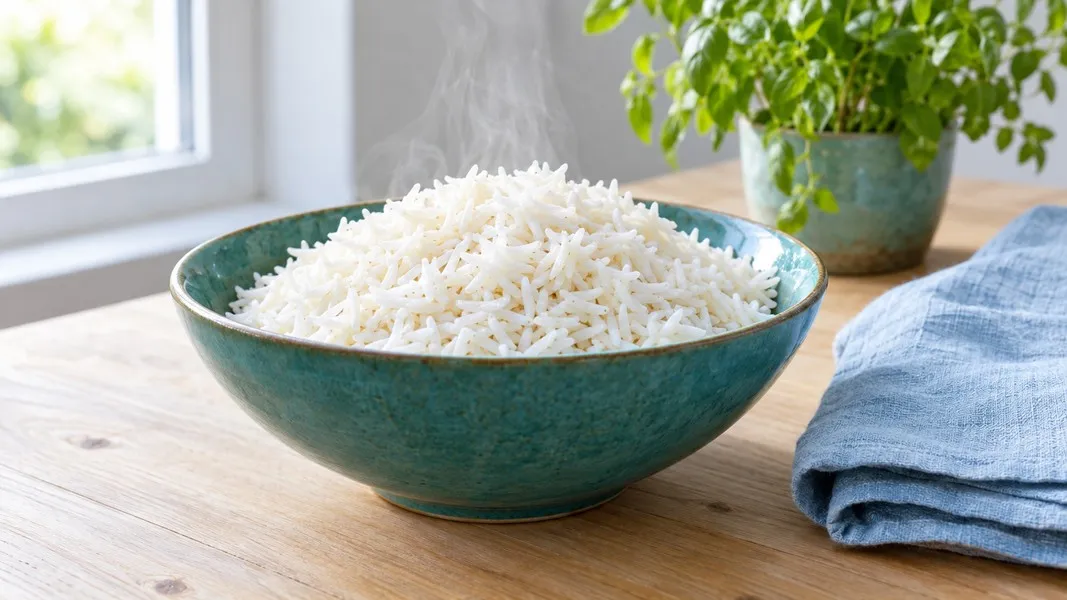
The calories in 1 cup of rice depend first on whether the rice is cooked. One cup of cooked long-grain white rice is about 205 calories, while one cup of the same rice uncooked is about 675 calories, more than three times as much. Both figures come from the standard reference data in USDA FoodData Central, and the gap between them is where most rice calorie mistakes start.
If your food diary has ever shown a bowl of rice at 600 calories, or a whole pot at 300, you have met this problem. The rice did not change. The entry did. This guide gives you the figures by type, per cup and per 100 g, explains why the numbers drift, and shows how to log rice from what you actually cooked.
Calories in 1 Cup of Rice, Cooked and Uncooked
A cup of cooked rice holds far fewer calories than a cup of dry grain, because most of what fills the cooked cup is water. The table below uses the USDA standard reference entries, with the cup weights USDA lists for each one.
| Rice type | 1 cup cooked | 1 cup uncooked |
|---|---|---|
| Long-grain white, enriched | 205 kcal (158 g) | 675 kcal (185 g) |
| Long-grain brown | 248 kcal (202 g) | 679 kcal (185 g) |
| Short-grain white, enriched | 242 kcal (186 g) | 716 kcal (200 g) |
| Long-grain white, parboiled | 194 kcal (158 g) | not listed |
| Glutinous (sticky) white | 169 kcal (174 g) | not listed |
| Wild rice | 166 kcal (164 g) | 571 kcal (160 g) |
The cooked figures are the ones most people need, because a cup of rice on a plate is almost always cooked rice. The uncooked column matters when you portion dry rice into a pot and want to know what the whole batch carries.
Jasmine, basmati and other rices
Jasmine and basmati do not have their own rows in that reference data. Both are long-grain white rices, so the long-grain white row is the closest match. A package label is the better source for a specific brand, since it reflects that product.
If you want the cup weights on their own, without the calories, the companion guide to a cup of rice in grams covers medium-grain rice and the conversion between dry and cooked cups.
Calories in Rice per 100 g
Per 100 g, the picture changes. Brown rice carries 248 calories in a cooked cup against 205 for white, yet per 100 g it is the lower of the two.
| Rice type | Per 100 g cooked | Per 100 g uncooked |
|---|---|---|
| Long-grain white, enriched | 130 kcal | 365 kcal |
| Long-grain brown | 123 kcal | 367 kcal |
| Short-grain white, enriched | 130 kcal | 358 kcal |
| Long-grain white, parboiled | 123 kcal | 374 kcal |
| Glutinous (sticky) white | 97 kcal | 370 kcal |
| Wild rice | 101 kcal | 357 kcal |
The uncooked column sits in a narrow band, 357 to 374 calories per 100 g. Dry rice is mostly starch, and dry rices have broadly similar calories.
The cooked column spreads out more, from 97 to 130 calories per 100 g. That spread comes mostly from water. A grain that soaks up more water while it cooks carries fewer calories in each 100 g of the finished rice.
So the brown rice puzzle has a plain answer: a cup of cooked brown rice is heavier, at 202 g against 158 g, which is why it carries more calories per cup and fewer per 100 g. When you compare rice types, compare them per 100 g, or you are partly comparing how tightly a cup packs.
Why Your Rice Calories Look Wrong
Rice is one of the easiest foods to log badly, and the reasons are mechanical rather than careless. Three of them account for most of the drift.
Raw and cooked entries get swapped
Food databases list rice both ways, often with near-identical names. Pick "rice, white, long-grain" without checking the word "cooked", and a 100 g serving of cooked rice gets logged at 365 calories instead of 130. A cooked cup logged against the raw entry jumps from 205 to 675.
The reverse mistake is just as common. Someone measures 100 g of dry rice, cooks it, eats all of it and logs 100 g against the cooked entry. That records 130 calories for rice that carried about 365.
Water changes the weight, not the energy
Cooking adds water and water carries no calories. The calories in the pot are the calories that went into it dry.
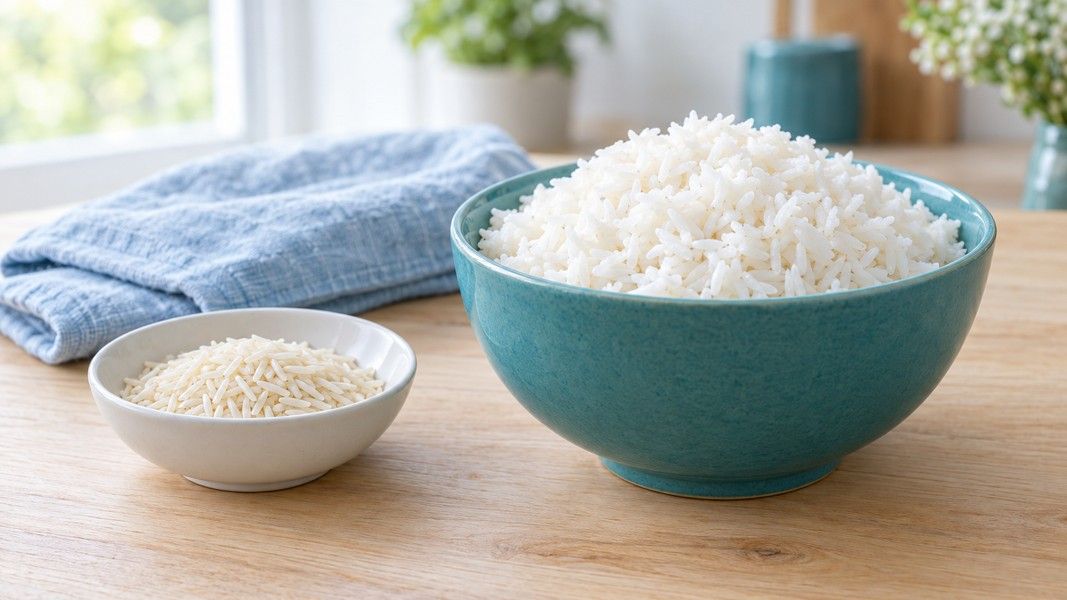
The USDA pair for long-grain white rice shows the scale of it. Dry rice has 365 calories per 100 g and cooked rice 130, so 100 g of dry grain has to become roughly 280 g of cooked rice to spread those calories that thin. Your pot may land higher or lower. Cook it longer, add more water or rinse it differently, and the cooked weight shifts, while the calories stay where they were.
That is also why one cup of dry rice does not turn into a fixed number of cooked cups. The usual rule of thumb is about three. On the USDA figures, 675 calories of dry grain divided by 205 calories per cooked cup comes to a little over three cups, and your stove may make it 2.8 or 3.4.
A cup is a volume
A cup measures space, not grams. Rice spooned loosely into a cup and rice pressed down with the back of a spoon can differ by a good share of the cup. The USDA figure for a cooked cup assumes a typical fill, and your scoop may not match it.
Restaurant and takeaway portions add a further problem. A side of rice is rarely a level cup, and a fried rice or a pilaf carries oil or butter that a plain-rice entry does not include.
How to Log Rice Calories From What You Cooked
The steadiest method is to count calories from the dry rice and divide by the cooked weight. It sidesteps the water problem entirely, because the dry figure does not depend on how you cooked it.
Here is how it works with a kitchen scale and one batch of long-grain white rice:
- Measure the dry rice in grams before it goes in the pot, say 200 g. At 365 calories per 100 g, the batch carries about 730 calories.
- After cooking, put the whole pot of rice on the scale, minus the pot's own weight. Say it comes to 560 g.
- Divide: 730 calories across 560 g is about 130 calories per 100 g of this batch, and a 250 g plate is about 326 calories.
With a scale for the dry rice but none at the table, portion the cooked rice by share instead. If the whole batch carried 730 calories and you served a third of the pot, your plate is about 243 calories.
When you have no scale at all, use the cooked cup figures from the first table and be honest about the fill. A level cup of cooked long-grain white rice is about 205 calories; a heaped serving spoon is not a cup. Our guide on how to estimate calories from photos covers what to expect when a picture is all you have.
Picking the right database entry
When you search a food diary, read the full name of the entry before you add it. Look for the words "cooked" or "uncooked", "dry" or "raw", and check the grain type. If an entry gives about 130 calories per 100 g for white rice, it is cooked. If it gives about 365, it is dry.
Does Cooling Rice Lower Its Calories?
A popular claim says that cooking rice, cooling it and reheating it cuts its calories sharply. The research behind it measured something narrower.
A 2015 study published in the Asia Pacific Journal of Clinical Nutrition tested cooled white rice against freshly cooked rice. Fresh rice had 0.64 g of resistant starch per 100 g. Rice cooled for 10 hours at room temperature had 1.30 g, and rice cooled for 24 hours at 4 °C and then reheated had 1.65 g. In 15 healthy adults, the cooled and reheated rice produced a lower blood glucose response than the fresh rice.
The study measured resistant starch and glucose response. It did not measure calories. The change it found is about 1 g of resistant starch in every 100 g of rice, while 100 g of cooked white rice holds about 28 g of carbohydrate in the USDA data.
For a calorie log, cooled rice goes in at the same figure as fresh rice. The cooling effect is real, but it is small next to the difference between a level cup and a heaped one, and far smaller than the gap between a raw and a cooked entry.
Estimating Rice Calories From a Photo
A photo cannot see water content or how firmly rice was packed, so a photo estimate of rice is a starting point rather than a reading. Recent research gives a sense of where these estimates go wrong.
In a study presented at the American Society for Nutrition's 2026 meeting, researchers at the National Institutes of Health ran photos of 102 meals through four calorie apps. All four underestimated calories by about 250 to 345 per meal on average, and fat by about 30 g. They estimated carbohydrates more consistently than the other macronutrients.
That pattern suits plain rice better than most foods. Rice is mostly carbohydrate, and the hard part is portion size, which a photo can approximate from the size of the mound against the plate. Fried rice, buttered rice or rice cooked in stock is harder, because the fat that adds calories is the part a photo shows least.
Where a photo estimate helps
Primo Scale's Calorie Estimator gives estimated calories and macros for a plate or meal from one photo, drawing on USDA reference data. It shows its reasoning beside the result, so you can compare what it assumed with what you know about the dish.
If you cooked the rice yourself, the dry-weight method above will beat any photo. A photo estimate from Primo Scale earns its place when you did not cook the meal, such as a takeaway box or a friend's dinner, and a rough figure is better than none.
The Short Version
One cup of cooked long-grain white rice is about 205 calories, and one cup uncooked is about 675. Per 100 g, cooked white rice is about 130 calories and dry rice about 365. Brown rice has more calories per cup because its cup is heavier, and fewer per 100 g.
Most rice calorie errors come from mixing raw and cooked entries, from water changing the weight, and from cups that are not level. Counting from the dry rice and dividing by the cooked weight avoids all three. Cooling and reheating rice raises its resistant starch a little, but not enough to change the figure you log.