Chicken breast calories come to 120 per 100 grams raw and 165 per 100 grams roasted, for boneless, skinless meat. The cooked figure is higher because the same meat has lost water, not because cooking adds calories.
That one fact explains most of the confusion around this question. A 4 ounce serving can mean about 136 calories or about 186, depending on whether the meat was raw or cooked when it was measured. Skin, breading and the oil in the pan move the number further.
This guide lays out chicken breast calories per 100 grams for every common way of cooking it, then per breast, per 4 ounces and per cup, all from USDA's FoodData Central records. It ends with how to estimate a cooked breast that came with no label.
Chicken breast calories per 100 g, raw and cooked
USDA's raw breast record lists boneless, skinless chicken breast at 120 calories, 22.5 grams of protein and 2.6 grams of fat per 100 grams. There are no carbohydrates.
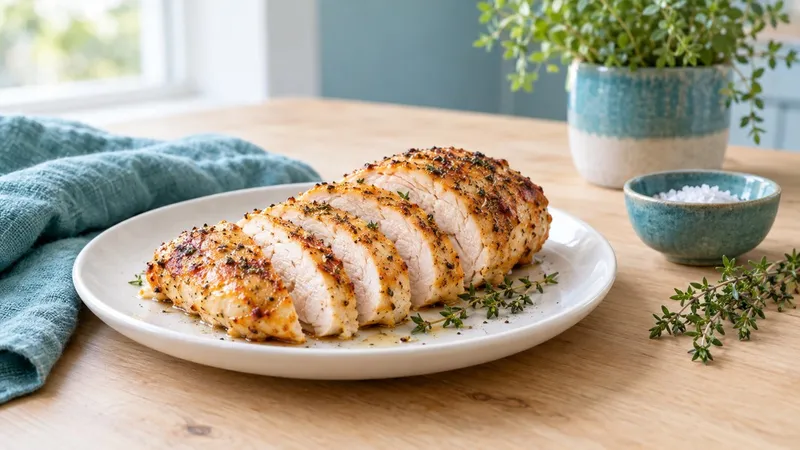
The roasted version of the same meat, in USDA's roasted breast record, comes to 165 calories, 31.0 grams of protein and 3.6 grams of fat per 100 grams. Every figure rises by about the same share, about 37 percent, because what left the meat was water.
Why the cooked number is higher
Raw breast is about three quarters water. Heat pushes part of it out, so 100 grams of raw meat ends up as roughly 72 grams once roasted, the yield USDA measures for this cut. The protein and fat that were in the raw piece are still there, packed into fewer grams.
Run the numbers on that 100 gram raw piece: 72 grams of roasted meat at 165 calories per 100 grams is about 119 calories. Cooking changes the grams on the plate, not the calories in the meat. What it can add is fat from the pan, skin you leave on, or a coating.
Which figure to log
Use the raw figure with a raw weight and the cooked figure with a cooked weight. Mixing them is the most common tracking error with chicken.
A breast that weighed 200 grams raw comes off the pan at about 144 grams. Logged as 144 grams of raw chicken, it reads as 173 calories, about 65 short of the roughly 238 it holds. Logged the other way round, 200 grams at the roasted value, it reads as 330 calories, about 90 too many.
Calories by cooking method
The cooking method changes the figure more than most people expect, mostly through what it adds. The table lists USDA's per 100 gram values for cooked breast, with and without skin.
| Chicken breast, cooked | Calories per 100 g | Protein | Fat |
|---|---|---|---|
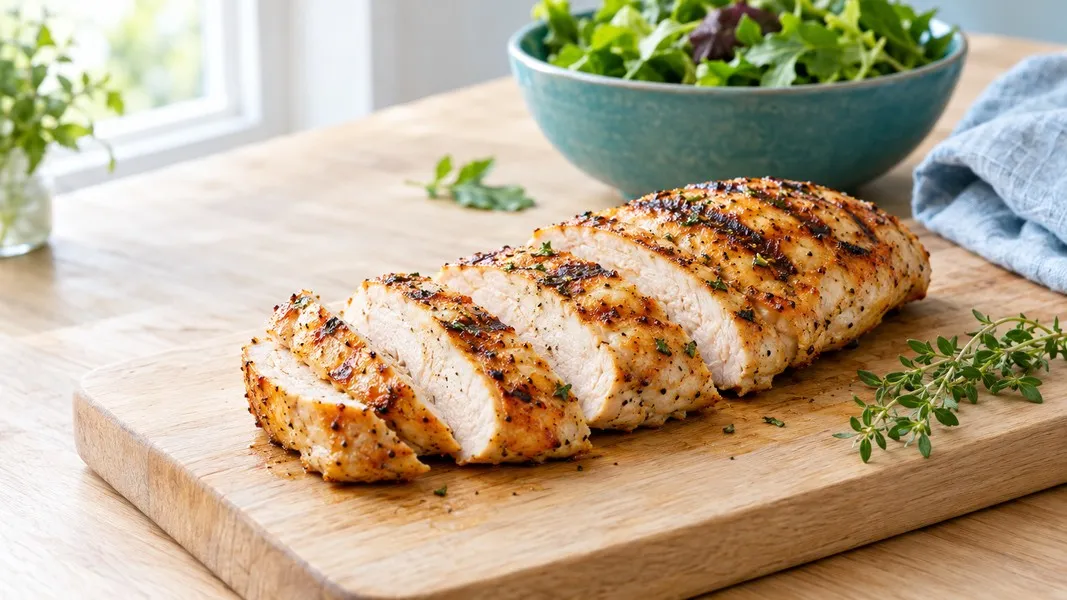
| Grilled, skinless | 151 | 30.5 g | 3.2 g |
| Stewed or poached, skinless | 151 | 29.0 g | 3.0 g |
| Roasted, skinless | 165 | 31.0 g | 3.6 g |
| Fried, skinless, no coating | 187 | 33.4 g | 4.7 g |
| Roasted, with skin | 197 | 29.8 g | 7.8 g |
| Fried in flour, with skin | 222 | 31.8 g | 8.9 g |
| Fried in batter, with skin | 260 | 24.8 g | 13.2 g |
The grilled row comes from USDA's grilled breast record, and the batter row from its batter fried record. The others are the matching USDA records for the same cut.
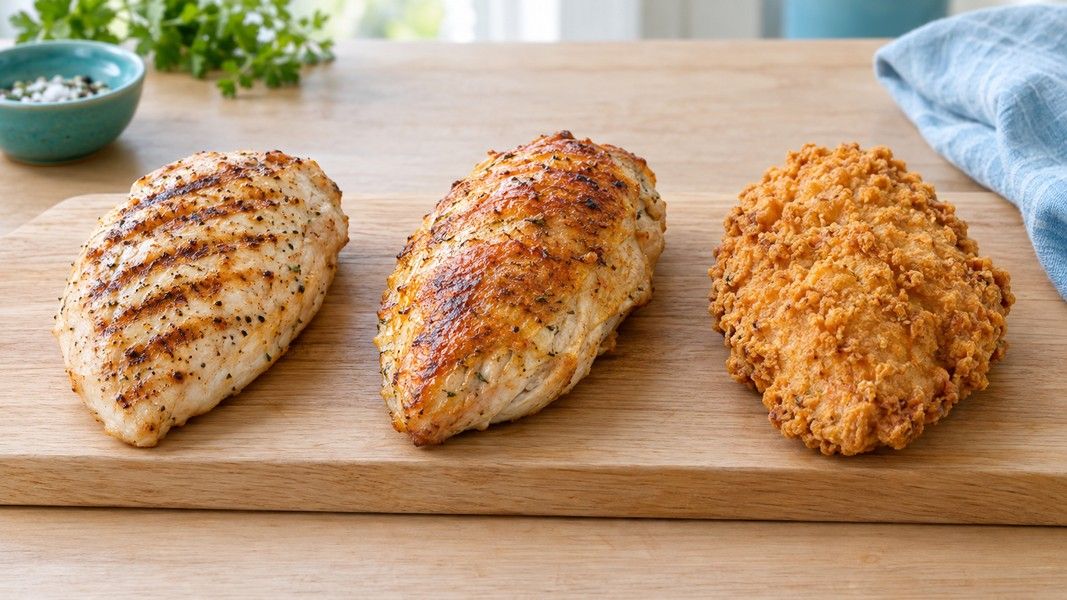
Grilled, poached and roasted
The first three rows sit within 14 calories of each other, and USDA lists braised skinless breast between them at 157. For a skinless breast cooked without added fat, any of them is a fair stand-in for the others.
Fried, with and without a coating
Frying a skinless breast with no coating raises it to 187 calories per 100 grams. Part of that is cooking fat, and part is extra water lost, which the higher protein figure shows. A flour dredge with the skin left on takes it to 222. Batter fried breast reaches 260 calories per 100 grams, about 58 percent more than plain roasted breast, and it is the only row with real carbohydrate, 9 grams, all from the coating.
The protein column moves the other way. Batter fried breast carries the least protein per 100 grams, because a share of every bite is coating and oil rather than meat.
Skin-on vs skinless chicken breast
Skin is where most of the fat in a chicken breast sits. Raw breast with skin has 172 calories per 100 grams in USDA's records, against 120 for the meat alone, a rise of about 43 percent.
Cooking narrows that gap in USDA's figures. Roasted breast with skin comes to 197 calories per 100 grams, about 19 percent more than roasted skinless breast at 165. Fat more than doubles, from 3.6 grams to 7.8.
If you remove the skin after cooking
Cooking a breast with its skin on and taking the skin off before eating removes most of what separates the two rows, so the skinless figures are the closer match for what you ate.
The reverse is the case to watch. A rotisserie or roast chicken breast eaten with the skin should be logged with the skin-on figures, since that is where the extra calories are.
Calories in one chicken breast
A calorie figure "per breast" depends on the size of the breast, and supermarket breasts range from well under 200 grams to about 300 grams raw. Our guide to the average chicken breast weight covers those sizes in detail, along with the calories for each raw size.
USDA's own portions describe a smaller, older reference: half of the bird's breast, which is what a shop sells as one breast. Its cooked weights and calories by method are below.
| One USDA half breast, cooked | Cooked weight | Calories |
|---|---|---|
| Roasted, skinless | 86 g | about 142 |
| Stewed, skinless | 95 g | about 143 |
| Fried, skinless, no coating | 86 g | about 161 |
| Roasted, with skin | 98 g | about 193 |
| Fried in flour, with skin | 98 g | about 218 |
| Fried in batter, with skin | 140 g | about 364 |
Scaling to a modern breast
Most breasts on sale today are bigger than USDA's reference half. A 200 gram raw fillet carries about 240 calories, and roasted it comes off at about 144 grams and still about 238 calories. A 272 gram fillet, USDA's raw reference piece, carries about 326.
The quickest scaling rule is the ratio of cooked weights. A roasted skinless breast twice the size of USDA's 86 gram portion holds about twice the 142 calories, roughly 285. The batter fried row scales the same way, so a large breaded breast passes 600 calories with no sauce on it.
Calories in 4 oz of chicken breast
Four ounces is the portion most labels and food diaries use, and it is where the raw and cooked figures part the most.
A 4 oz raw serving, 113 grams, has about 136 calories and 25 grams of protein. A 4 oz cooked serving of roasted skinless breast has about 186 calories and 35 grams of protein. Same weight on the scale, about 50 calories apart, because the cooked portion started as about 157 grams of raw meat.
Which 4 oz the pack label means
The nutrition panel on a pack of raw chicken describes the meat as it is sold. Federal rules require meat and poultry labels to state the serving size as packaged, as the Federal Register rule on meat and poultry labels sets out, so the 4 oz on a raw pack is 4 oz of raw meat.
That makes the label figure right for a raw weight and too low for a cooked one. If you measure your portion after cooking, use a cooked value rather than the number printed on the tray.
Packs marked "with added solution" hold a salt and water mix injected into the meat. USDA lists that raw meat at 108 calories per 100 grams instead of 120, because part of the weight is the solution.
3 oz and other common portions
The 3 oz cooked portion many guides use, 85 grams, comes to about 140 calories for roasted skinless breast. The table puts the common portions side by side.
| Portion | Grams | Raw, skinless | Roasted, skinless | Roasted, with skin |
|---|---|---|---|---|
| 100 g | 100 g | 120 | 165 | 197 |
| 3 oz | 85 g | about 102 | about 140 | about 167 |
| 4 oz | 113 g | about 136 | about 186 | about 223 |
| 6 oz | 170 g | about 204 | about 281 | about 335 |
| 1 cup, diced cooked | 140 g | not used | about 231 | about 276 |
Calories in a cup of chicken breast
Recipes for salads, soups and casseroles often measure cooked chicken by the cup. USDA puts one cup of chopped or diced cooked breast at 140 grams for roasted and stewed meat alike.
That cup comes to about 231 calories and 43 grams of protein for roasted skinless breast, and about 211 calories for stewed. With the skin chopped in, a roasted cup reaches about 276.
Diced vs shredded
A cup is a volume, so how the chicken fills it matters. Diced cubes leave gaps between them; shredded chicken packed down leaves fewer, and a firmly pressed cup can hold more meat than USDA's 140 grams. Treat a cup figure as a starting point and note how loosely the meat sat in the cup.
What the plate adds
The meat is often the smaller part of the calorie count on a chicken dish. Three additions account for most of the difference between a figure from a table and the plate in front of you:
- Oil. A tablespoon of olive oil is 13.5 grams and about 119 calories by USDA's record; a teaspoon is about 40. Some of it stays in the pan, and some ends up on the meat.
- Coating. Flour, breadcrumbs or batter add their own calories and soak up frying oil, which is why the batter fried row sits so far above the rest.
- Sauce. Glazes, creamy sauces and dressings sit on top of the meat and rarely appear in a "chicken breast" figure at all.
When you log a cooked chicken dish, count the breast from the tables above and add each of these on top. Our guide to estimating restaurant meal calories walks through the same split for a whole plate.
Estimating chicken breast calories from a photo
Without a label or a kitchen scale, the usual route is to guess the weight first and convert it. A cooked portion the size of a deck of cards is about 85 grams, close to 140 calories for plain roasted breast. A breast that fills a dinner plate's width is in the large range and could be twice that.
Primo Scale's Calorie Estimator works from one photo of the plate. It identifies the foods, draws on USDA reference data and returns estimated calories and macros for the meal, with its reasoning shown beside the result.
If you want the grams first, its Weight Estimator returns a typical figure with a likely range. Primo Scale does not weigh objects or use phone sensors. It estimates a likely range from visual analysis and reference data. Oil absorbed into the meat and sauce under the surface are hard to see in any photo, so treat the result as an estimate, and use a kitchen scale when the numbers have to hold.
Key takeaways on chicken breast calories
Boneless, skinless chicken breast has 120 calories per 100 grams raw and 165 roasted; the rise is lost water, not added energy. Match raw values with raw weights and cooked values with cooked weights, because mixing them shifts the count by about a quarter or more.
Grilled, poached, braised and roasted breast all fall between 151 and 165 calories per 100 grams. Skin raises roasted breast to 197, and batter frying takes it to 260.
A 4 oz raw serving has about 136 calories, a 4 oz cooked serving about 186, and the label on a raw pack describes the raw meat. Oil, coating and sauce often add more than the size of the breast itself, so they belong in the count on their own lines.