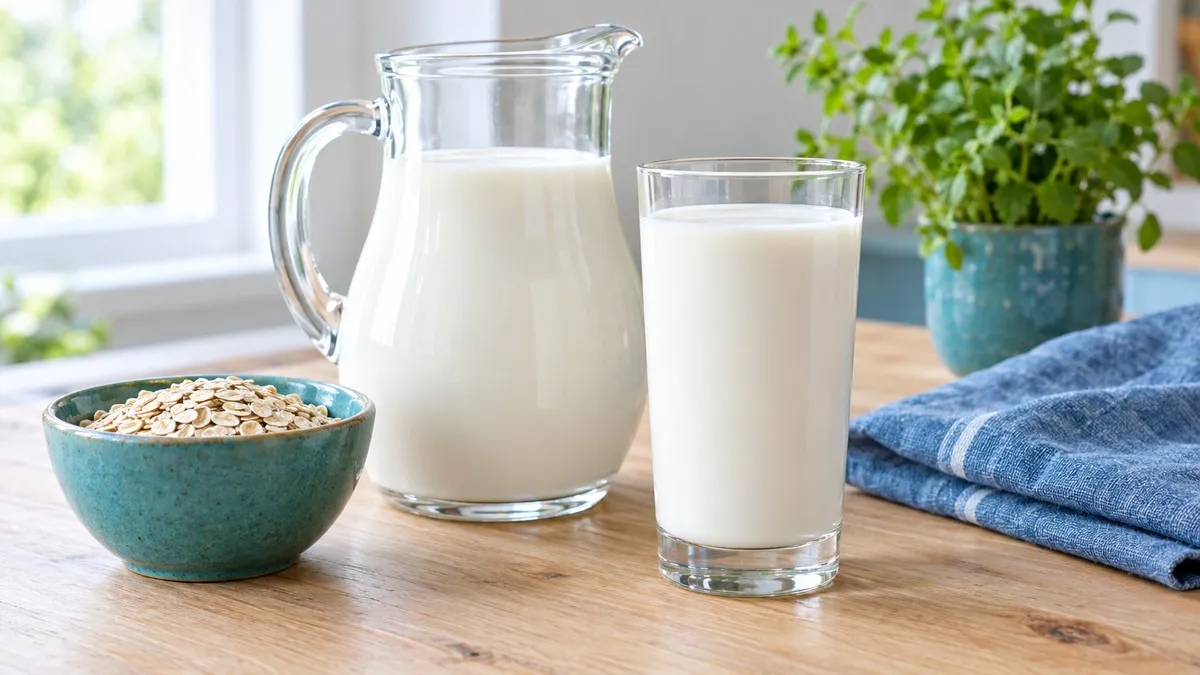
One US cup of whole milk is about 244 grams, and 2% milk is the same. Skim and buttermilk come in at about 245 grams, so for everyday cooking you can treat 1 cup of milk in grams as roughly 245 g whatever the carton says on the front. The figure that changes a recipe is not the type of milk but the size of the cup.
That is why one site says 227 g, a nutrition label implies 240 ml, and an Australian recipe works from 250 ml. Below you will find the figure for each kind of milk, where those other numbers come from, a step-by-step conversion, and a table for every cup fraction a recipe is likely to ask for.
1 Cup of Milk in Grams by Type of Milk
The reference figures come from the USDA nutrient tables, which list a gram weight for one US cup of each milk. The NIH calcium table, drawn from the USDA National Nutrient Database, shows the same portions side by side.
| Milk | Grams in 1 US cup | Source |
|---|---|---|
| Whole milk, 3.25% | 244 g | USDA |
| 2% reduced fat | 244 g | USDA |
| 1% low fat | 244 g | USDA |
| Skim (fat free) | 245 g | USDA |
| Buttermilk, low fat or whole | 245 g | USDA |
| Evaporated milk | 252 g | USDA |
| Sweetened condensed milk | about 312 g | King Arthur, 78 g per 1/4 cup |
| Soy milk | 243 g | USDA |
| Almond milk, unsweetened, shelf stable | 262 g | USDA |
| Canned coconut milk | 226 g | USDA |
The fresh dairy milks sit within one gram of each other. Removing fat makes milk very slightly denser, which is why skim lands a gram above whole, but no home recipe will notice a gram.
Where the whole milk figure comes from
The FoodData Central entry for whole milk lists 1 cup as 244 g, 1 tablespoon as 15 g, 1 fluid ounce as 30.5 g and 1 quart as 976 g. Those four numbers agree with each other: a quart is four cups, and four times 244 is 976. The 2% entry carries the same cup and quart weights.
Why Charts Say 227, 240, 244 or 250 Grams
If you have searched this before, you have probably seen four different answers. Each one is right for its own assumption, and knowing which assumption a recipe makes tells you which figure to use.
The fluid ounce trap
A US cup holds 8 fluid ounces. A fluid ounce is a volume, and an ounce on a scale is a mass, but the two share a name. The King Arthur chart lists fresh milk and buttermilk as 1 cup, 8 ounces, 227 grams, which treats the 8 fluid ounces as 8 ounces of mass.
For a baker that rounding is convenient and the recipes on that site are written around it. If you are converting a recipe from King Arthur, use 227 g, because that is the number its author used. If you are converting anything else, 244 g is closer to what a full US cup of milk holds.
US, label and metric cups
There are three cup sizes in common use. A US customary cup is about 236.6 ml. For nutrition labels, the FDA rule in 21 CFR 101.9 defines a cup as 240 ml, a tablespoon as 15 ml and a teaspoon as 5 ml. Australian recipes use a 250 ml metric cup.
Milk's density is what turns any of those volumes into grams. The FAO/INFOODS density database lists liquid whole milk at 1.030 to 1.031 g per ml and skimmed milk at 1.033 to 1.036 g per ml, with a single figure of 1.03 g per ml covering whole, semi-skimmed and skimmed milk. Multiply each cup by 1.03 and you get:
| Cup | Volume | Milk in grams, at 1.03 g/ml |
|---|---|---|
| US customary cup | 236.6 ml | about 244 g |
| US nutrition label cup | 240 ml | about 247 g |
| Metric cup (Australia) | 250 ml | about 258 g |
A metric cup of milk holds about 14 g more than a US cup, which is close to an extra tablespoon. In a cake that uses two cups, that is a difference of nearly two tablespoons of liquid.
What You'll Need
You need very little to turn a cup measure into grams, and most of it is already in your kitchen:
- The recipe, and a note of where it was written, so you know which cup it means
- The type of milk you are using, read from the carton or can
- A kitchen scale, if you want to measure by mass from now on
- A liquid measuring cup with a spout, if you are staying with volume
How to Convert a Cup of Milk to Grams, Step by Step
The conversion takes under a minute once you know the two inputs: the cup size and the milk.
- Find out which cup the recipe uses. An American recipe means a US cup. An Australian recipe means 250 ml. A recipe from a brand's test kitchen may state its own cup weight, as King Arthur does with 227 g.
- Identify the milk. Fresh whole, 2%, 1% and skim milk all count as about 244 to 245 g per US cup. Evaporated milk, condensed milk and plant milks need their own figure from the table above.
- Multiply by the cup fraction. Half a cup of whole milk is 244 divided by 2, so 122 g. Three quarters of a cup is 183 g.
- Round to what your recipe can feel. A sauce or a pancake batter will not notice a few grams, so 120 g for half a cup is fine. A custard or an enriched bread dough deserves the full figure.
- Measure it. Set a jug on the kitchen scale, zero it, and pour until the display reads your target. If you stay with a cup, read it at eye level on a flat counter, since a cup held in the hand tilts.
- Write the gram figure into the recipe. Next time you skip the conversion, and the result is the same from batch to batch.
Skipping the arithmetic
If you would rather not do the arithmetic, the cups to grams converter on this site covers milk alongside flour, sugar and other staples.
Grams in 1/2, 1/4, 3/4 and Other Cup Fractions
These figures scale the USDA value of 244 g per US cup for whole, 2% and 1% milk. For skim or buttermilk, add about half a gram per quarter cup, which rounds away.
| Amount | Whole or 2% milk | Metric cup equivalent, 250 ml |
|---|---|---|
| 1 tablespoon | 15 g | about 21 g, in a 20 ml tablespoon |
| 1/4 cup | 61 g | about 64 g |
| 1/3 cup | 81 g | about 86 g |
| 1/2 cup | 122 g | about 129 g |
| 2/3 cup | 163 g | about 172 g |
| 3/4 cup | 183 g | about 193 g |
| 1 cup | 244 g | about 258 g |
| 2 cups | 488 g | about 515 g |
The tablespoon differs too: a US tablespoon is about 15 ml, while an Australian tablespoon is 20 ml, so a tablespoon of milk in an Australian recipe is about 21 g. Half a cup of milk in grams is the conversion people look up most after the full cup, and for a US recipe it is 122 g.
Going the other way, grams to cups
To turn grams back into US cups, divide by 244. A recipe that asks for 100 g of milk wants about 0.41 cups, a little less than half a cup. For 200 g, you want about 0.82 cups, or a scant 3/4 cup plus a tablespoon.
Plant Milks, Buttermilk and Canned Milk
Non-dairy and processed milks are where the dairy rule of thumb stops working, because their density depends on what is dissolved or suspended in them.
Soy, almond and coconut milk
The USDA lists soy milk at 243 g per cup across original, vanilla, light and unsweetened versions, so it behaves much like dairy milk. Unsweetened shelf-stable almond milk is listed at 262 g per cup, while the chocolate almond milk entry is 240 g per cup. That spread is wider than the dairy milks, so for almond milk the brand matters more than the category.
Coconut milk splits in two. The USDA's coconut milk beverage, the carton kind made to pour on cereal, is listed at 240 g per cup. Canned coconut milk, pressed from grated coconut, is listed at 226 g per cup, lighter because of its fat content. If a curry recipe asks for a cup of coconut milk, it almost always means the canned kind.
The USDA reference tables cited here have no oat milk row, so this post gives no oat milk figure. If a recipe depends on it, measure your own carton once on a kitchen scale and keep the number.
Buttermilk
Buttermilk is listed at 245 g per cup by the USDA, the same as skim. The FAO/INFOODS database gives it a density of 1.022 g per ml. King Arthur uses 227 g, for the same fluid-ounce reason as its fresh milk figure.
Evaporated and sweetened condensed milk
Canned milks are denser because water has been removed. Evaporated milk is 252 g per cup in the USDA table, and FAO/INFOODS lists its density at 1.07 g per ml. Sweetened condensed milk is heavier still: King Arthur gives 78 g per quarter cup, which is about 312 g for a full cup. The sugar is what pushes it up.
Calories in a Cup of Milk by Type
The calories follow the fat, not the volume. Using the USDA energy values per 100 g and the cup weights above:
| Milk | Grams per cup | Calories per cup |
|---|---|---|
| Whole, 3.25% | 244 g | about 149 kcal |
| 2% reduced fat | 244 g | about 122 kcal |
| Skim | 245 g | about 83 kcal |
Whole milk is 61 kcal per 100 g, 2% is 50 kcal and skim is 34 kcal, so a cup of whole milk carries close to twice the energy of a cup of skim.
Milk inside a meal is harder to pin down than milk in a measuring cup. The Calorie Estimator in Primo Scale estimates the calories and macros of a bowl of cereal or a plate from one photo, but milk under cereal or stirred into coffee is partly hidden, so treat that figure as an estimate and log the milk separately when the number matters to you.
Tips for Better Results
Most errors with milk come from the cup rather than from the conversion. These habits remove the common ones:
- Use a liquid measuring cup with a spout and a line below the rim, not a dry cup filled to the brim, which spills and reads short
- Shake cartons of plant milk and cans of coconut milk before measuring, since the solids settle and the first pour is thinner than the last
- For canned evaporated or condensed milk, scrape the can, because a quarter cup of condensed milk left on the sides is about 78 g missing from the recipe
- Keep one gram figure per milk you buy regularly, written inside a cupboard door or in the recipe margin
The same reasoning applies to dry ingredients, where the spread is much wider. Flour varies by tens of grams per cup depending on how it is scooped, which the guide to cups of flour in grams covers in detail.
Troubleshooting Common Issues
My batter came out too thin
Check whether the recipe was written for a metric cup and you used a US one, or the other way round. A metric cup holds about 14 g more milk, and in a recipe with three cups of liquid that adds up to roughly 40 g. Swap in the gram figure from the recipe's own country.
My scale and my cup disagree
A US cup filled to the line should land close to 244 g of whole milk. If yours reads 225 to 230 g, the cup is probably not filled to the line, or it is a cup sold for dry ingredients. If it reads around 255 g, it may be a metric cup. Both are common in mixed kitchen drawers.
The recipe says ounces, not cups
If the ounces are fluid ounces, 8 of them are one US cup, about 244 g of milk. If the ounces are on a scale, 8 ounces is 227 g. When a recipe lists milk in ounces with no "fl", look at its other ingredients: if the flour and sugar are also in ounces of mass, the author was using a scale, and 227 g is the safer reading.
Estimating solids alongside the milk
Milk is the easy part of most recipes, because its density barely changes. The ingredients around it, such as fruit, cheese or a whole chicken breast, vary much more from one piece to the next. Primo Scale gives a typical figure and a likely range for food it identifies in a photo, with its reasoning shown beside the result. Primo Scale does not weigh objects or use phone sensors. It estimates a likely range from visual analysis and reference data. For a recipe that depends on a figure to the gram, a real kitchen scale is the tool.
If your recipe also lists sugar in cups, its weight changes a lot by type, as the guide to grams in a cup of sugar shows.
The Takeaway
One US cup of whole, 2% or 1% milk is about 244 g, and skim or buttermilk is about 245 g. Half a cup is 122 g and a tablespoon is 15 g. A 250 ml metric cup holds about 258 g, and King Arthur's recipes use 227 g because they treat 8 fluid ounces as 8 ounces of mass.
Plant and canned milks need their own figures: soy milk 243 g, unsweetened almond milk 262 g, carton coconut milk 240 g, canned coconut milk 226 g, evaporated milk 252 g and sweetened condensed milk about 312 g per cup. Match the gram figure to the cup your recipe was written for, and the type of milk becomes a detail.