The calories in oats come to 379 per 100 g dry, which puts a half cup of dry rolled oats at about 150 calories and a cup of oatmeal cooked with water at about 166. All three numbers are correct, and they are also why oatmeal is one of the most confusing foods to log. One label counts the oats before cooking, another counts the porridge after it, and neither counts the milk, honey or peanut butter that usually go on top.
This guide sorts that out. You get the USDA figures for dry and cooked oats, what a "cup" means in each case, how rolled, quick and steel cut oats compare, and what each kind of milk and topping adds. A worked bowl near the end shows how far the total can move with the same scoop of oats.
Calories in Oats per 100 g and per Serving, Dry
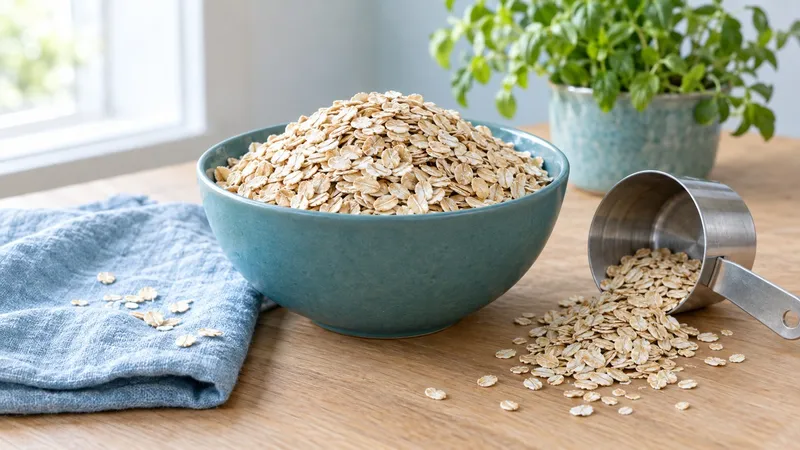
Start with dry oats, because that is what every package label describes. In the USDA record for regular dry oats, which covers both old fashioned and quick oats, 100 g carry 379 calories, and a level cup comes to 81 g.
| Dry oats | Grams | Calories |
|---|---|---|
| 1 cup | 81 g | 307 |
| 1/2 cup | about 40 g | about 150 |
| 1/3 cup | 27 g | 102 |
| 1/4 cup | about 20 g | about 77 |
| 100 g | 100 g | 379 |
The Quaker Old Fashioned label lands in the same place: one serving is 1/2 cup dry, 40 g, with 150 calories, 27 g of carbohydrate, 4 g of fiber and 5 g of protein. A half cup of dry oats at about 150 calories is the most useful number in this post, because nearly every recipe and every package starts from it.
A cup measure is only as good as the scoop. Oats pressed down into the cup, or a heaped cup, hold more than 81 g, so a level cup is what all of these figures assume.
Why Cooked Oatmeal Calories Look So Much Lower
Cooked with water, USDA's record for cooked oatmeal drops to 71 calories per 100 g. Nothing burned off on the stove. The oats soaked up water, and water adds weight and volume with no calories, so the same calories are spread across far more grams.
The Quaker stovetop directions make the ratio easy to see: one serving is 1/2 cup of oats cooked in 1 cup of water or milk. That 40 g of oats, about 150 calories, comes out of the pan as a full bowl of porridge that weighs several times as much as the dry flakes did.
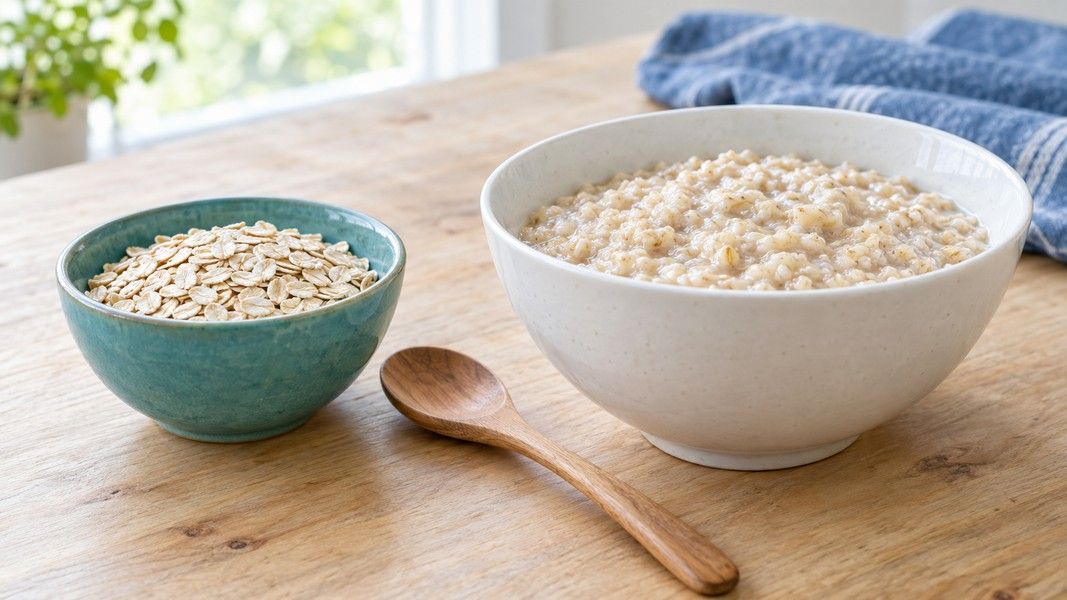
So the rule when you log oatmeal is simple: count the dry oats you poured, not the porridge you ended up with, whenever you know the dry amount. The cooked figure is for the times you only see the bowl. Rice behaves exactly the same way, and the raw versus cooked rice numbers follow the same logic.
Calories in a Cup of Oatmeal: Which Cup?
"How many calories in a cup of oatmeal" has two honest answers, and one is almost double the other.
| One cup of | Grams | Calories |
|---|---|---|
| Dry oats | 81 g | 307 |
| Oatmeal cooked with water | 234 g | 166 |
| 3/4 cup oatmeal cooked with water | 175 g | 124 |
A cup of dry oats holds 307 calories. A cup of cooked oatmeal, 234 g in the USDA record, holds 166. Work the cooked cup back to its oats and it contains roughly 44 g of dry oats, a little more than one half-cup serving.
A cooked cup is also less fixed than a dry one. Porridge cooked thick, with less water, packs more oats into each cupful; porridge cooked thin, with extra water, packs fewer. The 166 figure assumes oatmeal made the standard way, so treat it as a typical value and use the dry measure whenever you have it.
If a recipe or a food diary simply says "1 cup oatmeal", check which one it means before you copy the number. A database entry for cooked oatmeal and a package label for dry oats can sit side by side in the same app, and picking the wrong one moves your log by more than 140 calories for a single cup.
Rolled, Quick and Steel Cut Oats per Serving
All three are the same whole grain, pressed or cut differently, and gram for gram they are close. The difference people notice is in the measuring cup.
Rolled and quick oats share the USDA record above, 379 calories per 100 g, and Quaker lists both its Old Fashioned and its Quick 1-Minute oats at 150 calories per 1/2 cup dry. Steel cut oats are chopped rather than flattened, so they pack much more densely into a cup. Bob's Red Mill lists its quick cooking steel cut oats at 140 calories for 1/4 cup, 36 g.
| Oat type | Label serving | Grams | Calories |
|---|---|---|---|
| Old fashioned rolled, Quaker | 1/2 cup dry | 40 g | 150 |
| Quick 1-minute, Quaker | 1/2 cup dry | 40 g | 150 |
| Quick cooking steel cut, Bob's Red Mill | 1/4 cup dry | 36 g | 140 |
Per 100 g, that steel cut label works out to about 389 calories, within a few percent of rolled oats. A quarter cup of steel cut oats is roughly the same food as a half cup of rolled oats, so scooping a half cup of steel cut by habit gives you about 72 g and close to 280 calories before anything else goes in.
Instant Oatmeal Packets
Flavored instant packets are a separate case. They add sugar and flavorings to the oats, and the amounts differ between flavors and brands, so read the packet itself rather than using any plain-oat figure from this page.
Oatmeal With Milk Calories, Dairy and Plant
Water adds nothing. Milk adds a lot, and the kind of milk decides how much. USDA lists a cup of whole milk at 149 calories, 2% milk at 122 and skim at 83. Plant milks spread even wider: Oatly Original oatmilk lists 120 calories per cup, its unsweetened version 40, and Silk Unsweet almondmilk 30.
| Liquid | Per 1 cup | Per 1/2 cup |
|---|---|---|
| Water | 0 | 0 |
| Whole milk | 149 | about 75 |
| 2% milk | 122 | 61 |
| Skim milk | 83 | about 42 |
| Oatly Original oatmilk | 120 | 60 |
| Oatly Unsweetened oatmilk | 40 | 20 |
| Silk Unsweet almondmilk | 30 | 15 |
Cooked the Quaker way with a full cup of liquid, a half cup of oats comes to about 150 calories with water, about 180 with unsweetened almondmilk, about 233 with skim milk, about 272 with 2% milk and about 299 with whole milk. The liquid can add nearly as many calories as the oats themselves, and it is the part a database figure for cooked oatmeal never includes.
A common middle path is half milk and half water, which halves what the milk adds. Milk poured over the bowl at the table counts too, even when it is only a splash, so estimate it by the spoonful or the half cup rather than leaving it out.
Overnight Oats
Overnight oats are the same oats soaked instead of cooked. Quaker's rolled overnight oats carry the same 150 calories per 1/2 cup, 40 g, as its old fashioned oats, so soaking changes the texture and nothing else. The total depends on what goes into the jar: the milk or yogurt, any seeds, the fruit and the sweetener. Count each one, exactly as you would for a hot bowl.
Toppings That Change the Bowl
Toppings are where an oatmeal estimate usually goes wrong, because they are added by eye and they are dense. USDA's spoon figures for the common ones:
| Topping | Amount | Calories |
|---|---|---|
| Honey | 1 tbsp, 21 g | 64 |
| Maple syrup | 1 tbsp, 20 g | 52 |
| Brown sugar | 1 tsp unpacked, 3 g | 11 |
| Smooth peanut butter | 2 tbsp, 32 g | 188 |
Those are level spoons. A heaped spoon of peanut butter, or honey drizzled straight from the jar, can easily run past them, and a thick spread holds a different weight per spoon than a powder does, as the tablespoon to grams guide explains for butter, sugar and flour.
Nut butters carry the most. Two level tablespoons of peanut butter add more calories than the half cup of oats underneath them, so on a loaded bowl they deserve the most careful estimate of anything you add.
A Worked Example: Same Oats, Two Bowls
Take one half cup of dry rolled oats, about 150 calories, and make two breakfasts from it.
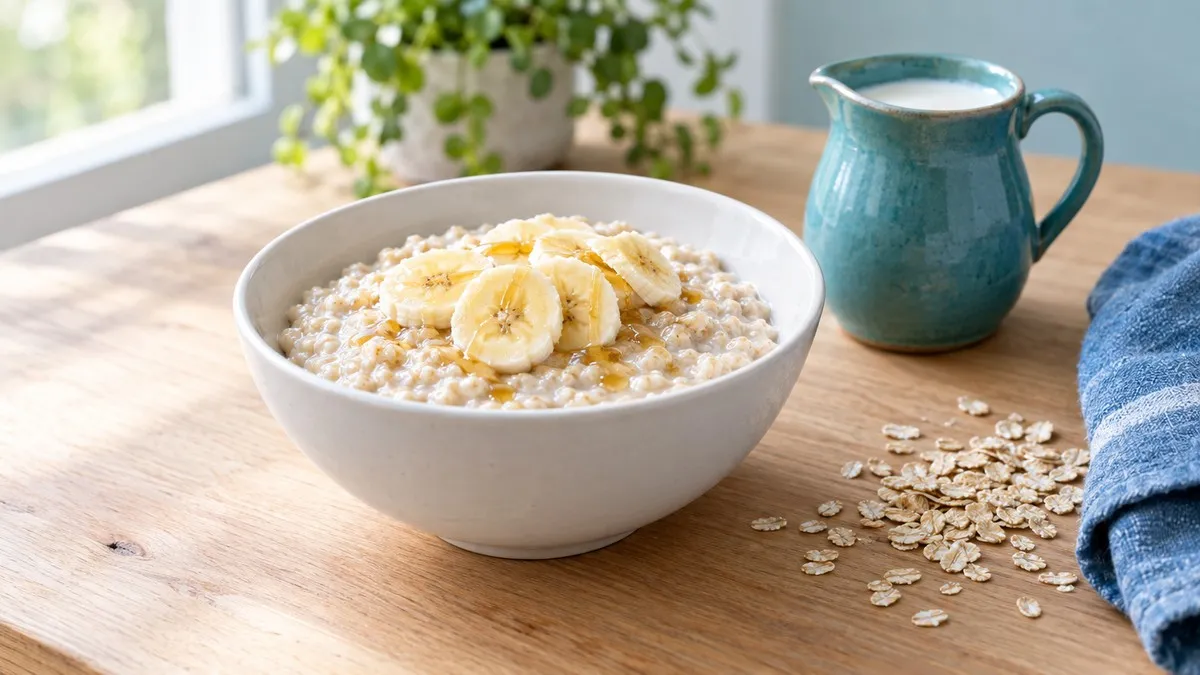
The first is cooked in 1 cup of water and eaten plain: about 150 calories. The second is cooked in 1 cup of 2% milk and finished with 1 tablespoon of honey and 2 tablespoons of peanut butter.
- Oats, 1/2 cup dry: about 150
- 2% milk, 1 cup: 122
- Honey, 1 tbsp: 64
- Peanut butter, 2 tbsp: 188
That second bowl comes to about 524 calories, roughly three and a half times the first, from the same scoop of oats. Log it as "1 cup of cooked oatmeal" from a database entry and you would record 166, missing more than 350 calories without noticing anything odd.
This is the practical fix for oatmeal: log the oats, the liquid and each topping as separate lines, and the confusion between dry and cooked figures stops mattering.
Estimating a Bowl Nobody Measured
At a café, a hotel breakfast or a friend's kitchen you only see the finished bowl. Work it out in the same order. Judge the base first: a pale, loose porridge suggests water, a creamier one suggests milk. Then judge the amount against a typical cereal bowl, and add the toppings one by one, because they carry the most uncertainty. A swirl of peanut butter or a ring of honey is hard to read from above, and a spoonful of sugar stirred in before serving is invisible.
Primo Scale's Calorie Estimator takes one photo of the bowl and returns estimated calories and macros, with its reasoning shown beside the result and USDA reference data behind the food figures. The reasoning is the useful part here: it shows how the estimate was reached, so you can compare it with what you know went into the bowl and correct your own log.
No photo can see what was stirred in, so Primo Scale's figure for a bowl of oatmeal is an estimate to start from rather than a reading. Add the butter, sugar or extra milk you know went in, and use the dry-oat numbers above whenever you made the bowl yourself.
The Oat Numbers Worth Remembering
Dry oats carry 379 calories per 100 g. A half cup dry, about 40 g, is about 150 calories, and a cup of oatmeal cooked with water is about 166, because cooking adds water and no calories.
Rolled and quick oats are the same food by weight. Steel cut oats are close by weight but denser by volume, so a quarter cup of steel cut matches a half cup of rolled.
Milk adds between 30 and 149 calories per cup depending on the kind, and toppings such as peanut butter and honey can add more than the oats themselves. Count the dry oats, the liquid and every topping separately, and oatmeal becomes one of the easier breakfasts to log.