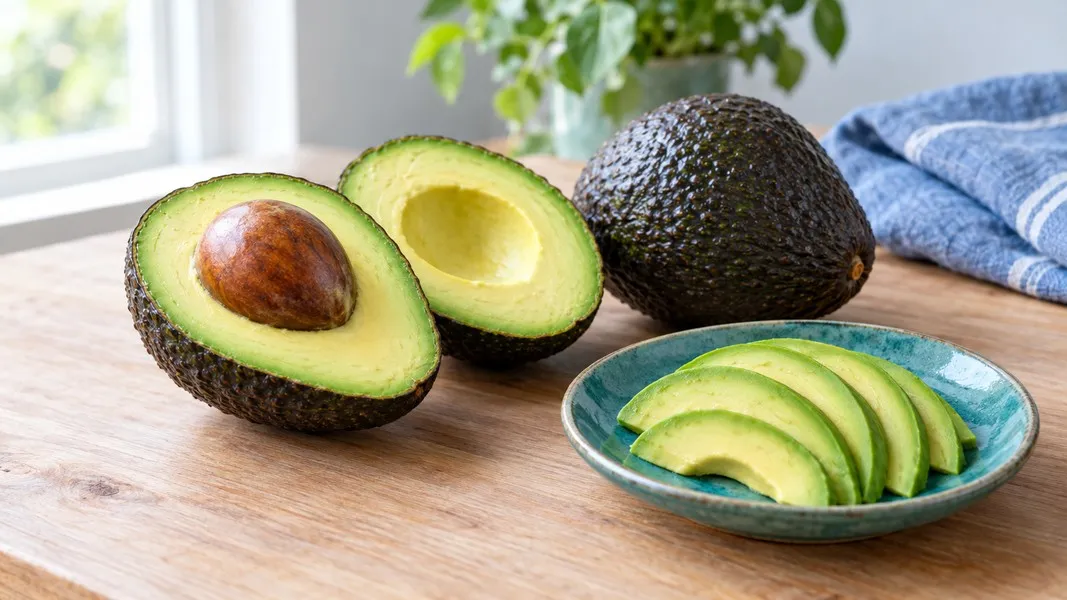
A whole avocado has about 322 calories, based on the USDA's standard avocado of 201 grams of flesh, and half an avocado has about 161. Avocado calories come to 160 per 100 grams of flesh, so the size of the fruit decides almost everything. A typical Hass avocado, the dark, pebbly-skinned kind, has less flesh than that standard fruit and comes to about 227 calories whole.
The single "322 calories" answer hides how much avocados vary. Here is what the USDA data and the avocado industry's own size figures show, in short:
- Size: a small Hass avocado has about 190 calories of flesh and an extra large one about 420, more than double.
- Variety: the large, smooth green Florida avocado has about 365 calories per fruit, yet only 120 per 100 grams, about 28 percent fewer than Hass.
- Portion: a cup of mashed avocado holds about 368 calories, more than one standard whole fruit, because mashing packs the flesh tight.
The sections below give the figures behind each of those, so you can match a number to the avocado on your board.
Avocado calories per 100 grams, by variety
The standard figure comes from the USDA FoodData Central record for raw avocados of all commercial varieties. It lists 160 calories per 100 grams of flesh, and its footnote explains the blend: 86 percent California fruit and 14 percent Florida fruit. Two more records split the varieties apart, and they differ more than most people expect.
| Per 100 g of flesh | All varieties | California (Hass) | Florida |
|---|---|---|---|
| Calories | 160 | 167 | 120 |
| Fat | 14.7 g | 15.4 g | 10.1 g |
| Carbohydrate | 8.5 g | 8.6 g | 7.8 g |
| Fiber | 6.7 g | 6.8 g | 5.6 g |
| Protein | 2.0 g | 2.0 g | 2.2 g |
The California avocado record stands for Hass, which the California Avocado Commission calls the leading variety of California avocado. Its flesh holds 72.3 grams of water per 100 grams. The Florida record holds 78.8 grams, and that extra water is most of the reason a Florida avocado carries fewer calories gram for gram.
Every figure in this post describes the flesh you eat, not the whole fruit with its skin and seed. That distinction matters more for avocados than for almost any other fruit, as the size section shows.
How many calories in an avocado by size
The USDA gives one portion per record: 201 grams of flesh for an avocado of unspecified variety, and 136 grams of flesh for a California avocado without skin and seed. At 167 calories per 100 grams, that Hass avocado comes to about 227 calories. Real avocados sit on both sides of it.
Growers and packers do not sell avocados as small, medium or large. They use size codes, the number of fruit that fill a standard 25-pound carton, as California Avocado Growers explains in its crop estimating guide. A size 60 avocado is one of 60 in the carton, so it averages 400 ounces divided by 60, about 6.7 ounces. The California Avocado Commission describes Hass as running across "a full range from average to large, 5 to 12 ounces", which covers roughly sizes 70 through 32.
Applied to each common size, with the flesh at 71 percent of the whole fruit (explained in the next section) and the Hass figure of 167 calories per 100 grams:
| Hass size code | Whole fruit | Flesh | Calories | Fat |
|---|---|---|---|---|
| 70, small | about 162 g (5.7 oz) | about 115 g | about 193 | 17.8 g |
| 60 | about 189 g (6.7 oz) | about 134 g | about 225 | 20.7 g |
| 48, medium | about 236 g (8.3 oz) | about 168 g | about 281 | 25.9 g |
| 40 | about 283 g (10 oz) | about 202 g | about 337 | 31.1 g |
| 36, large | about 315 g (11.1 oz) | about 224 g | about 374 | 34.5 g |
| 32, extra large | about 354 g (12.5 oz) | about 252 g | about 421 | 38.8 g |
The whole fruit weights are carton averages, so any single avocado of a given code can sit a little above or below them. Retail labels vary too: one store's "large" can be another's medium. The size code is the steadier reference.
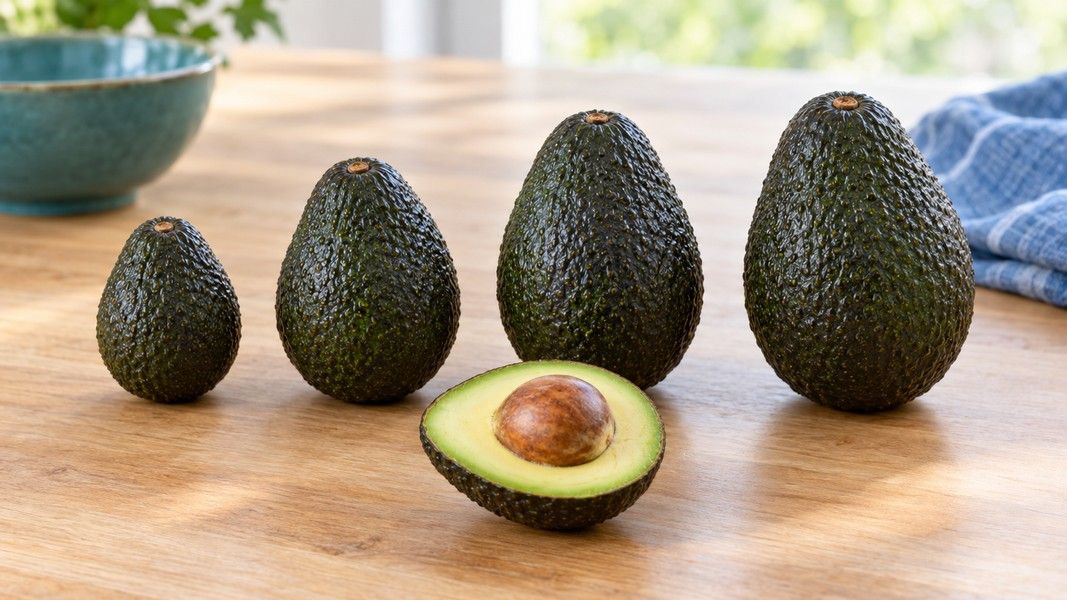
Each step up in size code adds about 30 to 55 calories or a little more, and the gap from small to extra large is about 230. That is the difference between a light topping and a meal's worth of fat, which is why the size is worth noting.
Which size the USDA figures describe
The USDA's 136-gram California fruit lines up with a size 60, and its 201-gram standard avocado with a size 40. The 201-gram figure is the one behind the common "322 calories in an avocado" answer, so that answer describes a fairly large fruit.
Why the skin and seed change the count
Nearly 30 percent of an avocado is not food. The best measured figure comes from a California Avocado Society yearbook study by John S. Shepherd of Calavo Growers. He analyzed packing house records covering more than 225 million pieces of fruit, then measured table-ready Hass and Fuerte avocados piece by piece, separating seed and skin from flesh.
His conclusion: the average California avocado weighed 7.6 ounces (215 grams) whole, and its edible portion weighed 5.4 ounces (153 grams). That puts the flesh at about 71 percent of the fruit. A typical half-avocado serving in the same study came to 2.7 ounces, or 77 grams.
The share varies with the fruit. A large seed takes more of a small avocado, and a thin skin peels closer to the flesh. Seventy percent is a fair working figure, and it explains a common logging mistake: applying the per-100-gram figure to a whole, unpeeled avocado overstates the calories by about 40 percent.
Calories in half an avocado
Half an avocado is the portion most people actually eat, on toast, in a salad or beside eggs. The figure depends on which whole fruit you start from:
| Half of | Flesh | Calories |
|---|---|---|
| A small Hass, size 70 | about 58 g | about 96 |
| The USDA California avocado | 68 g | about 114 |
| A medium Hass, size 48 | about 84 g | about 140 |
| The USDA standard avocado | 100.5 g | about 161 |
| A Florida avocado | 152 g | about 182 |
The Shepherd study's half-avocado serving of 77 grams lands between the USDA California half and the medium Hass half, at about 129 calories using the Hass figure. A quarter of an avocado is half of any of these.
For a typical half Hass on toast, about 115 to 140 calories is a fair range. The bread, butter, egg or oil beside it each needs its own figure.
Avocado calories per cup, slice and serving
Recipes measure avocado in cups and slices rather than fruit. The all-varieties record gives weights for three kinds of cup, and the USDA's survey database adds a slice of 15 grams.
| Portion | Flesh | Calories |
|---|---|---|
| 1 slice | 15 g | about 24 |
| 1 serving, about a third of a medium fruit | 50 g | about 80 |
| 1 cup, sliced | 146 g | about 234 |
| 1 cup, cubed | 150 g | about 240 |
| 1 cup, mashed or pureed | 230 g | about 368 |
The mashed cup holds more than half as much flesh again as the cubed one, because cubes leave air between them. A guacamole recipe that calls for a cup of mashed avocado is asking for one standard avocado and then some, close to two small Hass.
The 50-gram serving is the one on US nutrition labels. The California Avocado Commission describes it as one third of a medium avocado with 80 calories, and the same 50 grams of Hass comes to about 84. Spread across a cup, each tablespoon of mashed avocado is about 14 grams and about 23 calories.
Hass versus Florida avocado calories
Florida avocados, smooth skinned and bright green, look like a different fruit, and nutritionally they nearly are. The Florida avocado record lists one fruit at 304 grams of flesh, more than twice the California fruit, with about 365 calories.
So a whole Florida avocado has more calories than a whole Hass, while each bite has fewer. At 120 calories per 100 grams against 167, the same cup of mashed flesh comes to about 276 calories from Florida fruit and about 384 from Hass.
If a recipe gives the avocado by count, the variety matters. If it gives cups or grams, the Florida fruit is the lighter one. The difference is mostly water and fat: Florida flesh carries 10.1 grams of fat per 100 grams against 15.4 for Hass.
Where avocado calories come from
Unlike most fruit, an avocado gets its calories mainly from fat. In the all-varieties record, fat accounts for about three quarters of the energy, carbohydrate for most of the rest, and protein for a small share. Of the 15.4 grams of fat in 100 grams of Hass, 9.8 grams are monounsaturated.
The carbohydrate figure is mostly fiber. Of the 8.5 grams of carbohydrate in 100 grams of avocado, 6.7 grams are fiber, so the sugar and starch left over are small. A standard 201-gram avocado carries about 13.5 grams of fiber.
That fat content is also why the size matters so much. A gram of fat holds more than twice the energy of a gram of carbohydrate, so an extra 50 grams of avocado flesh adds about as many calories as a small banana.
Estimating an avocado's calories without a scale
Most avocados arrive without a size code on them, so the estimate comes down to judging the fruit. Three things carry most of the information.
- Variety first. Dark, pebbly skin means Hass and the 167 figure. Smooth, bright green and much larger means a Florida type and the 120 figure.
- Then size. Most fruit sits near the middle of the range: the Shepherd study found at least a third of each year’s shipments in the size that includes the average avocado. Start from about 225 to 280 calories for a typical Hass and move up the table for an obviously large one.
- Then the portion. Half, a quarter, or a few slices, using the tables above.
The guide to estimating grams without a scale covers the same reasoning for other foods, with everyday objects to compare against.
Estimating from a photo
Primo Scale works through these steps from one photo. The AI identifies the avocado, estimates its size from the image, with LiDAR depth on iPhones that have it, and compares it with USDA reference data. The Calorie Estimator returns estimated calories and macros, for a single half or for a whole plate with the avocado on it, and the reasoning is shown beside the result, so you can see which size and variety it assumed.
The Weight Estimator gives the avocado's typical weight with a likely range, which is the portion behind the calorie figure. Primo Scale does not weigh objects or use phone sensors. It estimates a likely range from visual analysis and reference data. When the grams have to be exact, a kitchen scale is the right tool.
When an estimate is close enough, and when it is not
For one avocado half, the spread between a small and a medium Hass is about 45 calories. For most meals that is noise next to the bread, oil or cheese served with it. A size-based estimate, from a table or a photo, is close enough for a rough daily picture.
Mixed dishes are harder. Guacamole, a burrito bowl or a salad hides how much avocado went in, and avocado's fat is the kind of ingredient photo estimates tend to miss. In a study presented at the American Society for Nutrition meeting in July 2026, NIH researchers found four popular photo-based calorie apps underestimated meals by 250 to 345 calories on average, and fat by about 30 grams. The findings are preliminary until published in a journal, and they point at the same weak spot: dense, oily foods. The guide to how photo calorie estimates work explains what a single photo can and cannot see.
When the number matters, for a recipe you scale up or a portion you log every day, measuring the flesh once gives you a reference you can reuse for every avocado of that size.
Key takeaways
An avocado has about 160 calories per 100 grams of flesh, or 167 for Hass. A whole standard avocado of 201 grams comes to about 322 calories, a typical Hass to about 227, and half an avocado to roughly 115 to 160.
Size moves the figure most. Hass avocados run from about 190 calories for a small size 70 fruit to about 420 for an extra large size 32, and about 30 percent of every fruit is skin and seed that the calorie figures leave out. Florida avocados are larger and lighter per gram, at 120 calories per 100 grams. By the cup, sliced and cubed avocado come to about 234 to 240 calories, and mashed to about 368.
For a single half on toast, a size-based estimate is close enough. In mixed dishes, the avocado's fat is easy to underestimate, so a measured portion is the better reference.