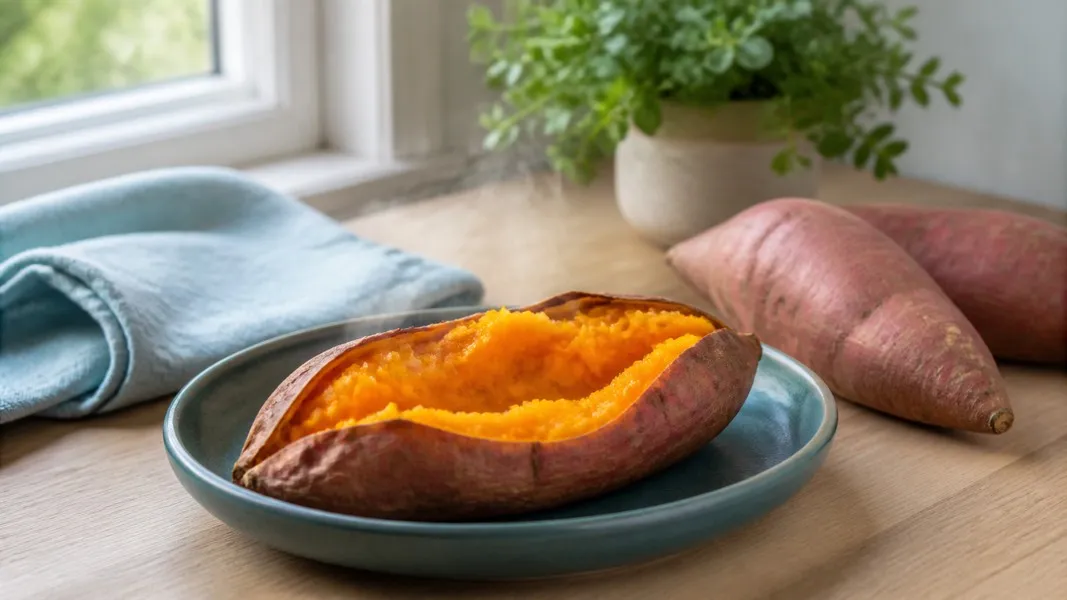
A medium baked sweet potato has about 103 calories, from about 114 grams of flesh. Sweet potato calories per 100 grams are about 90 baked, 86 raw and 76 boiled, so the figure you log depends on two things: how big the sweet potato was and how it was cooked.
Most calorie answers stop at one number for "a sweet potato". This guide breaks it down by size, by cooking method and by what goes on top, with every figure taken from USDA records, so you can match the number to the sweet potato actually on your plate.
Sweet potato calories at a glance
Every figure below comes from the USDA's food composition database, and the detail behind each one is further down.
- Baked, per 100 g of flesh: about 90 calories, 20.7 g of carbohydrate and 3.3 g of fibre.
- Boiled without skin, per 100 g: about 76 calories.
- Raw, per 100 g: about 86 calories.
- A medium baked sweet potato: about 103 calories.
- One tablespoon of butter on top: about 102 more calories, nearly doubling it.
The pattern to remember is that the vegetable itself is modest, cooking moves the per-100 g figure by water rather than by energy, and the largest swing comes from fat and sugar added in the kitchen.
Calories in a sweet potato by size
The USDA FoodData Central record for sweet potato baked in its skin, flesh eaten, lists four portion sizes. USDA measured the medium one before baking, at about 2 inches across and 5 inches long, and the grams are the flesh you eat after baking.
| Baked sweet potato | Flesh | Calories | Carbs | Fibre |
|---|---|---|---|---|
| Small | about 60 g | about 54 | 12.4 g | 2.0 g |
| Medium | about 114 g | about 103 | 23.6 g | 3.8 g |
| Large | about 180 g | about 162 | 37.3 g | 5.9 g |
| One cup | about 200 g | about 180 | 41.4 g | 6.6 g |
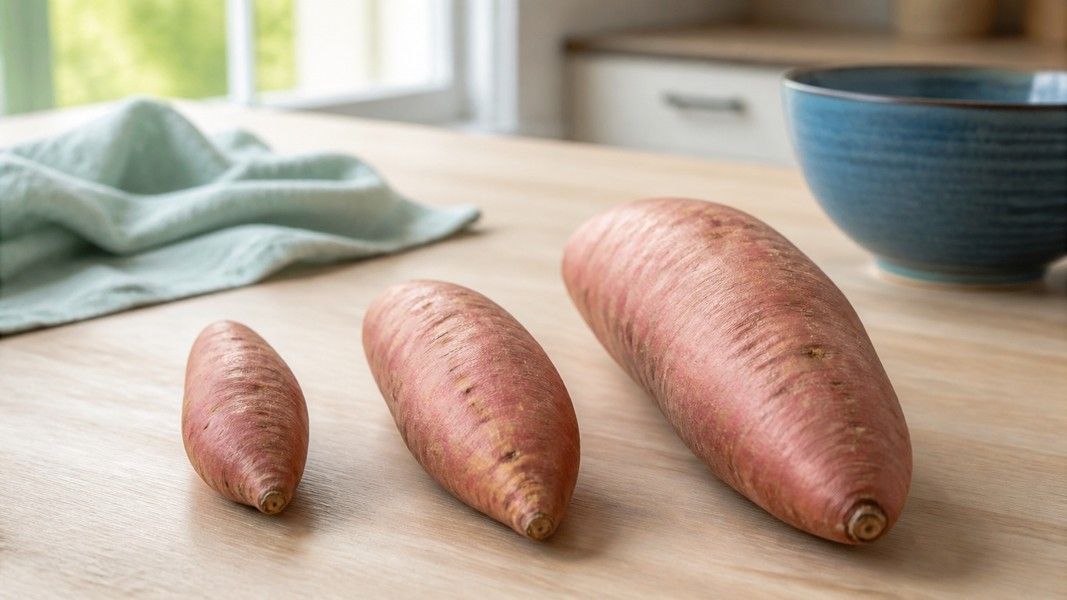
Size moves the number more than anything else on this list. A large sweet potato carries three times the calories of a small one, a gap of about 108 calories, which is larger than the difference between any two cooking methods for the same potato.
The cup figure is useful when the sweet potato is mashed or scooped into a bowl, since a cup is easier to judge than the size of a potato that is no longer whole.
Raw, baked and boiled per 100 grams
Here are the three plain forms side by side, plus home-made candied sweet potato as an example of what added sugar and fat do. The raw figures come from the USDA's raw sweet potato record, and the boiled ones from its record for sweet potato boiled without skin.
| Per 100 g | Calories | Carbs | Fibre | Sugar | Protein |
|---|---|---|---|---|---|
| Raw | 86 | 20.1 g | 3.0 g | 4.2 g | 1.6 g |
| Baked in skin, flesh | 90 | 20.7 g | 3.3 g | 6.5 g | 2.0 g |
| Boiled, no skin | 76 | 17.7 g | 2.5 g | 5.7 g | 1.4 g |
| Candied, home-made | 164 | 32.1 g | 2.1 g | 27.3 g | 0.9 g |
Fat stays near zero in the three plain forms, at 0.15 g per 100 g baked. Candied sweet potato carries 3.5 g of fat and more than four times the sugar of baked flesh, which is where its extra 74 calories per 100 g come from.
The same records give whole portions for the other forms. A raw sweet potato 5 inches long is about 130 g and about 112 calories. A medium boiled one, peeled, is about 151 g and about 115 calories, and a cup of boiled and mashed sweet potato is about 328 g and about 249 calories.
Why boiled reads lower than baked
Boiling does not remove calories from a sweet potato. It adds water. Baking does the opposite: the oven drives water out, so the same energy sits in fewer grams.
A 2011 Jamaican study of ten sweet potato varieties shows the effect in its own measurements. Boiled tubers held about 19 to 22 g of available carbohydrate per 100 g, while the roasted, baked and fried ones held about 27 to 32 g. To serve 50 g of carbohydrate, the researchers needed portions of about 218 to 346 g boiled against about 157 to 183 g for the drier methods.
This is why the medium potatoes in the USDA records barely differ in calories. The baked medium is 114 g at about 103 calories, the boiled medium is 151 g at about 115, and the raw one is 130 g at about 112. The grams change with the water; the calories of one whole sweet potato stay within about a dozen of each other.
Which figure to log
The rule that keeps a food diary honest is to match the figure to the state the sweet potato was in when you measured it.
If you measured it raw, before cooking, use the raw figure of 86 per 100 g, whatever you did to it afterwards. If you measured the cooked flesh, use the figure for that cooking method.
A worked example shows how far a mismatch can go. Say you boil a sweet potato and end up with 200 g of mashed flesh:
- Logged as boiled, at 76 per 100 g, it is about 152 calories.
- Logged as baked, at 90 per 100 g, it is about 180 calories.
That 28 calorie gap, about 18 percent, is the largest error a cooking mix-up produces with plain sweet potato. It matters over weeks of logging, and it is small next to what goes on top.
What butter and candying add
A sweet potato is close to fat-free until it reaches the plate. USDA figures put one tablespoon of butter, about 14 g, at about 102 calories, almost exactly the 103 calories of the medium baked sweet potato under it.
A buttered medium sweet potato is therefore about 205 calories, and the butter is half of it. Two tablespoons take it past 300.
Candied sweet potato goes further. A USDA serving of home-made candied sweet potato is a piece about 2.5 inches long and 2 inches across, about 105 g and about 172 calories. The same 105 g of plain baked flesh is about 95 calories, so the glaze adds about 77.
Sweet potato fries add oil, and how much oil depends on how they were cooked. Logging the sweet potato and the oil separately keeps that variable in view rather than hiding it inside one combined number.
Sweet potato vs white potato
Sweet potato has a reputation as the lighter choice, and on calories the two are close. USDA lists white potato baked with its skin at 93 calories per 100 g, against 90 for baked sweet potato flesh, with carbohydrate within about half a gram.
What differs is the rest of the profile and the size people serve. A large baked white potato in the USDA records is far heavier than a large sweet potato, so a "potato" and a "sweet potato" on two plates are rarely the same amount of food. The calories per gram are close; the portion is what to compare.
Cooking changes blood sugar response more than calories
The cooking method matters for something other than calories. In the same Jamaican study, ten healthy adults ate portions holding 50 g of carbohydrate from each preparation, and their blood glucose was tracked.
Boiled sweet potato produced a glycemic index between about 41 and 50, the low range. Baked samples came in at about 82 to 94 and roasted ones at about 79 to 93, the high range. The researchers concluded that the preparation method changed the glycemic index more than the variety did.
This is a measure of how quickly the carbohydrate shows up in the blood, not of how many calories it holds. A boiled and a baked sweet potato of the same size carry similar calories and behave very differently on this scale. Anyone managing blood sugar should take that question to a doctor or dietitian rather than to a calorie table.
Estimating the size without a scale
A sweet potato rarely comes labelled with its size, so the USDA dimensions are the most useful cue you have. A sweet potato about 2 inches across and 5 inches long is the USDA medium, about 103 calories baked. One clearly shorter and thinner is closer to small; one longer and thicker is closer to large.
Two habits keep the estimate honest. Compare against the medium rather than guessing grams from nothing, and give yourself a range: "a medium to large sweet potato, somewhere between 100 and 160 calories baked" is more truthful than one figure to the calorie. The guide to estimating grams without a scale covers more everyday references of this kind, and the food weight calculator lists the baked sweet potato sizes with grams and calories.
Estimating from a photo
Primo Scale applies the same reasoning with a camera. You take one photo, the AI identifies the sweet potato, estimates its size from the image, with LiDAR depth on iPhones that have it, and compares it with USDA reference data. The Weight Estimator returns a typical figure with a likely range, and the Calorie Estimator returns estimated calories and macros for the sweet potato or the whole plate, with the reasoning shown beside each result.
Primo Scale does not weigh objects or use phone sensors. It estimates a likely range from visual analysis and reference data.
A photo has the same blind spot as your eyes: it sees the sweet potato and not the butter melted into it. A 2026 study abstract ran photos of 102 controlled meals through four popular calorie-tracking apps. Every app underestimated the meals, which averaged 918 calories, by about 252 to 345 calories, and every app underestimated fat by about 30 g. The study did not test this app, and the lesson applies to any photo estimate, which is why the article on how photo calorie estimates work treats hidden fat as the first thing to check. When the app estimates a buttered or glazed sweet potato, adding the butter or the glaze yourself keeps the figure honest.
When an estimate is good enough, and when it is not
An estimate covers most everyday questions: whether a sweet potato side fits a day's rough calorie budget, how a baked one compares with fries, or whether the large one in the bag is worth splitting.
It is the wrong tool when the grams have to be right, such as a diet planned gram by gram with a dietitian or a recipe written in grams. For those, put the sweet potato on a kitchen scale and use the USDA figure for the state it is in.
Key takeaways
A medium baked sweet potato is about 103 calories, a small one about 54 and a large one about 162. Per 100 grams it is about 90 calories baked, 86 raw and 76 boiled, and the difference between those figures is mostly water, so one whole sweet potato lands within about a dozen calories whichever way it is cooked.
Size matters most, then what goes on top: a tablespoon of butter adds about as many calories as the sweet potato itself, and candying adds sugar and fat that plain cooking never does. Boiling keeps the glycemic index low while baking pushes it high, a difference in how the carbohydrate behaves rather than in how much of it there is. Match the figure to the state you measured, add the toppings separately, and give a range when the sweet potato was never on a scale.