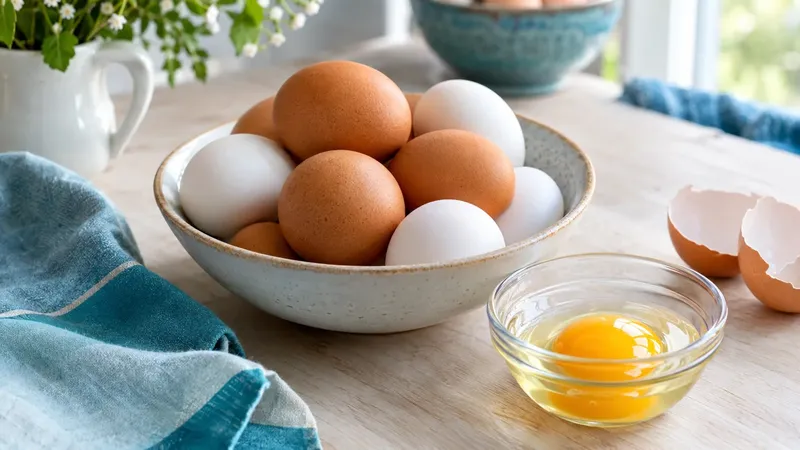

A large egg has about 72 calories raw or poached, about 78 hard-boiled, and about 90 fried or scrambled. The calories in an egg depend on two things you can see, its size and how it was cooked, and one thing you usually cannot: how much butter or oil it picked up in the pan.
Most answers give one number for "an egg" and leave it there. This guide breaks the figure down by size class and by cooking method, shows where the calories sit inside the egg, and explains why the number on the carton is rounded differently from the one in the USDA database, so you can match the figure to the egg actually on your plate.
Calories in an egg by size and cooking method
Every figure here comes from USDA FoodData Central. The raw whole egg record lists 143 calories per 100 grams and gives the edible weight of each size class without the shell: 38 g for small, 44 g for medium, 50 g for large, 56 g for extra large and 63 g for jumbo. The guide to how much an egg weighs covers those size classes and the shell in detail.
USDA lists the cooked forms per 100 grams: 143 calories poached, 155 hard-boiled, 196 fried and 149 scrambled. It gives a cooked weight only for the large egg, so the other sizes below are scaled from the large one in proportion to their raw weight.
| Size | Raw or poached | Hard-boiled | Fried | Scrambled |
|---|---|---|---|---|
| Small | about 54 | about 59 | about 69 | about 69 |
| Medium | about 63 | about 68 | about 79 | about 80 |
| Large | about 72 | about 78 | about 90 | about 91 |
| Extra large | about 80 | about 87 | about 101 | about 102 |
| Jumbo | about 90 | about 98 | about 114 | about 115 |
Size and cooking method move the number by similar amounts. Going from a medium to a jumbo egg adds about 27 calories. Frying a large egg instead of poaching it adds about 18. Both are small next to what a spoonful of butter can do, which is covered further down.
The per-100 g figures can mislead if you read them on their own. A fried egg's 196 calories per 100 g looks far higher than a raw egg's 143, but the USDA fried large egg weighs only 46 g, because frying drives water out. Per egg, the gap is 72 against 90.
Where the calories sit: yolk and white
An egg's calories are not spread evenly. USDA lists the white of a large egg at about 33 g and 52 calories per 100 g, and the yolk at about 17 g and 322 calories per 100 g.
Worked through for one large egg:
- White: about 17 calories, with about 3.6 g of protein and almost no fat.
- Yolk: about 55 calories, with about 2.7 g of protein and about 4.5 g of fat.
- Together: about 72 calories, which matches the whole raw egg.
The yolk is a third of the egg's weight and about three quarters of its calories. That is why egg-white omelets read so much lower: two large whites come to about 34 calories, less than half of one whole large egg.
The USDA size figures apply one per-100 g value to every size class, so they assume each egg has the same mix of yolk and white. An egg with a larger yolk than usual carries more calories than its class suggests, which is one more reason to treat each figure as typical for its class rather than true of your egg to the calorie.
Why a boiled egg reads higher than a raw one
Boiling an egg in its shell adds nothing to it. No fat goes in, and the USDA weight for a large egg is 50 g both raw and hard-boiled. So the 6 calorie gap between the raw figure of about 72 and the boiled figure of about 78 needs another explanation.
It comes from the records themselves. The raw egg profile was refreshed after a nationwide USDA sampling of large eggs from 12 locations in 2010. The hard-boiled record carries protein and fat values that FoodData Central dates to 1976, and its fat figure of 10.6 g per 100 g sits above the raw record's 9.51 g. The two numbers describe eggs analysed decades apart, not a change that boiling makes.
For a plain boiled or poached large egg, anything from about 72 to 78 calories is a fair figure. The difference is smaller than the gap between one size class and the next, so it rarely matters for a food diary. If you want one number, use the size class first and the cooking method second.
What frying and scrambling add
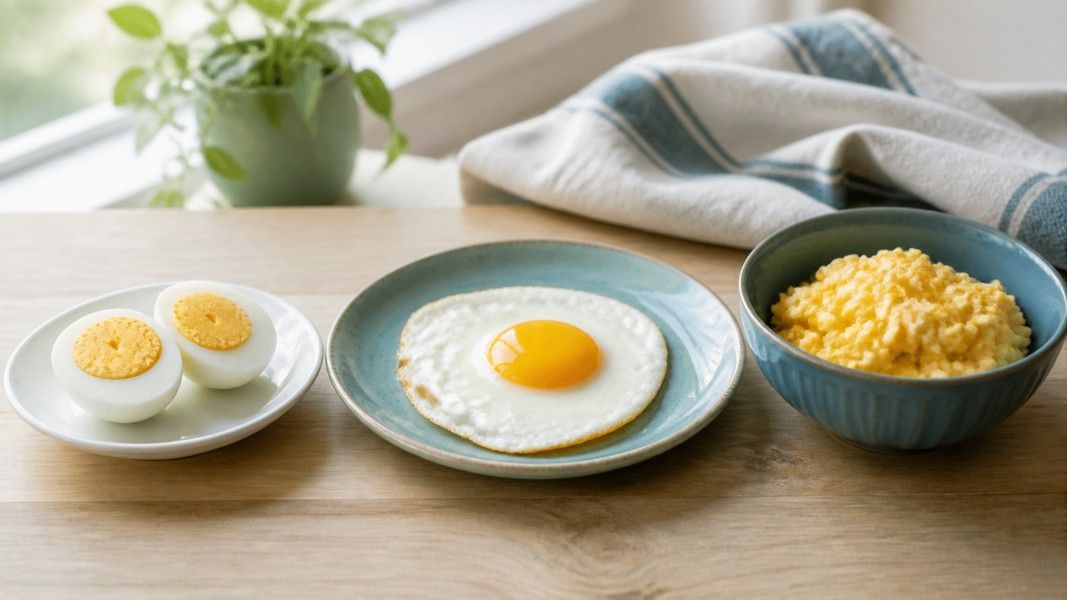
Frying is where the egg itself starts to gain calories. The USDA fried egg record lists a large egg at 46 g with 14.8 g of fat per 100 g, which is about 6.8 g of fat per egg. The same large egg raw holds about 4.8 g.
An egg cannot make fat in the pan, so those extra 2 grams came from the cooking fat. At 9 calories per gram of fat, that accounts for almost exactly the 18 calories between a raw large egg and a fried one.
The scrambled record tells a similar story. A USDA scrambled large egg weighs 61 g, 11 g more than the raw egg that went into it, so something was added to the bowl. Its fat comes to about 6.7 g per egg, again about 2 g above the raw egg, and its calories land at about 91. The USDA omelet record is close, at 154 calories per 100 g and 61 g per large egg, or about 94 calories.
These records describe a modest amount of fat. Two grams of fat is roughly what half a pat of butter holds, and a home cook can easily use more.
Butter and oil are the real variable
USDA lists a tablespoon of salted butter at 14.2 g and about 102 calories, and a single pat of about 5 g at about 36 calories. A tablespoon of olive oil, at 13.5 g, comes to about 119 calories.
A tablespoon of butter carries more calories than a large egg. That is the figure that decides most egg breakfasts, and it is the one a plain "calories in an egg" answer leaves out.
A worked example shows how far apart the same two eggs can end up:
- Two large eggs, hard-boiled: about 155 calories.
- Two large eggs, scrambled the USDA way with about 2 g of added fat each: about 182 calories.
- Two large eggs, scrambled in a full tablespoon of butter that all ends up on the plate: about 144 for the eggs plus 102 for the butter, or about 246 calories.
The last figure is an upper bound for that pan, since some butter always stays behind. The point is the spread: the same two eggs land anywhere from about 155 to about 246 calories depending on what went into the pan, a wider range than every size class in the table above.
The practical habit for a food diary is to log the egg and the cooking fat separately. Use the raw or poached figure for the egg, then add the butter or oil you used, or a share of it. That keeps the variable visible rather than buried inside one combined number that may not match your cooking.
Why the carton says 70 calories
If your carton of large eggs lists 70 calories and USDA says about 72, both are right. US nutrition labels follow the rounding rule in FDA labeling rules, which state calories per serving to the nearest 5 calories up to and including 50, and to the nearest 10 above 50.
Applied to eggs, that rule produces these label figures from the USDA values:
| Size | USDA raw figure | Rounded for a label |
|---|---|---|
| Small | about 54 | 50 |
| Medium | about 63 | 60 |
| Large | about 72 | 70 |
| Extra large | about 80 | 80 |
| Jumbo | about 90 | 90 |
The rounding is legal and it is small, but it adds up in one direction for a large egg. Three large eggs logged from the carton come to 210 calories, against about 215 from the USDA figure. For most people that is noise. It matters only when you compare a label with a database entry and wonder why they disagree.
Labels also describe the raw egg. A carton cannot know whether you will poach it or fry it in butter, so its figure is the starting point, not the plate.
Estimating eggs on a plate from a photo
Eggs on a plate rarely come with a carton. Scrambled eggs have no size class at all, and a fried egg shrinks as it cooks. Two cues help when you are estimating by eye.
Count the eggs first, then the fat. A plate of scrambled eggs is usually two or three eggs, and the cook can tell you which. The fat is the harder part: a glossy surface, a pool of butter on the plate or crisp brown edges on a fried egg all point to more fat than the USDA records assume.
Give yourself a range. "Two large eggs scrambled in some butter, somewhere around 180 to 250 calories" is more honest than one figure to the calorie.
Primo Scale works through the same questions with a camera. You take one photo of the plate, the AI identifies what is on it, estimates the portion from the image, with LiDAR depth on iPhones that have it, and compares it with USDA reference data. The Calorie Estimator returns estimated calories and macros for the plate, and the Weight Estimator returns a typical weight with a likely range for a single egg, with the reasoning shown beside each result. Primo Scale does not weigh objects or use phone sensors. It estimates a likely range from visual analysis and reference data.
What a photo cannot see
A photo shares the blind spot your eyes have: it sees the egg and not all of the butter cooked into it. NIH researchers ran photos of 102 meals prepared in a controlled kitchen through four popular calorie-tracking apps, and Medscape reported that the apps underestimated calories by about 33 percent and fat by about 30 g per meal. The study did not test Primo Scale, and its lesson applies to any photo estimate. The article on how photo calorie estimates work covers why hidden fat is the first thing to check. When eggs were cooked in butter or oil, adding that fat yourself keeps the figure honest.
When an estimate is good enough, and when it is not
An estimate covers most everyday questions: how a fried egg compares with a boiled one, whether three eggs fit a day's rough calorie budget, or roughly how much a brunch plate added.
It is the wrong tool when the numbers have to be right, such as a diet planned gram by gram with a dietitian or a recipe written in grams. For those, put the cracked egg and the cooking fat on a kitchen scale and use the USDA figure for each.
Key takeaways
A large egg has about 72 calories raw or poached, about 78 hard-boiled, and about 90 fried or scrambled the USDA way, with a small egg about 54 raw and a jumbo about 90. The yolk carries about three quarters of those calories, which is why egg whites on their own read so low.
Boiling adds nothing; the gap between the raw and boiled figures comes from records analysed decades apart. Frying and scrambling add calories only through the fat in the pan, and a tablespoon of butter at about 102 calories outweighs the egg itself. The 70 on a carton is the USDA's 72 rounded under FDA rules. Log the egg by its size, add the cooking fat separately, and give a range when nothing went on a scale.