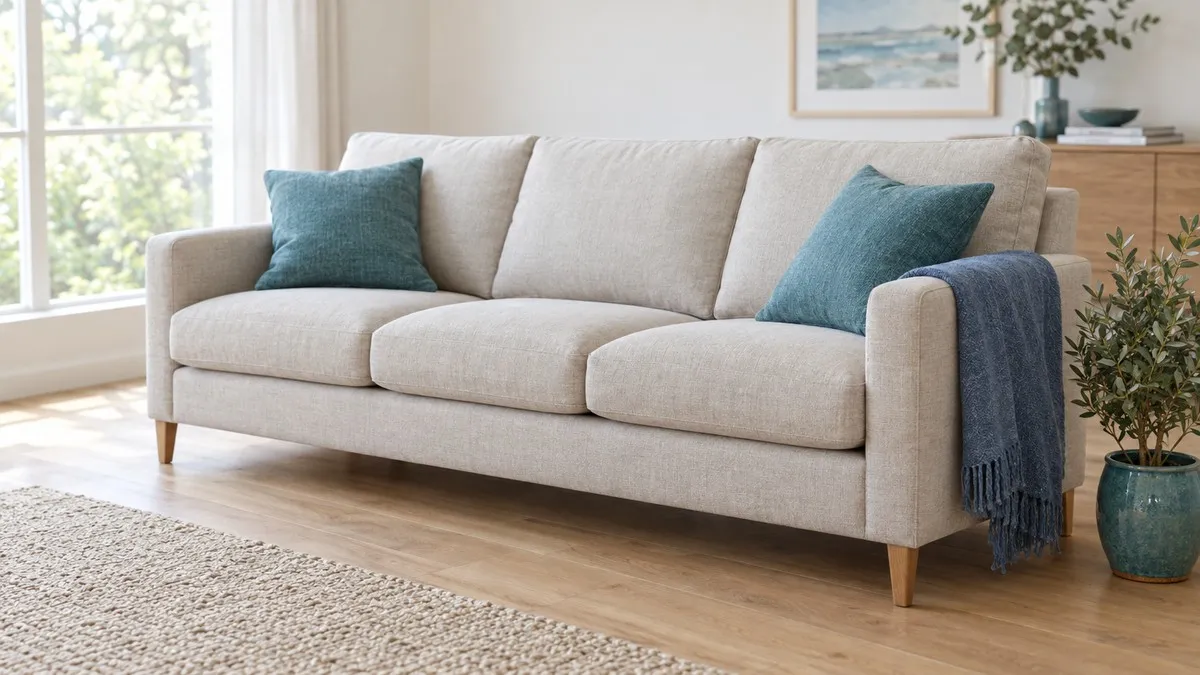
Standard couch dimensions sit close to 88 inches long, 38 inches deep and 36 inches tall for a three-seat sofa. That is the median across 191 sofas compared by the retailer What's New Furniture, and the same comparison put the median loveseat at 64 inches long. In metric, that is roughly 224 by 97 by 91 cm for the sofa and 163 cm for the loveseat.
No body enforces a couch standard. These are the sizes the market sells most often, so any one model can sit well outside them. The useful part is knowing the normal range for each type, which measurements actually matter, and how to tell before delivery day whether the couch will make it through your front door.
Standard Couch Dimensions at a Glance
The figures below are the ranges furniture guides report for each type, with the length measured across the outside of the arms. They come from the sizing guide at Roomephant, which gives every range in both inches and centimetres.
| Type | Length | Depth | Height |
|---|---|---|---|
| Loveseat (2 seats) | 58-72 in / 150-185 cm | 32-41 in / 85-105 cm | 32-37 in / 80-95 cm |
| Three-seater sofa | 78-96 in / 200-245 cm | 35-43 in / 90-110 cm | 32-39 in / 80-100 cm |
| Sectional, longest side | 95-110 in / 240-280 cm | 32-42 in / 85-105 cm | 32-40 in / 80-100 cm |
What the comparisons found
Four findings stand out once you put the guides side by side:
- The middle of the market is a sofa about 88 inches long and 38 inches deep. What's New Furniture found most of its 191 sofas between 80 and 100 inches long.
- Depth changes far less than length between types: the loveseat and three-seater depth ranges overlap almost entirely.
- Very few sofas are under 30 inches deep or tall. Only 10 of those 191 sofas had a depth or height under 30 inches, which matters at a narrow door.
- Sectional sizes vary the most, because the same model is sold in several configurations.
Different guides draw the edges of each range slightly differently. Modern Furnishings, for example, puts a typical three-seater at 84 to 96 inches long, a little narrower than the table above at the short end.
Loveseat Dimensions: Two Seats in 55 to 72 Inches
A loveseat is a sofa for two. Across the 147 loveseats What's New Furniture compared, the median was 64 inches long and most fell between 57 and 74 inches. Roomephant's range of 58 to 72 inches lands in almost the same place.
In feet, a 64-inch loveseat is 5 feet 4 inches long. In centimetres it is about 163 cm, which matches the 150 to 180 cm range Koala gives for a two-seater in Australia.
Depth is where a loveseat surprises people. It is rarely much shallower than a full sofa, usually somewhere between 32 and 41 inches. If you are buying a loveseat to save space in a small room, it saves length, not depth.
Loveseat or apartment sofa?
The label "apartment sofa" means different things at different shops. Modern Furnishings uses it for a sofa of 72 to 80 inches, between a loveseat and a full three-seater. Other retailers use it for a two-seater with slim arms. Read the length on the spec sheet rather than trusting the name.
3-Seater Couch Dimensions and Seat Measurements
A three-seat couch is the size most people mean when they say "a couch". The guides agree on a length of roughly 78 to 96 inches, and the 88-inch median from What's New Furniture sits right in that band. That is about 7 feet 4 inches, or 224 cm.
Koala, writing for Australian buyers, gives 200 to 230 cm for a three-seater, with total height usually 75 to 95 cm.
Seat height and seat depth
Two smaller numbers decide whether a couch is comfortable, not just whether it fits:
- Seat height, from the floor to the top of the seat cushion, is usually 17 to 19 inches, according to Interior Insider. Koala gives 40 to 50 cm for the same measurement.
- Seat depth, the cushion you actually sit on from its front edge to the back cushion, is usually 20 to 24 inches.
- Arm width is part of the overall length. Roomephant suggests taking 6 to 10 inches off per arm to get the real seating width.
Overall depth is always bigger than seat depth, because it adds the back cushion and the frame. On the 104 Stanton sofas What's New Furniture measured, overall depth was usually 15 to 19 inches more than seat depth. So a 38-inch-deep sofa might give you only about 19 to 23 inches of seat.
L-Shaped Couch Dimensions and Sectionals
Sectionals are the hardest couches to pin to a standard size, because one model often comes in several layouts. An L-shaped sectional has a long side and a shorter return, and both sides can be swapped or extended.
Typical figures from the guides:
| Configuration | Long side | Short side | Depth |
|---|---|---|---|
| Small L-shape | 78-94 in | 56-78 in | 36-38 in |
| Standard L-shape | 94-120 in | 78-94 in | 36-40 in |
Those rows come from Interior Insider's sectional chart. In its own catalogue, Modern Furnishings reports L-shaped sectionals running about 100 to 165 inches on the long side, with a median of 120.5 inches. One of its examples is 130 inches wide with a 92-inch return and a 37-inch component depth.
Measure both walls, then each piece
For an L-shape, measure the two walls it will sit against, then subtract the walkway you want to keep. Modern Furnishings suggests 30 to 36 inches of clear walkway around and behind a floating sofa.
The upside of a sectional is delivery. It arrives as separate pieces, so each section only has to pass the doorway on its own. That is why the next section matters more for a big three-seater than for a modular L-shape.
Couch Dimensions in Feet and Centimetres
Shoppers in the US often think in feet, while buyers in the UK, Canada and Australia read listings in centimetres. Converted from the medians and ranges above:
| Size | Inches | Feet | Centimetres |
|---|---|---|---|
| Median loveseat length | 64 in | 5 ft 4 in | 163 cm |
| Median sofa length | 88 in | 7 ft 4 in | 224 cm |
| Median sofa depth | 38 in | 3 ft 2 in | 97 cm |
| Median sofa height | 36 in | 3 ft | 91 cm |
| Standard L-shape, long side | 94-120 in | 7 ft 10 in to 10 ft | 239-305 cm |
One inch is 2.54 cm, so a quick check on any listing is to multiply inches by 2.5 and add a little. A sofa listed at 220 cm is about 87 inches, close to the American median.
Will Your Couch Fit Through the Door?
A couch is carried through a door on its back, on its end or tipped at an angle, so its length rarely decides the fit; its depth, height and diagonal depth do. Modern Furnishings puts the rule simply: the smaller of the sofa's depth and height has to clear the door's width.
The trouble is that most sofas are deeper than a typical doorway is wide. A 38-inch-deep sofa will not pass a 32-inch door upright. Tipping it back and using the diagonal depth is what gets most couches inside.
Measure the clear opening, not the door
The number on a door is the width of the door leaf. The space you can actually carry furniture through is smaller, because the open door and the stop on the frame take part of it. The ADA standards for accessible buildings measure this clear width "between the face of the door and the stop, with the door open 90 degrees", and require at least 32 inches of it.
Homes are often tighter. TheSize.net estimates that a standard 32-inch interior door leaves only about 29 to 30 inches of clear opening, and a 36-inch front door about 33 to 34 inches. In Australia, Koala reports the most common door at 820 mm wide by 2040 mm high, with older homes often narrower.
Revel Sofa notes that taking the door off its hinges buys back another 1.5 to 2 inches, which is often the margin between a tight squeeze and a sofa left on the porch.
Find the couch's diagonal depth
Diagonal depth is the measurement that tells you whether a couch fits when tipped back. Many retailers print it on the spec sheet. If yours does not, you can find it on a sofa you can reach:
- Lay a straight edge across the side of the sofa, from the top of the back to the front of the arm.
- Measure from the bottom back corner of the frame up to that straight edge, at a right angle to it.
- Compare that figure with the narrowest clear opening on the route.
TheSize.net gives a worked example. A sofa 38 inches deep and 34 inches high will not pass a 30-inch clear opening upright. If its diagonal depth is 28 inches, it goes through tipped, with 2 inches to spare.
Interior Insider puts most sofas' diagonal depth at 28 to 36 inches. Put next to a clear opening of 29 to 34 inches, that explains why so many deliveries come down to an inch or two.
Hallways, corners and stairs
The door is only the first gap. Measure every hallway, the turn into the room, stairwells and any lift on the way in, and write down the narrowest point.
For a flat turn at a hallway corner, Revel Sofa suggests adding the hallway width to the door depth, typically 5 to 6 inches. A 36-inch hallway plus a 6-inch door depth means you can turn roughly 42 inches of sofa length flat around the corner. Anything longer has to be stood on end or angled up, which needs ceiling height above it.
Removable legs help too. TheSize.net notes that unscrewing them gains 3 to 6 inches of height, which can turn a "no" into a "just".
Estimating a Couch's Size From a Photo
Spec sheets give you the couch's numbers when you are buying new. The harder cases are a second-hand sofa in a listing photo, a couch you are thinking of moving to a new flat, or a piece in a shop where nobody can find the tag.
A photo can give you a fast first estimate of a couch's size class before you measure anything. Primo Scale's Size Estimator identifies the object in one photo and returns an estimated width, height and depth as single figures, with its reasoning shown beside the result. That is often enough to tell whether you are looking at a 64-inch loveseat or a 90-inch three-seater.
On iPhones that carry the sensor, Primo Scale also uses LiDAR depth, and our guide to which iPhones have a LiDAR scanner lists the models. A photo estimate is still an estimate. For a doorway decision measured in single inches, confirm the clear opening and the diagonal depth with a tape measure before you order or start carrying.
The same routine works for anything boxy you need to move or ship. If the couch arrives flat-packed, our walkthrough on how to measure a box without a tape measure covers the cartons.
Key Takeaways
A typical three-seat couch is about 88 inches long, 38 inches deep and 36 inches tall, or roughly 224 by 97 by 91 cm. A typical loveseat is about 64 inches long but nearly as deep as a full sofa. L-shaped sectionals vary the most, with a common long side of 94 to 120 inches and a depth of 36 to 40 inches.
Seat height of 17 to 19 inches and seat depth of 20 to 24 inches decide comfort, and overall depth usually runs 15 to 19 inches more than the seat itself.
For delivery, length rarely matters. Compare the couch's depth, height and diagonal depth with the clear opening of the narrowest door on the route, which in many homes is only 29 to 34 inches. Measure the hallway turns and stairs too, and remember that removable legs, a door off its hinges or a sectional that arrives in pieces can each win back the last few inches.