
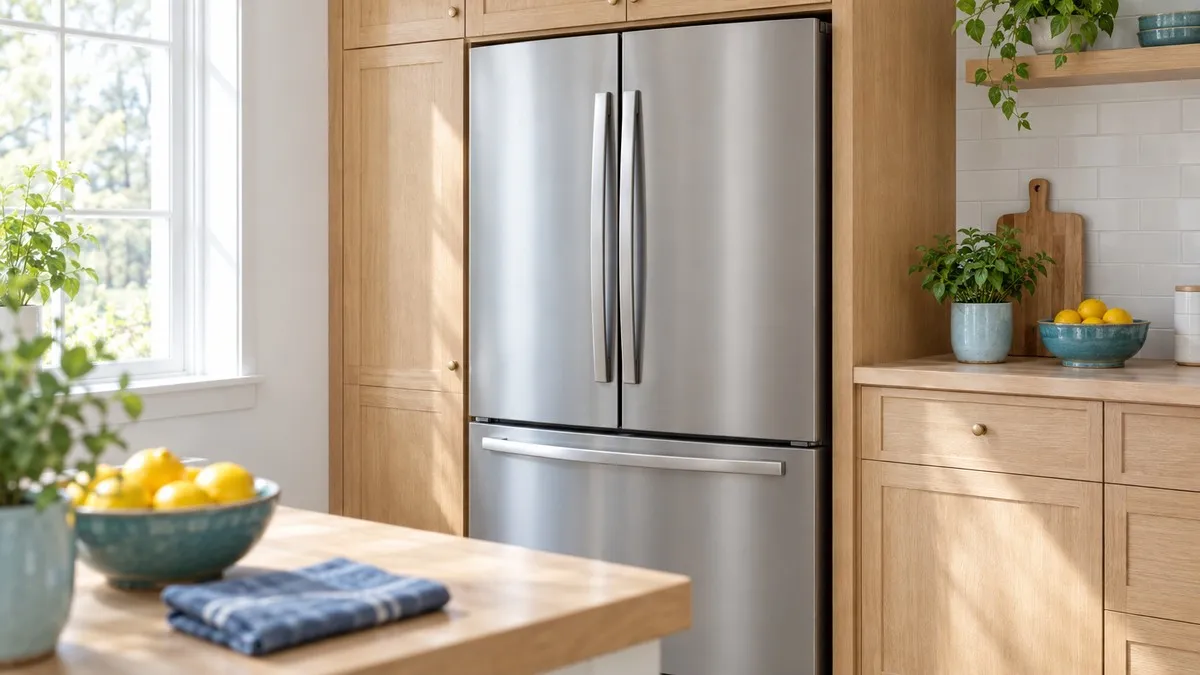
Most full-size refrigerator dimensions fall between 24 and 40 inches wide, 61 and 72 inches tall and 28 and 37 inches deep, which is roughly 61 to 102 cm wide, 155 to 183 cm tall and 71 to 94 cm deep. Thirty-six inches is considered the standard width in the US, while a standard freestanding fridge freezer in the UK is 60 cm wide.
Those ranges are wide for a reason, and that is why a new fridge so often arrives and refuses to go where the old one stood. A model can match the gap on paper and still fail on handles, hinge clearance, ventilation or a narrow hallway. This guide gives you the typical sizes for every common type, then walks through each reason a fridge does not fit and the measurement that prevents it.
Standard Refrigerator Dimensions at a Glance
Manufacturers and retailers publish ranges rather than one standard size, because every brand sizes its own cabinets. The table below combines the ranges from Whirlpool's size guide, Lowe's buying guides and Consumer Reports. Every range varies by model, so treat it as a shortlist rather than a spec.
| Type | Width (in) | Height (in) | Depth (in) | Capacity (cu ft) |
|---|---|---|---|---|
| Top freezer | 28 to 33 | 61 to 67 | 28 to 35 | up to 24 |
| Bottom freezer | 24 to 33 | 67 to 71 | 27 to 34 | 12 to 22 |
| Side-by-side | 30 to 36 | 66 to 70 | 29 to 35 | 21 to 28 |
| French door | 30 to 36 | 67 to 70 | 29 to 35 | 19 to 31 |
| Counter depth | about 36 | often taller | 24 to 30 | 15 to 25 |
| Apartment size | 22 to 24 | 60 to 75 | varies | 7 to 14 |
The width is the number that decides most fits, and the depth is the one that surprises people. According to Consumer Reports, 36 inches is considered the standard width, with 24, 28, 30 and 33 inches also common, and built-in models at 42 or 48 inches. The same guide notes that some refrigerators stand up to 10 inches proud of the countertop.
Why Refrigerator Dimensions Vary So Much
If you are replacing a fridge, the frustration is real: you measured the old one, bought something "the same size", and it does not slide in. Four things drive the spread.
The door layout sets the width. A single-door top or bottom freezer can be narrow because one door covers the whole front. Side-by-side and French door models split the front into two doors and usually start at 30 inches.
Depth comes in two families. Standard-depth models trade a flush look for capacity, while counter-depth models are shallower and make up the space in width or height.
Published depth often excludes handles and doors. Whirlpool suggests recording depth with and without handles, with the door open at 90 degrees, and with doors and drawers fully open, because with the doors fully open the depth can reach 45 to 50 inches.
Region changes the default. A US kitchen is planned around a 30 to 36 inch fridge, while a UK or European kitchen is planned around a 60 cm unit.
Top Freezer and Bottom Freezer Sizes
Top freezer models are the shortest of the full-size types. Lowe's lists them at 28 to 33 inches wide and 61 to 67 inches tall, and Consumer Reports caps their capacity at about 24 cubic feet. Consumer Reports also notes that their doors need a wide space to swing open.
Bottom freezer models are slightly taller, at 67 to 71 inches in Whirlpool's guide, with the freezer taking roughly a third of the total capacity. Whirlpool puts slim top and bottom freezer models as narrow as 24 inches, which is where they overlap with apartment fridges.
Side-by-Side and Double Door Refrigerator Dimensions
"Double door" means different layouts depending on where you shop. Most often it covers the two-door styles, side-by-side and French door, so check the product photo before you trust the label.
Whirlpool's side-by-side chart splits the type into three groups. Standard models are 30 to 33 inches wide, 68 to 70 inches tall and 30 to 31 inches deep, holding 21 to 25 cubic feet. Large models run 36 to 39¾ inches wide with up to 30 cubic feet. Counter-depth side-by-sides are 32 to 36 inches wide but only 23 to 27 inches deep.
The narrow doors are the reason people pick this style for tight kitchens. Consumer Reports points out that they need little swing room, while the narrow freezer struggles with wide items such as a pizza box.
French Door Refrigerator Dimensions
Whirlpool puts most French door models at 30 to 36 inches wide, 67 to 70 inches tall and 29 to 35 inches deep. Capacity runs from about 19 to 31 cubic feet. Two half-width fridge doors need less clearance than one full-width door, which helps where an island sits close. The freezer drawer still pulls straight out, so measure the drawer's full extension as well as the doors.
Counter Depth Refrigerator Dimensions
A counter-depth refrigerator is built to sit closer to flush with your cabinets. Whirlpool gives a typical depth of 24 to 30 inches without handles against 30 to 36 inches for standard depth, with an average capacity of about 22 cubic feet.
To recover the space they lose in depth, counter-depth models are often a little wider or taller. Lowe's notes that a standard-depth fridge at around 36 inches deep extends past the counter by about 6 inches, which is the overhang a counter-depth model removes.
Counter depth does not mean perfectly flush. Consumer Reports says these models still stick out a few inches past the cabinetry, and only a built-in sits truly level with it. Samsung's installation notes add a useful detail: in its range, counter-depth and standard-depth models share the same 35¾ inch width, so the difference is purely how far they project into the room.
If the gap in your cabinetry was built for an older standard-depth fridge, a counter-depth model may need a taller opening than you expect. Measure the height to the underside of any cabinet above, not to the ceiling.
Apartment Size and Small Refrigerator Dimensions
Apartment fridges sit between a mini fridge and a full-size model. Lowe's describes the typical apartment refrigerator as about 24 inches wide with 11 to 13 cubic feet of capacity. Maytag's range for small apartment models is 22 to 24 inches wide, 60 to 75 inches tall and 7 to 14 cubic feet.
The height is the part people miss. A narrow fridge is often just as tall as a standard one, so it suits a slim gap but not a low cabinet. RTINGS adds that some 24 inch models are deep and tall to make up for the narrow width, and that they are usually bottom freezer designs.
If you want features such as an ice dispenser or a small French door layout, Maytag places the smallest standard size at 30 inches wide with 17 to 20 cubic feet. That is still a realistic option for many apartments, provided the cutout allows it.
Fridge Freezer Sizes in the UK and Australia
Readers outside the US work in centimetres and with different defaults. These ranges come from AO and Samsung UK for Britain and from CHOICE for Australia.
| Type | Width (cm) | Height (cm) | Depth (cm) |
|---|---|---|---|
| UK freestanding fridge freezer | 60 | 130 to 200 | 60 to 70 |
| UK wide fridge freezer | 70 or 75 | varies | varies |
| UK American-style | 70 to 95, often 91 | 170 to 210 | 59 to 90 |
| UK under-counter | about 60 | about 85 | about 65 |
| Australia top or bottom mount | 54 to 80 | 130 to 180 | 59 to 75 |
| Australia side by side | 76 to 91 | 170 to 178 | 85 to 94 |
| Australia French door | 92 to 96 | 170 to 180 | 90 to 96 |
Integrated fridge freezers in the UK are designed to fit a housing unit 60 cm wide and 60 cm deep, so the measurement that changes between models is the height. When you replace an integrated model, AO's measuring guide also advises matching the split, such as 50/50 or 70/30, and the hinge type, so the cabinet doors still line up.
Why a New Fridge Doesn't Fit, and How to Fix Each Cause
Each failed fit traces back to one of four measurements. Take them on the space, not on the old fridge, because the old one may have been squeezed in.
The Cutout Was Measured Once
Floors, walls and baseboards are rarely true. Consumer Reports recommends measuring width and height in several spots and working from the smallest figure. For depth, measure from the back wall to the front edge of the counter, then decide how far past it you will accept the fridge sitting.
There Is No Room to Breathe
A fridge sheds heat from its coils, and every manufacturer asks for a gap. The figures differ more than you might expect:
- Whirlpool asks for ½ inch on the sides, top and back.
- Consumer Reports subtracts 1 inch per side, 1 inch on top and at least 1 inch behind.
- Samsung US recommends 2 to 4 inches, with 3/8 to 1 inch as the minimum in a tight space.
- AO in the UK suggests 5 cm at the back and 2 cm at each side.
- CHOICE in Australia suggests at least 5 cm at the sides, 10 cm on top and 5 cm at the rear.
The installation manual of the model you are buying decides the number. Use the larger figure until you have read it.
The Door Hits the Wall
When one side of the fridge sits against a wall, Whirlpool and Samsung both ask for about 2½ inches on the hinge side so the door can swing fully open. Check the space in front too, especially with an island in the way.
It Never Reaches the Kitchen
The delivery path catches the most people out. Best Buy sets a simple rule in its measuring tips: the narrowest point on the route must be at least 1 inch wider than the fridge's width or depth, whichever is smaller. Measure the front door, every inside doorway, hallway corners, stairs and any lift.
If the numbers are close, CHOICE suggests removing the house doors and the fridge doors to gain room. Ask the retailer whether its delivery team will do that before the day.
Getting a Rough Size Before You Measure
Sometimes the tape measure is not the first step. You may be browsing a used fridge in a listing photo, or checking whether the one in a rental is a 30 or a 36 inch model before you start shopping.
Primo Scale's Size Estimator gives an estimated width, height and depth from one photo, with its reasoning shown beside the result. On iPhones with a LiDAR sensor it also uses depth data; the list of which iPhones have LiDAR shows whether yours does.
Treat that as a first filter. An estimate from Primo Scale can suggest roughly which size class a fridge belongs to, which narrows the shortlist. A cutout with half an inch to spare still needs a tape measure and the manufacturer's spec sheet. The same logic applies to other bulky furniture, as the guide to standard couch dimensions shows for sofas and doorways.
Your Action Plan
- Pick the type first, because it sets the width range: apartment, top or bottom freezer, side-by-side, French door or counter depth.
- Measure the cutout's width, height and depth in several spots and keep the smallest figures.
- Subtract the ventilation gap from the manual of the model you want, and about 2½ inches on a hinge side that meets a wall.
- Compare against the spec sheet's depth with handles and with doors open, not only the headline depth.
- Measure every doorway and corner on the delivery path against the fridge's smaller side plus 1 inch.
Key Takeaways
Refrigerator dimensions vary by type more than by brand. Apartment fridges start around 22 to 24 inches wide, top and bottom freezer models sit around 28 to 33 inches, and side-by-side and French door models reach 30 to 36 inches, with 36 inches the usual US standard. In the UK the default is a 60 cm fridge freezer and American-style units run to about 91 cm.
Counter-depth models are shallower, at roughly 24 to 30 inches, but still project slightly past the cabinets. Most fit failures come from four places: a single measurement of an uneven cutout, a missing ventilation gap, no room for the door on the hinge side, and a doorway on the delivery route. Measure the space, read the manual's clearances, and check the route before the fridge is on the truck.