Without a tape measure, use something whose size you already know, lay it along each side of the box and count. A bank card is 8.56 cm by 5.40 cm (3.37 by 2.13 inches) almost everywhere in the world. A sheet of US Letter paper is 8.5 by 11 inches, and an A4 sheet is 21 by 29.7 cm. With one of these and a little care, you can size a box to within a centimetre or two on each side.
This guide shows how to do it, why the size of a parcel can matter as much as its weight when you post it, and when a rough figure is enough.
Objects with a known size
These are standardised, so they are the same in every wallet and every printer tray:
| Object | Size |
|---|---|
| Bank or credit card (ISO/IEC 7810 ID-1) | 8.56 × 5.40 cm (3.37 × 2.13 in) |
| US Letter paper | 21.6 × 27.9 cm (8.5 × 11 in) |
| A4 paper | 21.0 × 29.7 cm (8.3 × 11.7 in) |
Your hand works too, once you have checked it against one of these. The span from thumb tip to little finger tip, spread wide, varies a lot from person to person, so yours is the number that counts. Measure it once against a sheet of paper and remember it.
Measuring the box, side by side
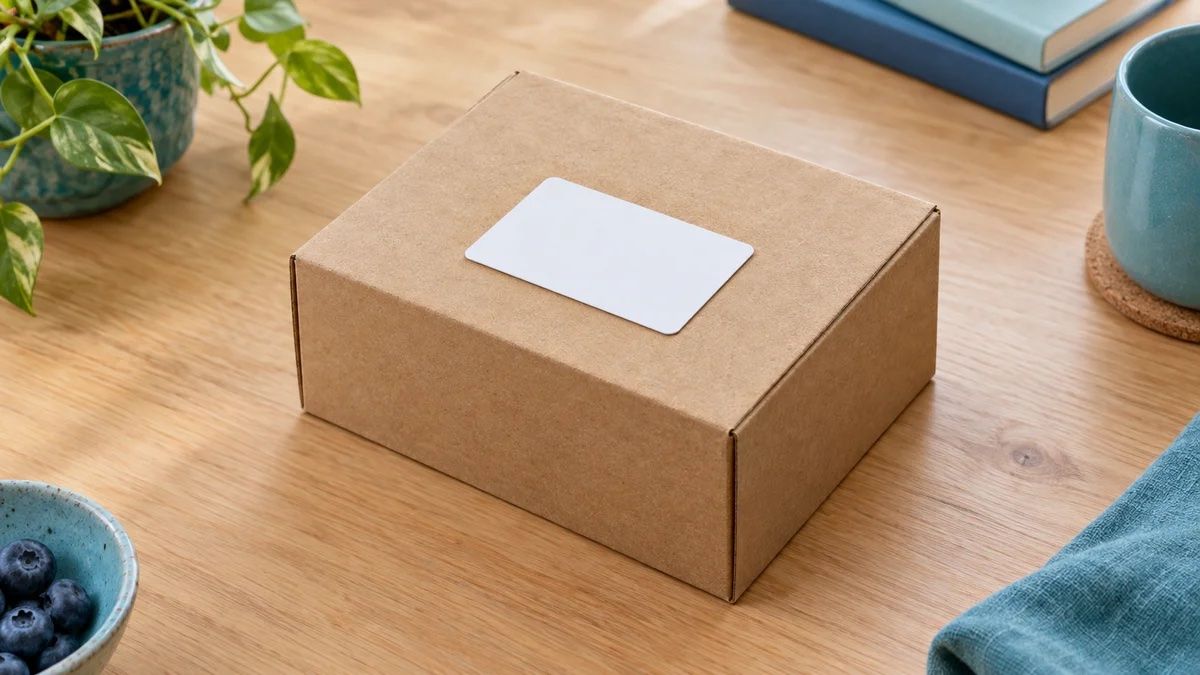
Length, width, height. Carriers want all three, measured at the longest point of each side. Bulges count.
Step the reference along the edge. Lay the card or the paper at one corner, mark where it ends with a finger or a pencil, move it on, and count. Add the last partial length by eye.
Round up. UPS, FedEx and USPS round each side up to the next whole inch, so you should too.
Why size matters when you post a parcel
Carriers price large parcels by dimensional weight: length times width times height in inches, divided by a fixed number, the divisor, gives a weight in pounds. You pay for whichever is greater, that figure or the parcel’s actual weight. The divisor depends on the carrier and on how you pay. UPS uses 139 for its daily rates, the prices on a business account, and 166 for its retail rates, what you pay at a counter. USPS applies dimensional weight to parcels over one cubic foot, and since July 12, 2026 it divides by 139 instead of 166 and rounds every fraction up. FedEx works the same way; check the divisor for the rate you pay.
A 16 by 12 by 10 inch box is 1,920 cubic inches. Divided by 139, that is about 13.8, rounded up to 14 pounds; at a retail divisor of 166, about 11.6, so 12 pounds. If the contents are a light jacket, you still pay for 12 or 14 pounds. Knowing the size before you pack lets you pick a smaller box, or compare carriers, before you get to the counter. The dimensional weight calculator runs one box through the UPS, FedEx, USPS and DHL Express rules side by side, in inches or centimetres.
Estimating the size from a photo
Primo Scale's Size Estimator does the comparison for you. Take one photo of the box; the app identifies it, estimates its width, height and depth from the image, using LiDAR depth on iPhones that have it, and shows them with its reasoning. Together with the Weight Estimator, that gives you a rough size and weight estimate before posting.
It is an AI estimate, not a measurement: Primo Scale does not weigh objects or use phone sensors to measure weight, and its sizes are estimated from the image. For the label, the carrier's own figures decide what you pay.
When a rough size is enough
A rough size is enough to choose between box sizes, to see whether something fits a shelf or a car boot, or to compare shipping prices before you pack. It is not enough for a shipping label: carriers measure parcels themselves, and a wrong declaration can mean an extra charge. Before you print the label, measure it with a tape measure and put it on a calibrated scale.
Quick answers
How big is a credit card? 8.56 by 5.40 cm, or 3.37 by 2.13 inches.
How do I calculate dimensional weight? Length × width × height in inches, divided by the carrier’s divisor: 139 for USPS and for UPS daily rates, 166 for UPS retail rates. Round each side up first.
Can I measure a box with my phone? You can estimate its size from a photo. For a shipping label, measure it with a tape measure.