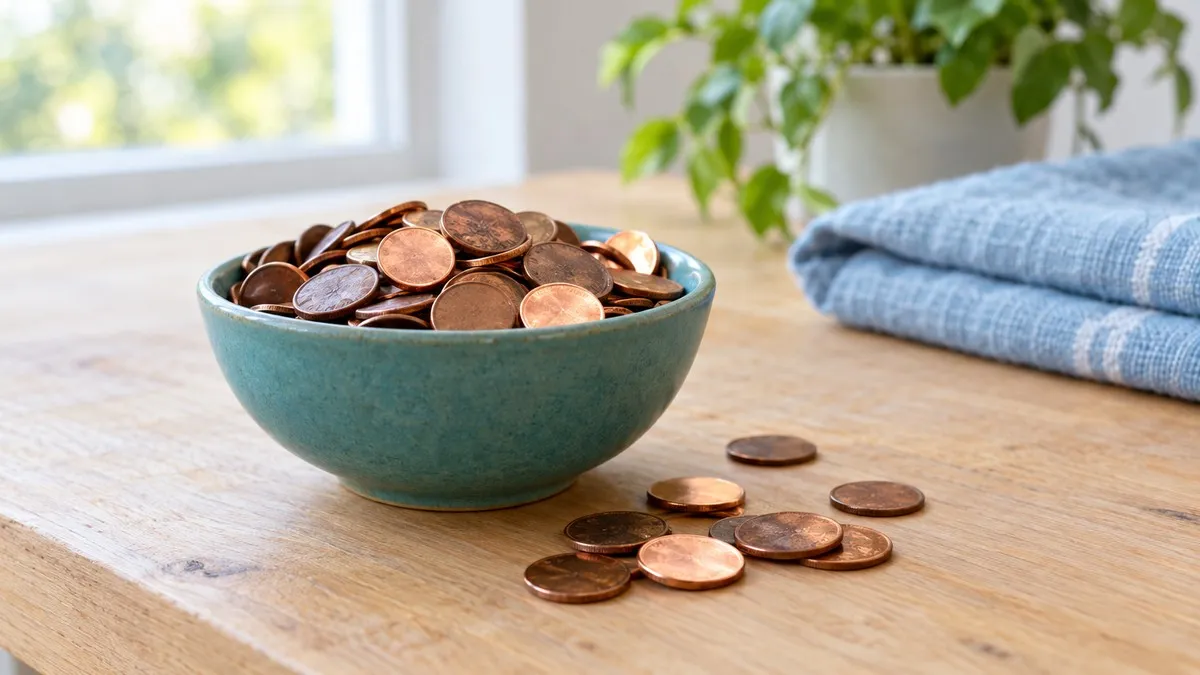
A US penny made in 1983 or later weighs 2.50 grams, and a copper penny made between 1944 and 1982 weighs 3.11 grams. That is the whole answer to penny weight in grams for nearly every coin in a jar, and the date on the coin tells you which one you are holding.
The difference sounds small until you have a few thousand of them. A pound of modern pennies holds about 181 coins, while a pound of older copper ones holds about 146. If you are sorting a coin jar, checking a kitchen scale or settling an argument about the 1982 penny, the figures below cover every era, the other US coins, the UK's coppers and the jeweller's unit that shares the penny's name.
Penny Weight in Grams by Year
The one-cent coin has changed metal several times since 1793, and its weight changed with it. The US Mint's current coin specifications list today's penny at 2.50 g, or 0.088 oz, made of 97.5% zinc with a 2.5% copper plating. Older figures come from the composition history collectors use, which lines up with the Mint's own timeline.
| Years | Metal | Weight | Pennies per pound |
|---|---|---|---|
| 1856 to 1864 | 88% copper, 12% nickel | 4.67 g | about 97 |
| 1864 to 1942 | Bronze, 95% copper | 3.11 g | about 146 |
| 1943 | Zinc-coated steel | 2.70 g | about 168 |
| 1944 to 1982 | Bronze, 95% copper | 3.11 g | about 146 |
| 1982 to 2025 | Copper-plated zinc | 2.50 g | about 181 |
The pennies-per-pound column is simple division: 453.6 grams in a pound, split by the weight of one coin. For anything in your change today, 2.50 g and 3.11 g are the only two numbers you need. Wheat cents, steel cents and the earlier copper-nickel coins are mostly collector territory.
How much does a penny weigh in ounces?
A zinc penny is 0.088 oz and a copper one is about 0.11 oz. Ounces are an awkward unit for something this light, which is why coin references and collectors work in grams.
Why the 1982 Penny Comes in Two Weights
Rising copper prices made a mostly copper cent too expensive to produce, so the Mint switched to a zinc core with a thin copper skin. The change happened partway through 1982, according to the GOVMINT composition guide, which means pennies dated 1982 exist in both versions.
That makes 1982 the one year where the date does not settle the question. Every penny dated 1983 or later is zinc at 2.50 g. Every penny dated 1944 through 1981 is copper at 3.11 g. A 1982 penny could be either, and the only quick way to tell is its weight or its sound.
The 1943 steel penny is the other oddity. Copper was diverted to the war effort during World War II, so that year's cents were struck in zinc-coated steel and weigh 2.70 g. They look grey rather than brown and stick to a magnet. The Mint also struck a small number of 1943 pennies in copper by mistake, and those are rare and valuable today. If an old jar turns up wheat cents or a suspicious 1943 coin, Primo Worth's guide to old coins walks through how collectors judge what one is worth.
How Much Does a Penny Weigh Next to Other US Coins?
Every current US coin has a published target weight. The Mint's table gives the following, and the per-pound figures again come from dividing a pound by one coin.
| Coin | Weight | Coins per pound | Value per pound |
|---|---|---|---|
| Penny (zinc) | 2.50 g | about 181 | about $1.81 |
| Nickel | 5.00 g | about 91 | about $4.54 |
| Dime | 2.268 g | about 200 | about $20 |
| Quarter | 5.67 g | about 80 | about $20 |
| Half dollar | 11.34 g | about 40 | about $20 |
| Dollar coin | 8.10 g | about 56 | about $56 |
Two things stand out. A dime is lighter than a penny, 2.268 g against 2.50 g, even though it is worth ten times more. And dimes, quarters and half dollars all come to about $20 a pound, because those three coins share one alloy and their weights rise in step with their face value.
A pound of pennies is worth about $1.81; a pound of quarters is worth about $20. That is the strongest argument for sorting a mixed jar before you count it, since a handful of quarters changes the total far more than a cup of pennies.
Coins as small test weights
The nickel's 5.00 g makes it a handy check for a kitchen scale. Two nickels should read 10 g and ten pennies made after 1982 should read 25 g. If your scale is off by a gram or two on that test, it will be off on a teaspoon of yeast too. For more household objects with known weights, see this guide on how to estimate grams without a kitchen scale.
How Many Pennies in a Pound
The phrase "how many pennies in a pound" has two meanings, and search results often mix them up. One is a pound of weight, the American question. The other is a pound sterling, the British one.
Pennies in a pound of weight
A pound is 453.6 grams, so the count depends entirely on which pennies are in the bag.
Zinc pennies, 1983 and later, come to about 181 per pound, or about 400 per kilogram. Copper pennies from 1944 to 1982 come to about 146 per pound and about 322 per kilogram. A jar of mixed pennies lands somewhere between those two, closer to 181 the more recent the coins are. Fifty zinc pennies weigh 125 g, and fifty copper ones weigh about 156 g.
If you are trying to value a jar by its weight, take the jar's own weight off first, then divide what is left by 2.50 g for a modern estimate. The result will be a little high if older copper coins are mixed in, because each of those counts as more than one zinc penny.
Pennies in a British pound
A pound sterling is 100 pence, so the money question has a fixed answer: 100 pennies, or 50 two-pence coins. The weight question is more interesting.
The Royal Mint lists the 1p coin at 3.56 g and the 2p at 7.12 g, exactly double. So a pound's worth of either coin weighs the same, 356 g. A pound of weight in 1p coins holds about 127 of them.
UK coppers changed metal too. Both coins were bronze until September 1992 and have been copper-plated steel since, which is why newer 1p and 2p coins are magnetic. The Royal Mint gives the same 3.56 g and 7.12 g for both versions.
Penny Weight vs Pennyweight
Search for "penny weight" and you will also find pennyweight, written dwt, which has nothing to do with coins in your pocket. It is a troy unit used for precious metals and jewellery.
The National Institute of Standards and Technology defines it in Handbook 44: 24 grains make 1 pennyweight, 20 pennyweights make 1 troy ounce, and 1 pennyweight equals 1.555 grams. A troy ounce is 31.103 grams, a little heavier than the ordinary 28.35 g ounce used for food.
So a pennyweight is lighter than any US penny ever struck. A zinc penny is about 1.6 pennyweights, and a copper penny at 3.11 g comes to almost exactly 2 pennyweights. If you are pricing gold or silver scrap and the buyer quotes per dwt, they mean 1.555 g, not the weight of a cent.
How to Tell a Copper Penny From a Zinc One
Start with the date. Anything from 1983 on is zinc, anything from 1944 to 1981 is copper, and only 1982 needs a closer look.
For a 1982 coin, a scale that reads to a tenth of a gram does the job. A copper cent reads around 3.1 g and a zinc cent around 2.5 g, so the gap is wide enough that even a basic kitchen scale with 0.1 g steps can separate them.
Without a scale, the drop test works surprisingly well. GOVMINT notes that a copper penny dropped on a hard table gives a clear ring, while a zinc one lands with a dull thud. Try it with a known 1975 coin and a known 1995 coin first, so you have both sounds in your ear before testing the 1982.
Why the metal matters
Collectors sort pre-1982 copper cents because the copper in them has value of its own. For everyday purposes the difference is mostly about counting: a jar valued by weight comes out wrong if you use the zinc figure on a jar of copper coins.
Estimating a Coin Jar Without Counting Every Coin
Counting a full jar by hand takes a long time, and most people only want a rough total before deciding whether to roll the coins, sort them or take them to a bank. There are three practical approaches.
- Put the jar on a bathroom or kitchen scale, subtract the empty jar, and divide by the coin weight from the table above.
- Spread a single layer of coins on a table and count from a photo of that layer.
- Sort out the dimes and quarters first, since they carry most of the value, and estimate only the pennies.
Counting pennies from a photo
The photo route is where an app helps. Primo Scale's Object Counter estimates how many similar items are in one photo, such as a layer of pennies spread on a table, and returns a single estimated count with its reasoning beside it. Overlapping coins and glare from a ceiling light make any photo count less reliable, so a flat, single layer in soft daylight works best. This walkthrough on how to count small items from a photo covers lighting, angle and overlap in more detail.
Primo Scale's Weight Estimator can also give a typical figure and a likely range for a small pile of coins it identifies. Primo Scale does not weigh objects or use phone sensors. It estimates a likely range from visual analysis and reference data. When a number matters, such as a bank deposit, a real scale or a hand count is the way to confirm it.
Why No New Pennies Are Being Made
The US stopped making pennies for circulation in 2025. According to the US Mint's penny FAQ, the Secretary of the Treasury suspended production after the cost of making one penny rose from 1.42 cents to 3.69 cents over a decade. The Mint expects to save about $56 million a year. GOVMINT reports that the last circulating penny was struck at the Philadelphia Mint on November 12, 2025.
The penny remains legal tender, and existing coins keep circulating. The Mint still strikes one-cent coins for collector sets, and the specification for those is the same 2.50 g copper-plated zinc. That means the two weights in this guide, 2.50 g and 3.11 g, will describe almost every penny you ever find in change from here on.
What to Remember About Penny Weight
A US penny weighs 2.50 g if it is dated 1983 or later and 3.11 g if it is dated 1944 to 1981, with 1982 split between the two. The 1943 steel cent is 2.70 g. That puts about 181 modern pennies or about 146 copper ones in a pound, and a pound of pennies is worth far less than a pound of dimes or quarters.
In the UK, a pound's worth of 1p or 2p coins weighs 356 g either way. And the pennyweight used for gold and silver is a separate unit of 1.555 g, lighter than any coin that carries the penny's name.