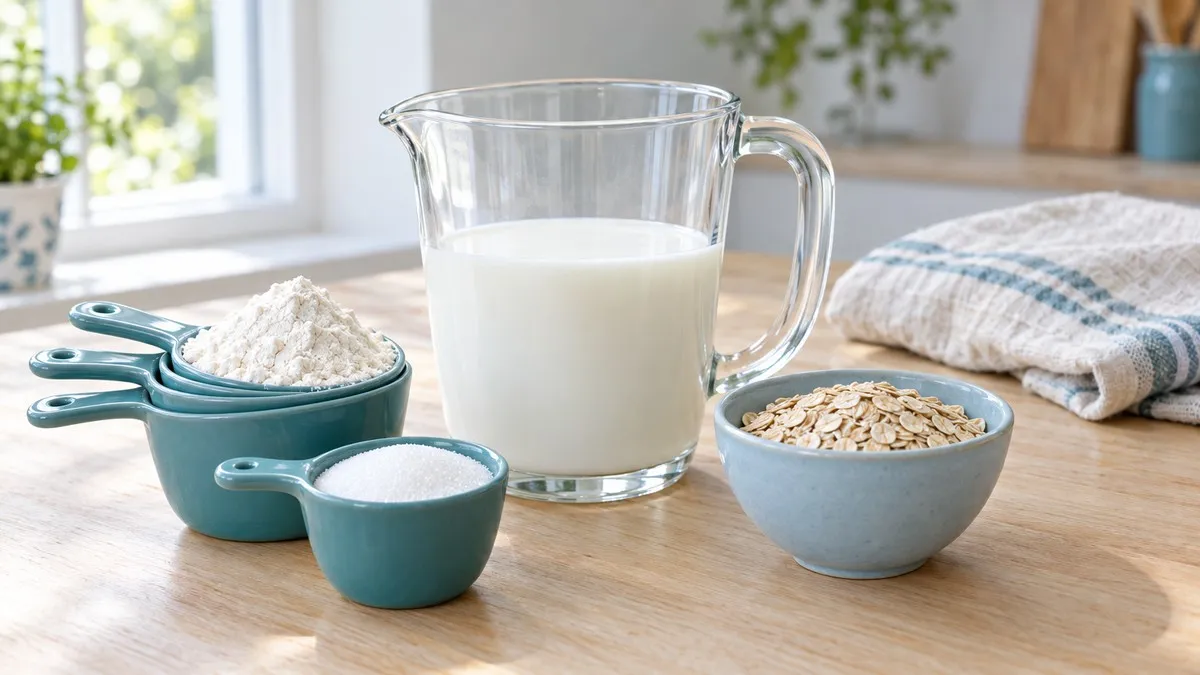
A US cup holds 8 fluid ounces, which is about 236.6 ml. That answers how many ounces in a cup when the ounces measure volume, as they do for water, milk or stock. When a recipe means ounces of weight, there is no single answer: a cup of all-purpose flour comes to about 4 1/4 ounces, a cup of granulated sugar to about 7.
Both units are called "ounce", and that shared name is an easy way to ruin a batch of cookies. This guide separates the two, gives the fluid ounce figures for every common cup fraction, lists the weight of a cup for the ingredients people ask about most, and shows how US, imperial and metric cups differ.
How Many Ounces in a Cup: The Short Answer
One US cup is exactly 8 US fluid ounces. The NIST Handbook 44 defines the measuring cup as 8 fluid ounces exactly, which is half a US liquid pint, and puts one US fluid ounce at 29.57353 ml. Multiply the two and a cup is 236.59 ml, usually rounded to 237 ml.
That is the figure behind every "8 ounces in a cup" answer, and it holds for any liquid. A cup of water, a cup of orange juice and a cup of olive oil all fill the same 8 fluid ounces of space.
What changes from one liquid to the next is the weight of that space. Oil is lighter than water, honey is much heavier, and a dry ingredient like flour is mostly air between the particles. So the question "how many ounces in a cup" has two honest answers, depending on which ounce the recipe means.
Fluid Ounces vs Dry Ounces: Volume and Weight
A fluid ounce measures how much space something takes up. An ounce without "fluid" in front of it, sometimes called a dry ounce, measures how heavy something is. Its full name is the avoirdupois ounce, and NIST defines it as exactly 28.349523125 grams, one sixteenth of a pound.
A fluid ounce and a dry ounce only line up for water and liquids close to it. One US fluid ounce of water has a mass of about 29.6 g, which is about 1.04 ounces by weight. The gap is small enough that "a pint's a pound" works as a kitchen rule for water and milk.
For anything else the two drift apart quickly. A cup of flour fills 8 fluid ounces but comes to about half that by weight. A cup of honey fills the same 8 fluid ounces and comes to half again more.
Recipes rarely say which one they mean, so a few clues help. Liquids written in ounces, such as "6 oz milk", are usually fluid ounces. Solids written in ounces, such as "8 oz flour" or "4 oz butter", are almost always weight. A measuring jug marked in ounces shows fluid ounces; a kitchen scale set to ounces shows weight.
How Many Fluid Ounces in a Cup, From 1/8 Cup to a Quart
Because the US cup is a fixed volume, the fluid ounce figures below hold for any liquid. The millilitre column comes from 29.57353 ml per US fluid ounce, rounded to one decimal place.
| US cups | US fluid ounces | Millilitres |
|---|---|---|
| 1/8 cup | 1 fl oz | 29.6 ml |
| 1/4 cup | 2 fl oz | 59.1 ml |
| 1/3 cup | 2 2/3 fl oz | 78.9 ml |
| 1/2 cup | 4 fl oz | 118.3 ml |
| 2/3 cup | 5 1/3 fl oz | 157.7 ml |
| 3/4 cup | 6 fl oz | 177.4 ml |
| 1 cup | 8 fl oz | 236.6 ml |
| 2 cups (1 pint) | 16 fl oz | 473.2 ml |
| 4 cups (1 quart) | 32 fl oz | 946.4 ml |
So how many fluid ounces in a 1/4 cup? Two. In half a cup? Four. Every fraction is simply 8 multiplied by that fraction, and 2 cups make a pint and 4 cups a quart, as the NIST tables set out.
Tablespoons and Nutrition Labels
A US fluid ounce is 2 tablespoons, so a cup is 16 tablespoons. The NIST kitchen table rounds a tablespoon to 15 ml and a fluid ounce to 30 ml for everyday metric cooking.
Food labels in the US round further. Under the FDA labeling rules, a cup means 240 ml, 1 fl oz means 30 ml and 1 oz in weight means 28 g for nutrition labeling purposes. A carton that says "1 cup (240 mL)" is using the label cup, which is 3.4 ml more than the 236.6 ml kitchen cup. The difference is under 1.5 percent and disappears in any recipe, but it explains why two charts can disagree in the last digit.
How Many Ounces in a Cup of Water?
By volume, a cup of water is 8 US fluid ounces, like any other cup of liquid. By weight it is slightly more than 8 ounces.
Water has a density of about 1 gram per millilitre, so a level 236.6 ml cup comes to about 236.6 g. Divide by 28.35 g per ounce and that is about 8.3 ounces by weight. King Arthur Baking rounds a cup of water to 8 ounces and 227 g in its ingredient weight chart, which is the figure most bakers use, and a cup filled to the line by eye lands somewhere between the two.
Milk and plain yogurt sit at the same 8 ounces and 227 g per cup in that chart. For these watery ingredients you can treat fluid and dry ounces as interchangeable without any recipe noticing. Scaling the same idea up, a gallon is 16 cups, and our guide to US and imperial gallons works through what that volume of water comes to by weight.
How Many Dry Ounces in a Cup? It Depends on the Ingredient
A dry cup is the same 8 fluid ounces of space, so how many dry ounces it holds depends on what is in it. The table uses King Arthur Baking's chart. Where the chart lists a half cup or a tablespoon, the cup figure here is that row multiplied out.
| Ingredient, 1 US cup | Ounces by weight | Grams |
|---|---|---|
| Water, milk or plain yogurt | 8 | 227 |
| Butter | 8 | 226 |
| Vegetable oil | 7 | 198 |
| Honey | 12 | 336 |
| Peanut butter | 9 1/2 | 270 |
| Granulated white sugar | 7 | 198 |
| Brown sugar, packed | 7 1/2 | 213 |
| Confectioners' sugar, unsifted | 4 | 113 |
| All-purpose flour | 4 1/4 | 120 |
| Whole wheat flour | 4 | 113 |
| Old-fashioned or quick oats | 3 1/8 | 89 |
| Long grain white rice, dry | 7 | 198 |
| Chocolate chips | 6 | 170 |
| Unsweetened cocoa | 3 | 84 |
The spread runs from 3 ounces for a cup of cocoa to 12 ounces for a cup of honey, all from the same 8 fluid ounce cup. That is why "how many dry ounces in a cup of sugar" and "in a cup of flour" have different answers, 7 and 4 1/4. Flour also varies with how it gets into the cup, which our post on a cup of flour in grams breaks down by scooping and spooning.
Why a Dry Measuring Cup Still Holds 8 Fluid Ounces
Dry measuring cups, the nesting set you level off with a knife, hold the same volume as a liquid measuring jug. A 1 cup dry measure and the 1 cup line on a glass jug both mark 8 fluid ounces.
The difference is in how they are used. A jug has space above the line so a liquid does not spill, and you read it at eye level. A dry cup is filled to the brim and levelled, because a heap of flour cannot be read against a line.
So a search for "how many ounces are in a dry measuring cup" has the same answer as for a liquid one: 8 fluid ounces of space. The weight of what fills it is the part that changes, and the table above is where that answer lives.
US vs Imperial Fluid Ounces, and the 250 ml Metric Cup
Older British recipes use the imperial fluid ounce, which is smaller than the US one. The UK measurement regulations set it at 28.4130625 ml and the imperial pint at 568.26125 ml. An imperial pint holds 20 imperial fluid ounces, while a US pint holds 16 US fluid ounces.
| Measure | Millilitres | US fl oz | Imperial fl oz |
|---|---|---|---|
| US cup | 236.6 | 8 | 8.33 |
| US nutrition label cup | 240 | 8.12 | 8.45 |
| Metric cup | 250 | 8.45 | 8.80 |
| Half imperial pint | 284.1 | 9.61 | 10 |
A US fluid ounce is about 4 percent larger than an imperial fluid ounce, so "10 fl oz" in a British recipe is about 9.6 US fluid ounces. For a sauce or a soup that gap does not matter. For a bread dough where liquid is measured against flour, it is worth converting through millilitres instead of trusting the number on the jug.
Australian recipes use a 250 ml metric cup, as Australian cookbooks spell out in their conversion pages, against 240 ml for a North American cup. A metric cup holds about 8.45 US fluid ounces, so an Australian recipe that asks for 4 cups of stock means about 1 litre, roughly 3 1/2 tablespoons more than 4 US cups.
The imperial system never changed the ounce of weight. The avoirdupois ounce is the same 28.35 g in Britain and the US, so a British recipe asking for 4 oz of butter means the same amount as an American one.
Converting a Recipe When the Ounces Are Weight
When a recipe lists a solid in ounces and you only have cups, divide the ounces by the weight of one cup from the table. Two worked examples show the method.
A bread recipe asks for 8 oz all-purpose flour. One cup of flour is about 4 1/4 ounces, so 8 divided by 4.25 is 1.88 cups, a little under 2 cups. Spoon the flour into the cup and level it, because a packed scoop holds more.
A cookie recipe asks for 12 oz chocolate chips. At 6 ounces a cup, that is 2 cups.
The mistake to avoid is reading "8 oz" of a dry ingredient as "1 cup". For flour, 1 cup is about 120 g, while 8 ounces by weight is about 227 g, nearly twice as much. A dough made that way comes out dry and stiff. For sugar the error is smaller, 7 ounces against 8, but it still shifts the sweetness and the spread of a cookie.
Going the other way works the same: multiply cups by the ounce figure. Two cups of granulated sugar are about 14 ounces, and half a cup of butter is 4 ounces, the familiar stick.
When a Rough Estimate Is Enough
For baking, measuring by weight on a kitchen scale gives the most repeatable result, which is why King Arthur recommends a digital scale over cups. For everyday cooking, a rough figure is often all you need: how much is left in a bag of rice with the label torn off, or about how heavy a block of cheese is before a recipe asks for 8 ounces of it.
Primo Scale's Weight Estimator is built for that kind of question: it identifies a food from one photo and returns a typical weight with a likely range in grams, with the reasoning shown beside the result. Primo Scale does not weigh objects or use phone sensors. It estimates a likely range from visual analysis and reference data. When an exact figure matters, a real scale is still the tool.
If you track what you eat, cups and ounces stop helping as soon as food is on a plate. Primo Scale's Calorie Estimator gives estimated calories and macros for a plate or meal from a photo, which is useful when a dish has no label and nothing was measured on the way in.
Key Takeaways
- A US cup is 8 US fluid ounces, about 236.6 ml; US food labels round it to 240 ml.
- Fluid ounces measure volume and dry ounces measure weight, and they only match for water, milk and similar liquids, at about 8 ounces a cup.
- The weight of a cup depends on the ingredient: about 4 1/4 ounces for all-purpose flour, 7 for granulated sugar, 8 for butter and 12 for honey.
- An imperial fluid ounce is 28.41 ml against 29.57 ml for a US one, so British liquid measures run about 4 percent smaller, while the ounce of weight is the same everywhere.
- An Australian metric cup is 250 ml, about 8.45 US fluid ounces.
When a recipe gives ounces, decide first whether it means space or weight. Liquids in a jug are fluid ounces, solids are almost always weight, and the ingredient table turns one into the other.