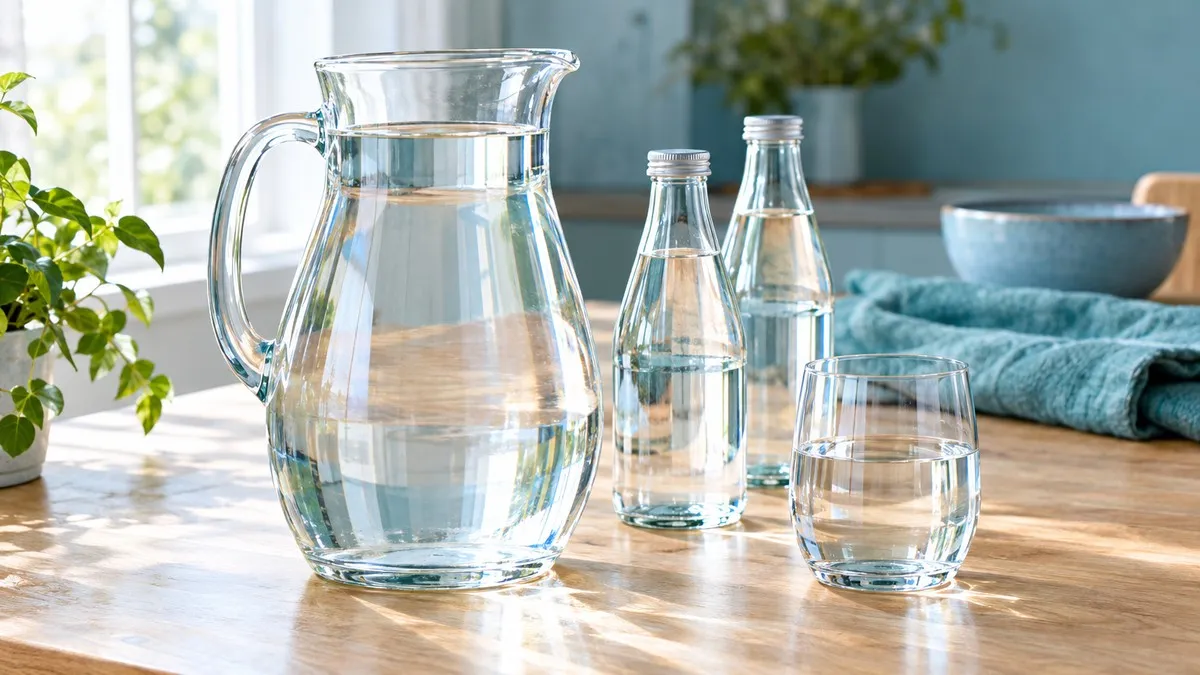
How much does a gallon of water weigh? A US gallon weighs about 8.34 pounds, or 3.79 kilograms, when it is cold, and about 8.33 pounds at room temperature. An imperial gallon, the one used in the UK, weighs about 10.02 pounds, or 4.55 kilograms. The gap is not about the water. It is about the gallon, because the two countries kept two different gallons.
If you landed here because a recipe, a hiking pack, a fish tank or a water cooler bottle left you wondering how much a gallon of water weighs, the short answer above covers most cases. The rest of this post shows where those numbers come from, how temperature moves them, and what bottles, jugs, tanks and drums add up to, so you can work out the figure for whatever container is in front of you.
Every figure below is calculated from published reference values: the gallon definitions from the US National Institute of Standards and Technology, and the density of water by temperature from the US Geological Survey.
How much does a gallon of water weigh: the key figures
The headline numbers, with water at two common temperatures. Cold means fridge cold, 32 to 39°F (0 to 4°C), where water is at its densest. Room temperature means about 70°F (21°C).
| Volume | Cold water | Room temperature water |
|---|---|---|
| 1 US gallon (3.785 L) | 8.34 to 8.35 lb, 3.79 kg | 8.33 lb, 3.78 kg |
| 1 imperial gallon (4.546 L) | 10.02 lb, 4.55 kg | 10.00 lb, 4.54 kg |
| 1 liter | 2.20 lb, 1.00 kg | 2.20 lb, 1.00 kg |
For everyday use, 8.3 pounds per US gallon and 10 pounds per imperial gallon are close enough. The USGS water facts page rounds the US figure to 8.33 pounds per gallon and gives the metric version as 1 kilogram per liter, which is the easiest rule of all if you think in metric.
A much older measurement agrees. The US Bureau of Standards published that one US gallon of water at 20°C comes to 3,778.649 grams, or 8.33049 pounds, in a vacuum. Real water in real air lands within a fraction of an ounce of that.
Why a US gallon and an imperial gallon weigh different amounts
A US gallon is defined by volume: 231 cubic inches, which is 3.785 liters. That definition, along with 128 US fluid ounces to the gallon, is set out in the tables of NIST Handbook 44, the reference US weights and measures inspectors work from.
The imperial gallon started from the other end. NIST's handbook notes that the imperial gallon was defined as the volume of 10 avoirdupois pounds of water under specified conditions. So the round number came first and the volume followed. Today it is fixed at 4.54609 liters, the value NIST lists in its conversion factor tables under "gallon, Canadian and U.K. (Imperial)".
An imperial gallon holds about 20 percent more than a US gallon, so it weighs about 20 percent more: roughly 1.67 pounds extra. The fluid ounces differ too. An imperial gallon divides into 160 imperial fluid ounces, while a US gallon divides into 128 US fluid ounces, and the two ounces are not the same size: a US fluid ounce is about 29.6 milliliters and an imperial one about 28.4.
Which gallon is on your label
If you are in the US, every gallon on a milk jug, a gas pump or a water bottle is a US gallon. In the UK and in older Canadian usage, a gallon is imperial. Australia measures water in liters, so a gallon there usually means a recipe or a product written for one of the other two markets. When a figure looks about 20 percent off, a mixed-up gallon is the first thing to check.
Gallon of water weight by temperature
Water is not quite the same weight per gallon at every temperature. It is densest at about 39°F (4°C) and expands as it warms, so a gallon of hot water holds slightly less water than a gallon of cold.
The USGS density table gives water's density from freezing to boiling. Multiplying each density by the volume of each gallon gives the weights below.
| Water temperature | Density (g/cm³) | US gallon | Imperial gallon |
|---|---|---|---|
| 32°F / 0°C | 0.99987 | 8.34 lb, 3.785 kg | 10.02 lb, 4.545 kg |
| 39.2°F / 4°C | 1.00000 | 8.35 lb, 3.785 kg | 10.02 lb, 4.546 kg |
| 60°F / 15.6°C | 0.99907 | 8.34 lb, 3.782 kg | 10.01 lb, 4.542 kg |
| 70°F / 21°C | 0.99802 | 8.33 lb, 3.778 kg | 10.00 lb, 4.537 kg |
| 100°F / 37.8°C | 0.99318 | 8.29 lb, 3.760 kg | 9.95 lb, 4.515 kg |
| 140°F / 60°C | 0.98338 | 8.21 lb, 3.722 kg | 9.86 lb, 4.471 kg |
| 180°F / 82.2°C | 0.97056 | 8.10 lb, 3.674 kg | 9.73 lb, 4.412 kg |
| 212°F / 100°C | 0.95865 | 8.00 lb, 3.629 kg | 9.61 lb, 4.358 kg |
The swing from fridge cold to boiling is about a third of a pound per US gallon. USGS tells the same story with a gallon of tap water at 70°F at 8.329 pounds and a gallon at the boiling point at 7.996 pounds.
Below about 100°F, temperature changes a gallon's weight by less than one percent, so for drinking water, aquariums and storage you can ignore it. It matters for hot water in a kettle, a brewing pot or a water heater, where the difference reaches four percent.
Ounces, cups and bottles in a gallon of water
A lot of searches about a gallon of water are really about smaller containers: how many bottles make a gallon, how many ounces it holds, how much a cup comes to. These figures use room temperature water and the US gallon unless the row says otherwise.
| Measure | How many in a US gallon | Weight of one, water at 70°F |
|---|---|---|
| US fluid ounce | 128 | about 29.5 g, just over 1 oz |
| US cup (8 fl oz) | 16 | about 236 g, 0.52 lb |
| US pint | 8 | about 1.04 lb |
| US quart | 4 | about 2.08 lb |
| 16.9 fl oz bottle (500 mL) | about 7.6 | about 1.10 lb |
That bottle row answers a question people ask more than almost any other about water. The standard single-serve bottle is labeled 16.9 fluid ounces, which is 500 milliliters, and 128 divided by 16.9 is about 7.6. So seven and a half standard bottles of water make one US gallon, and an imperial gallon takes just over nine.
A US fluid ounce of water comes out at roughly one ounce of weight, which is the idea behind the old saying "a pint's a pound". It is a rounding, not a rule: a US pint of water is about 1.04 pounds, and an imperial pint, 20 imperial fluid ounces, is about 1.25 pounds.
Water versus milk, juice and other liquids
These figures are for plain water. Liquids with sugar, fat or salt in them have a different density, so a cup of milk or juice comes to a slightly different weight than a cup of water. For milk in particular, the post on a cup of milk in grams goes through whole, skim and plant milks one by one.
How much do 5 gallons of water weigh? Jugs, tanks and drums
Once you know one gallon, every bigger container is a multiplication. The table uses room temperature water, which is what you will usually be carrying or storing. It is the water only: the jug, tank or drum adds its own weight on top.
| Volume | US gallons | Imperial gallons |
|---|---|---|
| Half gallon | 4.2 lb, 1.9 kg | 5.0 lb, 2.3 kg |
| 1 gallon | 8.3 lb, 3.8 kg | 10.0 lb, 4.5 kg |
| 2.5 gallons | 20.8 lb, 9.4 kg | 25.0 lb, 11.3 kg |
| 5 gallons | 41.6 lb, 18.9 kg | 50.0 lb, 22.7 kg |
| 10 gallons | 83.3 lb, 37.8 kg | 100.0 lb, 45.4 kg |
| 20 gallons | 166.6 lb, 75.6 kg | 200.1 lb, 90.7 kg |
| 55 gallons | 458.1 lb, 207.8 kg | 550.1 lb, 249.5 kg |
What those numbers mean in practice
A 5-gallon water cooler bottle holds about 42 pounds of water, which is why swapping one onto a dispenser is a two-handed lift. A 2.5-gallon box from the supermarket is about 21 pounds. A 10-gallon aquarium carries over 80 pounds of water before you count the glass, the gravel and the stand. A 55-gallon drum, the usual size for emergency water storage, holds about 458 pounds, so it needs to sit where it will stay.
For anything measured in cubic feet, such as a tub, a pond or a tank sold by its dimensions, NIST lists a cubic foot as 7.481 US gallons, and USGS gives water at 70°F as about 62.3 pounds per cubic foot. Measure the inside length, width and depth in feet, multiply them, and multiply again by 62.3 for a weight in pounds.
Ice, seawater and other things that change the figure
The tables above are for fresh liquid water. Three common situations move the number, and two of them are often misunderstood.
Frozen water weighs the same, but takes more room
Freezing does not add or remove any water, so a gallon of water weighs the same after it freezes. What changes is the volume. According to NOAA's ocean guide, water expands by about nine percent when its molecules lock into ice, which is why ice floats and why a full jug in the freezer can split. A gallon jug filled to the brim with ice therefore holds less water, and weighs less, than the same jug filled with liquid.
Seawater is heavier than fresh water
The same NOAA guide notes that seawater typically carries close to 35 grams of dissolved salt in every liter, within a range of 33 to 37 grams. That works out to roughly 130 grams of salt in a US gallon of seawater, and the dissolved salt is what makes seawater denser than fresh water. If you are filling a saltwater aquarium or carrying seawater from the beach, expect each gallon to come out a little above the fresh water figures.
Hard water and what is dissolved in it
USGS points out that as more material dissolves in a gallon of water, that gallon weighs more. For tap water and bottled water the minerals are a tiny fraction of the total, so the tables hold. The difference only becomes noticeable with brines, syrups and other heavily loaded liquids.
Estimating the weight of a full container from a photo
Most of the time you do not need a number down to the ounce. You want to know whether a bag will go over an airline limit, whether a shelf can take a row of jugs, or roughly how heavy a box of bottles will be to carry. The tables above get you there with a little multiplication once you know the volume.
Where the volume is not printed, or the container holds something other than water, a photo can give you a starting point. Primo Scale identifies the object in one photo and its Weight Estimator returns a typical figure with a likely range in grams rather than a single number. Primo Scale does not weigh objects or use phone sensors. It estimates a likely range from visual analysis and reference data. When the weight has to be right, for a shipment or a load limit, a real scale is still the tool for the job.
The same habit works in the kitchen. Water is the one ingredient where a milliliter comes very close to a gram, so it is the easy case; for flour, sugar and everything else, the guide to estimating grams without a scale covers the conversions that are less forgiving. Primo Scale's reasoning sits beside each estimate, so you can see which reference it started from and decide whether that is close enough for what you are doing.
Key takeaways
A US gallon of water weighs about 8.34 pounds cold and 8.33 pounds at room temperature, which is 3.79 kilograms. An imperial gallon is about 20 percent bigger and weighs about 10 pounds, or 4.55 kilograms, because it was originally defined as the volume of 10 pounds of water.
Temperature moves the figure by less than one percent across normal drinking and storage temperatures, and by about four percent at the boil. Freezing changes the volume, not the weight, and dissolved salt makes seawater a little heavier per gallon.
For anything bigger, multiply: about 42 pounds for a 5-gallon jug, over 80 pounds for a 10-gallon tank and about 458 pounds for a 55-gallon drum, each before the container itself. In metric the rule is simpler still: one liter of water is about one kilogram.