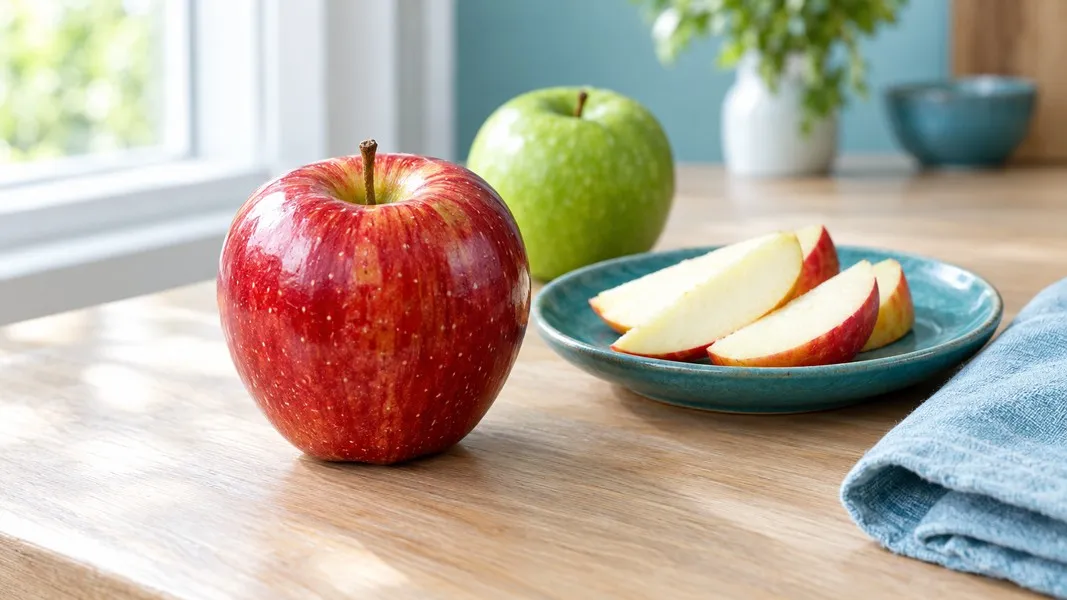
A medium raw apple with its skin has about 95 calories. That figure comes from USDA reference data, which puts a raw apple at 52 calories per 100 grams and a medium one, about 3 inches across, at 182 grams of edible fruit.
So when you ask how many calories in an apple, the honest answer is "about 95, depending on the apple". A small lunchbox apple lands nearer 77, a large one passes 115, and some varieties carry more calories per bite than others. Peeling changes the number too. This guide gives each of those figures from USDA data, shows where the calories come from, and explains why the apple in your hand may not match the label.
How many calories in an apple, by size
The size classes below come from the USDA entry for raw apples with skin in FoodData Central. Each portion is the part you eat, without the core and stem, and each calorie figure is that portion multiplied by 52 calories per 100 grams.
| Size | Diameter | Edible portion | Calories |
|---|---|---|---|
| Extra small | about 2.5 in (6.4 cm) | about 101 g | about 53 |
| Small | about 2.75 in (7 cm) | about 149 g | about 77 |
| Medium | about 3 in (7.5 cm) | about 182 g | about 95 |
| Large | about 3.25 in (8.3 cm) | about 223 g | about 116 |
The jump between sizes is bigger than the jump in width suggests. A quarter of an inch more across adds roughly 20 calories, because the amount of fruit grows with the volume of the apple, not with its width. If you want the grams behind each size and how much the core adds, the guide to apple weights by size covers that side.
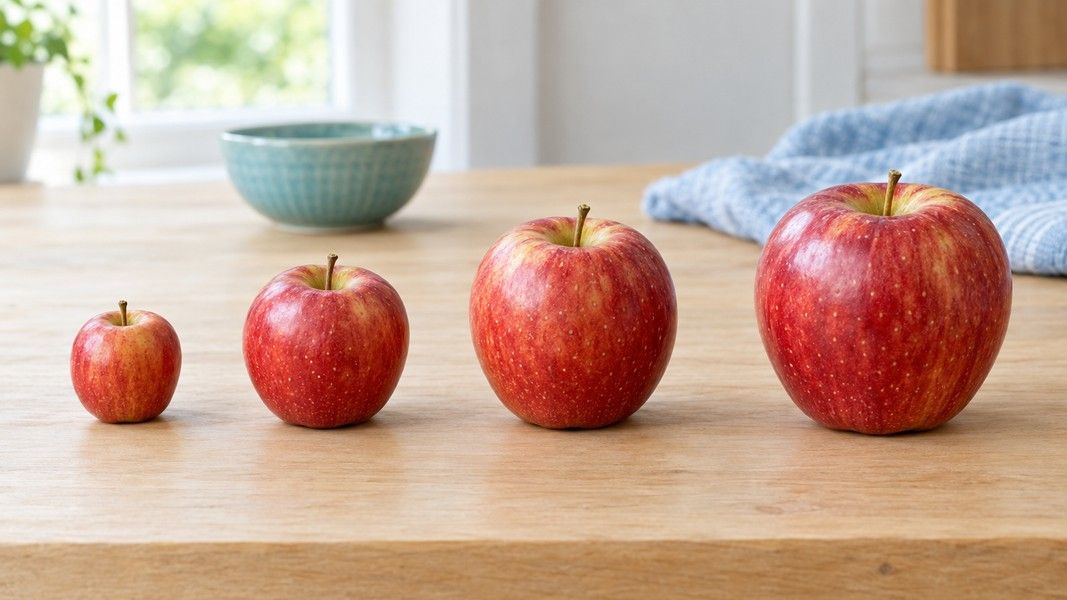
Calories in a small apple
A small apple, about 2.75 inches across, has around 77 calories, and the 149 grams of fruit behind that figure is about four fifths of a medium apple. An extra small apple, about 2.5 inches across, sits closer to 53. Half a small apple is about 39 calories.
Calories in an apple without the skin
Peeled apple has a little less energy per gram than unpeeled. USDA lists raw apple without skin at 48 calories per 100 grams, against 52 with the skin on, and a peeled apple also loses fruit along with the peel.
| Size | Peeled portion | Calories peeled | Calories with skin |
|---|---|---|---|
| Small | about 132 g | about 63 | about 77 |
| Medium | about 161 g | about 77 | about 95 |
| Large | about 216 g | about 104 | about 116 |
For a medium apple the gap is about 18 calories. Most of that is the fruit that goes into the bin with the peel, and a smaller part is the lower calorie density of the flesh.
The bigger loss is fiber. USDA gives 2.4 grams of fiber per 100 grams for apple with skin and 1.3 grams for apple without, so a medium apple drops from about 4.4 grams of fiber to about 2.1 grams once peeled. If you peel apples for a pie or for a child, the calorie difference is small; the fiber difference is roughly half.
Calories in an apple by variety
USDA analysed several common varieties separately, and their calorie density is higher than the generic apple figure. The older USDA entries, known as SR Legacy, give these values for raw apples with skin:
| Variety | Calories per 100 g | USDA medium portion | Calories per medium |
|---|---|---|---|
| Granny Smith | 58 | 167 g | about 97 |
| Golden Delicious | 57 | 169 g | about 96 |
| Gala | 57 | 172 g | about 98 |
| Red Delicious | 59 | 212 g | about 125 |
Two things stand out. Every named variety sits between 57 and 59 calories per 100 grams, above the generic 52. And "medium" does not mean the same thing across varieties: a medium Red Delicious in the USDA data is 212 grams, much heavier than a medium Granny Smith at 167 grams, which is why it lands near 125 calories.
Calories in a Granny Smith apple
A medium Granny Smith apple has about 97 calories, and a small one, about 144 grams, has around 84. The tart taste does not mean fewer calories. Granny Smith has slightly less sugar per 100 grams than Gala in the USDA data, 9.6 grams against 10.4, and slightly more fiber, 2.8 grams against 2.3, but its calorie density is about the same.
Fuji, Honeycrisp and newer USDA analyses
USDA has also published newer laboratory analyses of individual varieties in its Foundation Foods data. These tend to run a little higher than the older entries. Fuji comes in at about 65 calories per 100 grams, Honeycrisp at 60, and Gala at 61, against 57 in the older table.
Those newer entries do not list size classes, so the cleanest comparison is a fixed amount. An apple with 182 grams of edible fruit, the generic medium, would come to about 118 calories as a Fuji, about 109 as a Honeycrisp and about 111 as a Gala. A large apple with 223 grams of fruit would pass 140 as a Fuji.
Calories in a Pink Lady apple
USDA does not list Pink Lady, also sold as Cripps Pink, as a separate entry. The French fruit and vegetable agency Aprifel puts it at about 60 calories per 100 grams of peeled fruit, with 2.9 grams of fiber. That places it in the same band as Honeycrisp and Gala. Applied to the 161 grams of peeled fruit in a generic medium apple, it comes to about 97 calories.
Calories in half an apple, slices and a cup
Most people do not eat an apple as a single number. It goes into a lunchbox in slices, onto a salad chopped, or gets split between two children. USDA gives these portions for apple with skin:
| Portion | Grams | Calories |
|---|---|---|
| Half a medium apple | about 91 g | about 47 |
| 1 cup of slices | about 109 g | about 57 |
| 1 cup chopped or quartered | about 125 g | about 65 |
| 1 cup of peeled slices | about 110 g | about 53 |
Half an apple, then, is about 47 calories for a medium one and about 39 for a small one. A cup of chopped apple holds more fruit than a cup of slices because the pieces pack more tightly, which is why the two cups differ by about 8 calories.
Where the calories in an apple come from
Almost all of an apple's energy comes from carbohydrate. USDA lists 13.8 grams of carbohydrate, 0.3 grams of protein and 0.2 grams of fat per 100 grams of apple with skin, so carbohydrate supplies about 96 percent of the calories.
Within that carbohydrate, the sugar is about 10.4 grams per 100 grams, which works out to roughly 19 grams in a medium apple, alongside the 4.4 grams of fiber. The rest of the apple is mostly water, around 86 percent by weight. That high water content is why an apple is filling for its calories: a medium one is a sizeable piece of food at under 100 calories.
What changes the calories is the amount of apple, not the colour of the skin. Red and green apples of the same size and similar variety sit within a few calories of each other. The two numbers that move the result are how big the apple is and how much of it you eat.
Why your apple may not match the label
The figures above are reference values. A real apple can differ from them for three reasons, and each is worth knowing before you copy a number into a food diary.
Size is the largest. Supermarket apples are not sorted into the USDA's four classes, and a "large" apple from one store may be a medium at another. Since calories follow the volume of the fruit, a small misjudgement of size turns into a gap of 20 or 30 calories. The same pattern runs through other fruit, as the table of banana calories by size shows.
Variety is the second. Choosing the generic 52 calories per 100 grams for a Fuji undercounts it by about a fifth, while choosing a Fuji figure for a small generic apple overcounts it.
Storage and ripeness are the smallest. An apple that sits in a bowl for weeks slowly loses water, which leaves the same sugar in slightly less fruit. For one apple that change is minor.
Estimating apple calories from a photo
A single apple is one of the easier foods to estimate from a picture, because it is one item with a predictable shape and a well-documented calorie density. Most of the uncertainty is size, and size is what a photo shows.
Mixed meals are much harder. In a study presented at NUTRITION 2026, researchers at the US National Institutes of Health photographed 102 meals prepared in a controlled metabolic kitchen and ran the photos through four calorie apps. All four underestimated the meals by about 250 to 345 calories on average, and fat by about 30 grams. The findings had not yet been peer reviewed when they were presented.
That is the honest limit of any photo estimate: it works best on whole, visible foods and worst on sauces, oil and hidden layers. An apple is close to the best case. Sliced apple with peanut butter or caramel dip is not, because the dip carries the calories and its amount is hard to judge by eye.
What a photo estimate shows for an apple
Primo Scale is built around that limit. Its Calorie Estimator identifies the food in one photo and estimates calories and macros using USDA reference data, with its reasoning shown beside the result, so you can see which size and food it assumed. Its Weight Estimator gives a typical figure and a likely range in grams for the same apple, which you can multiply by the per-100-gram values above to apply a specific variety. Primo Scale does not weigh objects or use phone sensors. It estimates a likely range from visual analysis and reference data. When the number has to be exact, a real scale is the right tool.
Conclusion
A medium apple with skin has about 95 calories, a small one about 77 and a large one about 116, based on USDA's 52 calories per 100 grams. Peeling a medium apple takes it to about 77 calories and halves its fiber.
Named varieties run denser than the generic figure: Granny Smith, Gala and Golden Delicious sit at 57 to 58 calories per 100 grams in the older USDA data, and newer analyses put Fuji near 65 and Honeycrisp near 60. A medium Red Delicious, being heavier, comes to about 125.
The two things that move the number are the size of the apple and how much of it you eat. Pick the right size row and, where you know it, the right variety, and treat the result as an estimate with a range of a few dozen calories either side.