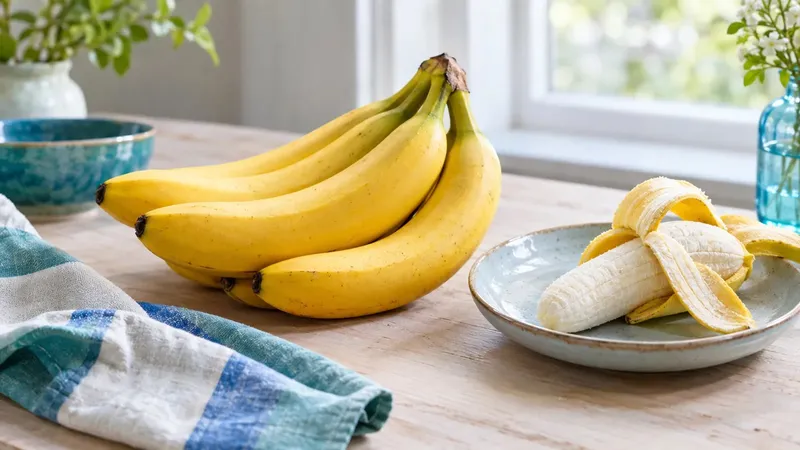
A medium banana, about 7 to 8 inches long, has about 105 calories, with 27 grams of carbohydrate, 14 grams of sugar and 3 grams of fiber. The calories in a banana run from about 72 for an extra small one to about 135 for an extra large one, and the size is the biggest thing that moves the number.
Ripeness and drying move it too, in ways a single "105 calories" answer hides. Here is what the USDA data shows, in short:
- Size: about 63 calories separate the smallest banana from the largest.
- Ripeness: a ripe banana and an overripe one differ by about 12 calories per 100 grams, mostly because the overripe fruit holds more water.
- Drying: gram for gram, dehydrated banana has about four times the calories of fresh fruit, and banana chips almost six times.
The sections below give the figures behind each of those, with the reasoning, so you can match a number to the banana actually in your hand.
Calories in a banana by size
The standard figure comes from the USDA FoodData Central record for raw bananas, which lists 89 calories per 100 grams of peeled fruit, along with 22.8 g of carbohydrate, 12.2 g of sugar, 2.6 g of fiber, 1.1 g of protein and 0.3 g of fat. The same record sorts bananas into five size classes by length and gives the peeled weight of each.
Applied to each size, that gives:
| Size and length | Peeled fruit | Calories | Carbs | Sugar | Fiber |
|---|---|---|---|---|---|
| Extra small, under 6 in | 81 g | about 72 | 18.5 g | 9.9 g | 2.1 g |
| Small, 6 to 7 in | 101 g | about 90 | 23.1 g | 12.4 g | 2.6 g |
| Medium, 7 to 8 in | 118 g | about 105 | 27.0 g | 14.4 g | 3.1 g |
| Large, 8 to 9 in | 136 g | about 121 | 31.1 g | 16.6 g | 3.5 g |
| Extra large, 9 in or more | 152 g | about 135 | 34.7 g | 18.6 g | 4.0 g |
Every row describes the fruit you eat, not the banana in its peel. The guide to how much a banana weighs covers the peel and the unpeeled weights of each size.
Each step up in size adds about 15 to 18 calories. Picking a large banana over a small one adds about 31, which is why the size is worth noting when you log one.
How many calories in a banana between two sizes
Most bananas sit between two classes. A banana that is long but thin, or short and thick, does not fit a length band cleanly. For those, the medium figure of about 105 calories is a fair middle, and a range of about 90 to 121 covers the small and large classes on either side.
Protein and fat barely register at any size. A medium banana carries about 1.3 g of protein and 0.4 g of fat, so almost all of its calories come from carbohydrate.
Calories in two bananas, a cup and a smoothie
Recipes and smoothies rarely say "one medium banana". They say two bananas, a cup of slices or a cup of mash. The USDA record gives weights for both cups.
- Two medium bananas: about 236 g of fruit and about 210 calories. Two large ones come to about 242.
- A cup of sliced banana: 150 g and about 134 calories, roughly one and a quarter medium bananas.
- A cup of mashed banana: 225 g and about 200 calories, close to two medium bananas pressed into the cup.
The mashed cup holds half as much fruit again as the sliced one, because the slices leave air between them. A banana bread recipe that asks for a cup of mashed banana is asking for about two bananas, not one and a bit.
In a smoothie, the banana is usually the smallest part of the total. One medium banana adds about 105 calories. Milk, yogurt, nut butter, oats or honey added to the blender usually account for more, and each needs its own figure.
Two USDA records, two answers for the same banana
FoodData Central holds more than one record for a raw banana, and they do not agree. Besides the 89-calorie record above, the database has newer Foundation Foods records that sort bananas by ripeness. The ripe banana record lists 97 calories per 100 grams, and a separate record for overripe bananas lists 85.
Applied to the same medium banana of 118 g:
| Record | Per 100 g | Medium banana |
|---|---|---|
| Bananas, raw (the standard figure) | 89 | about 105 |
| Ripe and slightly ripe | 97 | about 114 |
| Overripe | 85 | about 100 |
The records come from different sampling. USDA describes its Foundation Foods as analyses that focus on the variability of individual samples rather than being weighted by market share, and the ripeness records are built from those samples. The older record is the one most calorie apps and nutrition labels carry, which is why 105 is the number you will see almost everywhere.
The spread between records, about 14 calories on a medium banana, is smaller than one step between size classes. If you want one number, choose the size first and treat the record as a detail.
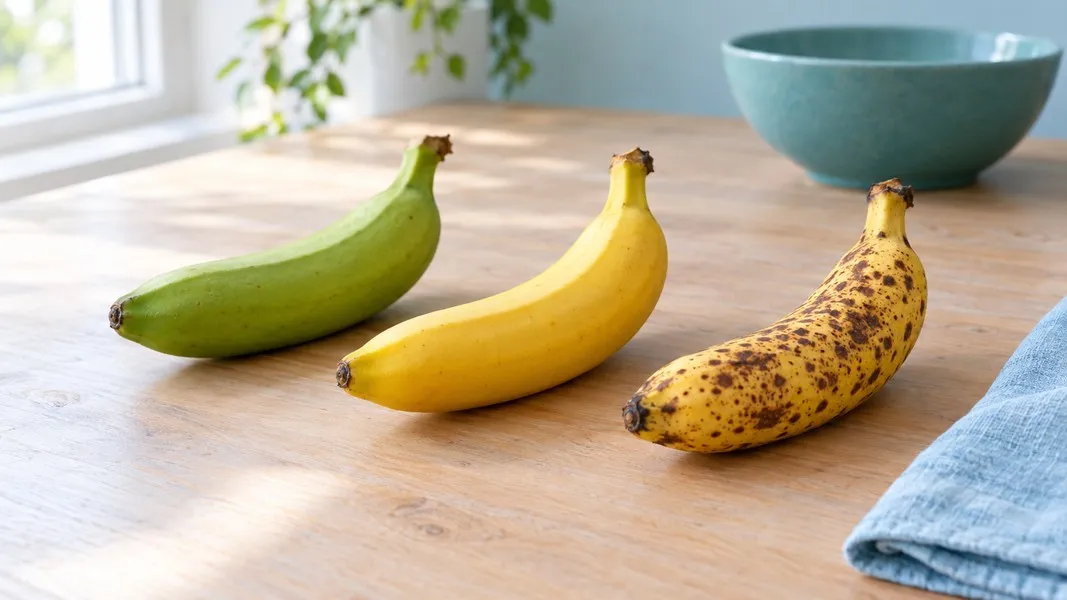
Does a ripe banana have more calories?
Not in the way most people expect. The Foundation records show a ripe banana and an overripe banana with the same 15.8 g of total sugar per 100 grams. What changes is the starch and the water.
In the ripe record, starch sits at 3.66 g per 100 grams. In the overripe record it has fallen to 0.41 g, almost gone. Total carbohydrate drops from 23.0 g to 20.1 g, while water rises from 75.3 g to 78.3 g. The overripe banana is a little wetter per gram, so each 100 grams holds about 12 fewer calories.
The overripe record also lists a smaller peeled banana, 110 g against 115 g for the ripe one. On those USDA portions, a ripe banana comes to about 112 calories and an overripe one to about 94.
That does not make brown bananas a lower calorie food in any useful sense. The difference is a few spoonfuls of water, and a banana of the same length can differ by more than that. For a food diary, size still decides the figure.
Green bananas: starch, not sugar
An unripe banana is a different food from a ripe one in one respect: what its carbohydrate is made of. In under-ripe bananas, starch makes up 80 to 90 percent of the carbohydrate, and as the banana ripens that starch turns into free sugars. That is why a green banana tastes far less sweet than a yellow one.
Much of that starch is resistant starch, which passes through the small intestine without being fully digested. A study of retail bananas at different stages of ripeness showed how much that changes the label. Measured with the newer fiber method that counts resistant starch, unripe bananas came out at about 18 g of fiber per 100 grams, ripe ones at 4 to 5 g, and overripe ones at about 2 g. With the traditional method, every stage read about 2 g. The same study found a large rise in sugars from unripe to ripe, and no difference between ripe and overripe.
Calories in a green banana
FoodData Central has no record for a green, unripe banana. Its banana records cover ripe, overripe and the generic raw banana. So there is no database figure to quote for a green one.
Because part of a green banana's starch is not fully digested, it likely delivers fewer usable calories than its weight suggests, but no USDA record puts a number on that. The honest approach is to log a green banana with the standard figure for its size and treat it as an upper estimate.
Ripeness and blood sugar
Ripeness also changes how fast the carbohydrate reaches the blood. In a small trial, 10 people with type 2 diabetes ate 120 g of under-ripe banana, 120 g of over-ripe banana or white bread on separate days. The under-ripe banana had a glycemic index of 43 and the over-ripe one 74.
That trial is about glucose response, not calories, and it is small. If blood sugar is something you manage, how bananas fit into it is a question for your doctor or dietitian rather than a calorie table.
Calories in dried banana and banana chips
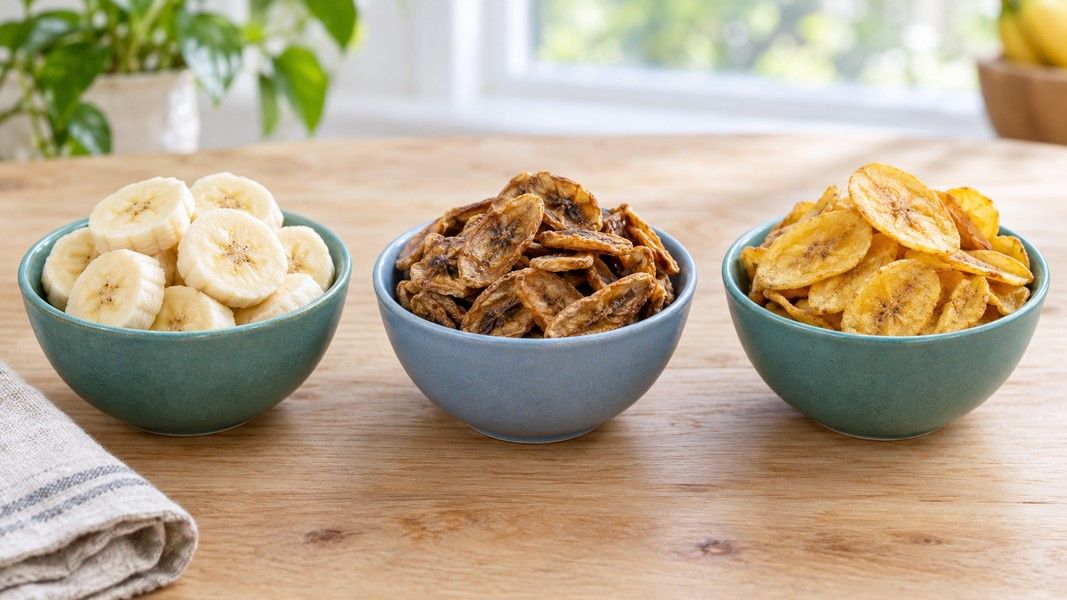
Drying removes water and leaves everything else behind, so the calories per gram climb fast. Fresh banana is about 75 percent water. The USDA record for dehydrated banana or banana powder lists 3 g of water per 100 grams and 346 calories.
100 grams of dehydrated banana holds roughly the fruit of 3 to 4 medium bananas. The calories match: about 387 g of fresh fruit at 89 calories per 100 grams comes to about 344, within a couple of calories of the dried figure. Nothing was added; the water was taken away.
A tablespoon of banana powder, 6.2 g in the USDA record, comes to about 21 calories. An ounce of dehydrated banana comes to about 98.
Why banana chips run higher
Banana chips are not simply dried banana. The USDA banana chips record lists 519 calories per 100 grams with 33.6 g of fat, against 0.3 g of fat in raw banana. That fat was added during processing, and at 9 calories per gram it accounts for more than half of the chips' calories.
An ounce of banana chips, 28 g, comes to about 147 calories, 9.5 g of fat and 10 g of sugar. A small handful of chips carries more calories than a large fresh banana. The USDA record also lists a 1.5 ounce bag at 42 g, which comes to about 218.
| Form | Calories per 100 g | Per ounce (28 g) |
|---|---|---|
| Fresh banana | 89 | about 25 |
| Dehydrated banana | 346 | about 98 |
| Banana chips | 519 | about 147 |
Packaged chips vary by brand, so the label on the bag beats the USDA figure when you have it.
Estimating a banana's calories by eye
When there is no label and no scale, three cues get you most of the way.
Measure the length against something you know. A US letter sheet is 11 inches long and a bank card is about 3.4 inches wide. A banana a little over two bank cards long sits in the medium band, about 105 calories.
Check the form before the size. Fresh, dried and fried banana differ far more than any two sizes do. A palmful of chips and a whole banana can carry the same calories.
Say it as a range. "One medium-to-large banana, about 105 to 121 calories" is more honest than one figure to the calorie, because bananas of the same length differ in thickness and curve.
Estimating from a photo
Primo Scale works through the same steps with a camera. You take one photo, the AI identifies the banana, estimates its size from the image, with LiDAR depth on iPhones that have it, and compares it with USDA reference data. The Calorie Estimator returns estimated calories and macros, for a single banana or for a whole breakfast plate with the banana on it, and the reasoning is shown beside the result.
The Weight Estimator gives the banana's typical weight with a likely range, which is the portion behind the calorie figure. Primo Scale does not weigh objects or use phone sensors. It estimates a likely range from visual analysis and reference data. For the grams to the gram, you still need a kitchen scale.
A photo has the same blind spots your eyes have. It cannot see how ripe the inside is, and from a picture alone, dehydrated banana and banana chips can look alike while differing by about 170 calories per 100 grams. The article on how photo calorie estimates work covers what a camera can and cannot pick up on a plate.
When an estimate is good enough, and when it is not
An estimate covers the everyday questions: whether a banana fits a snack budget, how much two bananas add to a smoothie, or roughly what a bowl of cereal with sliced banana comes to. At those sizes, the gap between the records and between ripeness stages is a few calories either way.
It is the wrong tool when the numbers have to be right, such as a diet a dietitian has set gram by gram or a recipe you are scaling to sell. For those, peel the banana, put the fruit on a kitchen scale and multiply by the USDA figure.
Key takeaways
A medium banana has about 105 calories, with an extra small one at about 72 and an extra large one at about 135, all for the peeled fruit. Each size step adds about 15 to 18 calories, and a cup of mashed banana is about 200 calories, close to two medium bananas.
USDA's newer ripeness records put a medium banana at about 114 calories ripe and about 100 overripe, with the gap coming mostly from water rather than sugar. Green bananas hold their carbohydrate as starch, much of it resistant, and no USDA record gives them their own calorie figure. Drying multiplies the calories per gram by about four, and frying into chips by almost six. Log a banana by its size first, its form second, and give a range when nothing went on a scale.