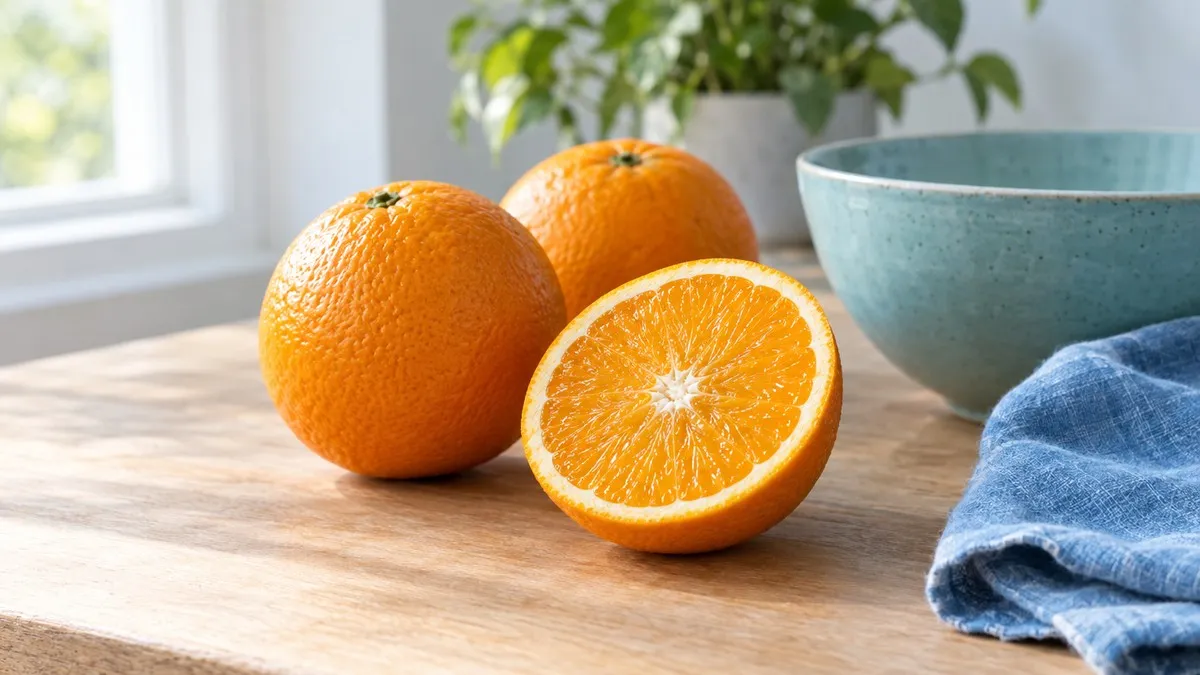
A medium orange, about 2-5/8 inches across, has about 62 calories in its 131 g of peeled fruit, according to USDA reference data. The calories in an orange run from about 45 for a small one to about 86 for a large one, and 100 g of orange flesh carries 47 calories whatever the size.
That range is why the number on one website rarely matches the number on the next. Oranges are sold in very different sizes, "medium" means different weights in different tables, and a mandarin, a clementine and a glass of juice each behave differently. This guide puts every common case side by side, with the sizes and gram weights behind each figure, so you can match the number to the fruit in your hand.
How Many Calories in an Orange, by Size
The figures below come from the USDA record for raw oranges of all commercial varieties, which you can open in FoodData Central. USDA defines each size by diameter and lists the weight of the edible fruit, peel and seeds removed.
| Portion | Diameter | Edible weight | Calories |
|---|---|---|---|
| Small orange | 2-3/8 in (6 cm) | 96 g | 45 |
| Medium orange | 2-5/8 in (6.7 cm) | 131 g | 62 |
| Large orange | 3-1/16 in (7.8 cm) | 184 g | 86 |
| Half cup of sections | - | 90 g | 42 |
| One cup of sections | - | 180 g | 85 |
| 100 g of flesh | - | 100 g | 47 |
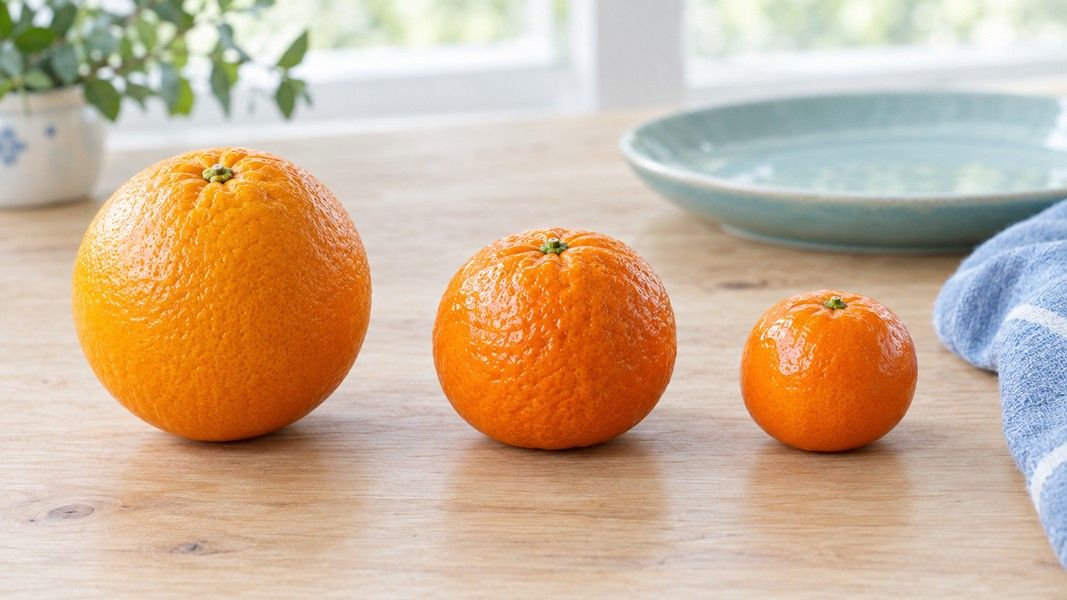
The calories in one orange scale almost exactly with its edible weight, at about 0.47 calories per gram. That is the single number worth remembering. A large orange has nearly twice the calories of a small one because it has nearly twice the flesh, not because the flesh is different.
Calories in one orange that sits between sizes
Most oranges in a shop do not match a table row exactly. If yours is wider than a medium but smaller than a large, the honest answer is somewhere between 62 and 86 calories. Estimate the edible weight first and multiply by 0.47, and you will be close enough for a food diary.
The diameter is the easiest handle. Health guides such as MedlinePlus compare one medium orange to a tennis ball, so an orange about that size lands near 62 calories. Anything clearly larger than that is heading toward the large row.
Why a Medium Orange Is 62 Calories in One Place and 80 in Another
Look up "calories in an orange" on a food label or a nutrition poster and you will often see 80, not 62. Both are correct; they describe different oranges.
The FDA raw fruits poster, which shops use for point-of-sale nutrition, lists one medium orange as 154 g with 80 calories, 19 g of carbohydrate, 3 g of fiber and 14 g of sugars. The USDA record for navel oranges uses the same 154 g serving and gives it 75.5 calories. US label rules round any calorie figure above 50 to the nearest 10, so 75.5 becomes 80 on the poster.
The USDA all-varieties medium, by contrast, is a smaller fruit: 131 g of flesh at 47 calories per 100 g. So the gap between 62 and 80 is mostly a gap of 23 g of orange, plus label rounding, plus the slightly higher calorie density of navels.
Which figure to use
Use 62 if your orange is a typical lunchbox size, about the width of a tennis ball. Use 75 to 80 if it is a large navel, closer in size to the 154 g label serving. When in doubt, the per-gram figure settles it: weight of the flesh times 0.47 for most oranges, or 0.49 for navels and Valencias.
Calories in Orange per 100 g, and Where They Come From
Per 100 g of raw flesh, USDA lists 47 calories, 11.75 g of carbohydrate, 9.35 g of sugars, 2.4 g of fiber, 0.94 g of protein and 0.12 g of fat. The rest is mostly water, 86.75 g of every 100 g.
That makes an orange a carbohydrate food in practice: about 91 percent of its calories come from carbohydrate, 7 percent from protein and 2 percent from fat. The sugars are the fruit's own; a raw orange has no added sugar.
What a medium orange gives you besides calories
Scaled to the 131 g medium, the same USDA record gives 15.4 g of carbohydrate, 12.3 g of sugars, 3.1 g of fiber, 1.2 g of protein and 0.2 g of fat. It also lists 69.7 mg of vitamin C and 237 mg of potassium.
The vitamin C is the figure oranges are known for. The NIH Office of Dietary Supplements publishes a USDA vitamin C table that lists 95.8 mg in a cup of orange sections and 124 mg in a cup of raw orange juice. Those amounts do not change the calorie count, but they explain why the fruit shows up in so many vitamin C lists.
Navel, Valencia and Florida Oranges Compared
USDA keeps separate records for the main orange types, and the differences per 100 g are small. What changes more is the typical size of each fruit.
| Orange type | Calories per 100 g | Typical portion | Calories per portion |
|---|---|---|---|
| All commercial varieties | 47 | 1 medium, 131 g | 62 |
| Navel | 49 | 1 cup sections, 165 g | 81 |
| Navel | 49 | Label serving, 154 g | 75 |
| California Valencia | 49 | 1 fruit, 2-5/8 in, 121 g | 59 |
| California Valencia | 49 | 1 cup sections, 180 g | 88 |
| Florida | 46 | 1 cup sections, 185 g | 85 |
The spread from 46 to 49 calories per 100 g is about 6 percent. For a single orange that is a difference of three or four calories, which is smaller than the difference between two oranges of the same type picked from the same bag.
Navel oranges
Navels are the large, seedless oranges most people peel and eat, and the fruit behind the 154 g, 80-calorie label serving. A big navel from a supermarket display can easily carry more flesh than the USDA medium, so 75 to 90 calories is a fair expectation for one.
Valencia and juice oranges
Per 100 g, Valencias match navels at 49 calories, and USDA lists one 2-5/8 inch Valencia at 121 g and 59 calories. Florida oranges come in slightly lower at 46 calories per 100 g.
Calories in a Mandarin Orange
Mandarins are a separate citrus species from sweet oranges, smaller, looser skinned and easier to peel. USDA files them as tangerines (mandarin oranges), and per 100 g they carry a little more energy than oranges, 53 calories against 47.
| Mandarin portion | Diameter | Edible weight | Calories |
|---|---|---|---|
| Small mandarin | 2-1/4 in | 76 g | 40 |
| Medium mandarin | 2-1/2 in | 88 g | 47 |
| Large mandarin | 2-3/4 in | 120 g | 64 |
| Label serving | - | 109 g | 58 |
| One cup of sections | - | 195 g | 103 |
A medium mandarin has about 47 calories, roughly three quarters of a medium orange, because it has about two thirds of the flesh at a slightly higher density. Two medium mandarins together come to about 94 calories, more than one medium orange.
Calories in a tangerine orange
"Tangerine" and "mandarin" are used interchangeably in shops, and USDA treats them as one record. So a tangerine orange carries the same 53 calories per 100 g, and the size table above applies to it. The FDA poster lists one medium tangerine at 109 g and 50 calories, a little below the 58 that the USDA record gives for the same weight.
Satsumas and other mandarins
Satsumas and Murcotts are mandarins too, and USDA keeps no separate record for either, so the mandarin per-gram figure of about 0.53 calories is the one to apply. Size matters far more than the variety name.
Calories in a Clementine Orange
A clementine is one of the smallest mandarins, usually seedless and very easy to peel. USDA lists one clementine at 74 g of edible fruit with 35 calories, which works out to 47 calories per 100 g, the same density as an ordinary orange.
The USDA Food Buying Guide, which school kitchens use to plan portions, puts one whole peeled clementine at about 3/8 cup of fruit. In other words, two or three clementines make roughly one cup of sections, at about 70 to 105 calories.
Calories in a Cutie orange
Cuties are a brand, not a variety. According to the Cuties FAQ, the bags hold clementines from November to January and W. Murcott mandarins from February to April. The brand gives about 45 calories for one Cuties fruit of roughly 84 g, and 90 calories for a 168 g serving of about two.
That 84 g fruit is a little heavier than the USDA clementine at 74 g, which is why the brand figure is 10 calories higher. A late-season bag of Murcotts can run slightly larger again, so treat 35 to 45 calories as the realistic range for one.
Orange Juice Calories Compared With a Whole Orange
One cup of raw orange juice, 248 g, has about 112 calories in the USDA record, at 45 calories per 100 g. That is nearly the calories of two medium oranges, and it arrives in a few swallows.
The bigger difference is what the juice leaves behind. A cup of raw juice carries about 26 g of carbohydrate and 21 g of sugars but almost no fiber, while a medium orange brings 3.1 g of fiber with its 12.3 g of sugars. Juicing keeps the calories and most of the sugar and drops the pulp and membranes that hold the fiber.
Calories per glass
Glass sizes vary more than oranges do, so the per-100 g figure is the useful one. A small 4 oz glass, about half a cup, comes to roughly 56 calories, and a 12 oz tumbler to roughly 168. Bottled juice from concentrate sits in the same range per 100 g, but the label on the carton is the figure to trust for a specific brand, especially if it has added sugar.
Calories in an Orange With the Peel
Almost nobody eats a whole orange peel, but zest, candied peel and whole-fruit smoothies do bring it in. USDA lists raw orange peel at 97 calories per 100 g, about twice the figure for the flesh. An orange eaten with its peel comes to 63 calories per 100 g in the USDA record for oranges with peel.
Grated zest
A recipe's teaspoon or two of grated zest weighs only a few grams, so it adds a handful of calories at most.
Whole Weight Versus the Edible Portion
Every figure above is for the edible part of the fruit. An orange you pick up in the shop includes peel, pith and sometimes seeds, and that part is a sizeable share of the total.
The USDA Food Buying Guide gives the yields school kitchens plan with. For Florida or Texas oranges of 126 count, one pound as purchased gives about 0.76 pound of ready-to-serve peeled orange. For larger 72 to 88 count oranges, about 3 inches across, one pound gives about 0.73 pound. Clementines yield about 0.86 pound of peeled sections per pound and 150 count tangerines about 0.85, because their peel is thinner.
What that means for the calories
Roughly a quarter of an orange's purchased weight is peel and waste. So if you put a whole orange on a kitchen scale and read 240 g, about 175 to 180 g of it is flesh, worth roughly 82 to 86 calories. Using the whole-fruit weight with the per-100 g figure would overstate it by about a third.
"Count" on a carton label, such as 113 or 138, is the number of fruits that fill a standard carton. A lower count means bigger oranges. The Food Buying Guide's 72 to 88 count fruit, about 3 inches across, sits close to the USDA large orange.
How to Estimate the Calories in Your Orange
A label is rarely attached to a loose orange, so most of the time the number has to come from the fruit itself. Three routes work, from quickest to most exact.
- Match the size. Compare the orange with a tennis ball. About the same is the 62-calorie medium; clearly smaller is the 45-calorie small; much larger is the 86-calorie large.
- Use the type. A mandarin of the same width carries less flesh than an orange, so start from 47 calories for a medium mandarin and 35 to 45 for a clementine.
- Use the weight. If you have a kitchen scale, peel the fruit, read the flesh weight and multiply by 0.47, or by 0.53 for a mandarin.
Worked example: a 3-inch navel
Say you have a navel orange about 3 inches across. That is a little under the USDA large orange at 3-1/16 inches and 184 g of flesh. Navels run at 49 calories per 100 g, so 170 to 180 g of flesh comes to about 83 to 88 calories.
If the same orange were 2-5/8 inches across, the medium row applies instead, and the answer drops to the low 60s. A half-inch difference in width changes the calories by about a third, which is why size beats every other detail in this guide.
Estimating from a photo
When you want a quick number without a scale, a photo is a reasonable starting point. Primo Scale's Calorie Estimator identifies the food in one camera photo and returns estimated calories and macros, using USDA reference data behind its food estimates and showing its reasoning beside the result. For a bowl of mixed fruit or a plate with an orange on the side, that is often faster than working out each item by hand.
If what you need is the weight of the fruit itself, the Weight Estimator in Primo Scale gives a typical figure in grams with a likely range, which you can then multiply by the per-gram figures above. Primo Scale does not weigh objects or use phone sensors. It estimates a likely range from visual analysis and reference data, so an exact gram figure still needs a real kitchen scale.
For a closer look at where photo estimates are strong and where they drift, see how photo calorie estimates work. The same size-first logic applies to other fruit, as the guide to calories in an apple shows with its own size table.
Calories in an Orange, the Short Version
A medium orange of about 2-5/8 inches has about 62 calories in 131 g of flesh, a small one about 45 and a large one about 86. The FDA's 80-calorie figure describes a bigger 154 g navel serving, rounded under label rules.
Mandarins and tangerines run at about 53 calories per 100 g, so a medium one comes to about 47. A clementine has about 35, and a Cuties fruit about 45 by the brand's own figure. A cup of raw orange juice has about 112 calories and almost none of the fiber of the whole fruit.
The most useful rule is the simplest one: about 0.47 calories per gram of orange flesh, 0.49 for navels and Valencias and 0.53 for mandarins. Estimate the edible weight, leave the peel out of it, and the calories follow.