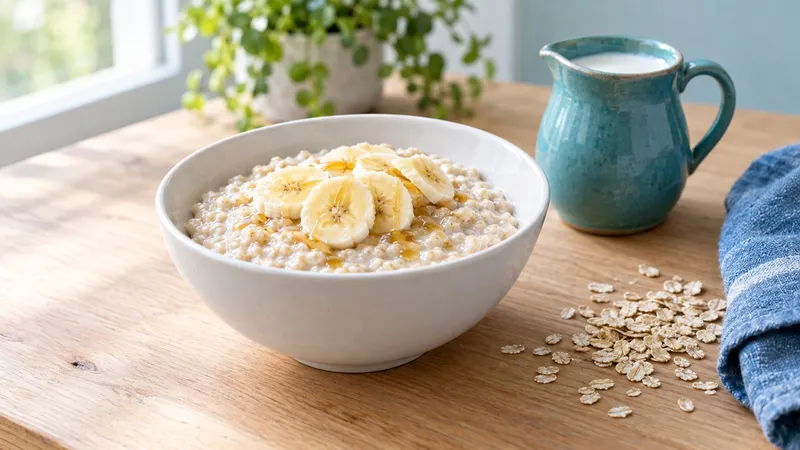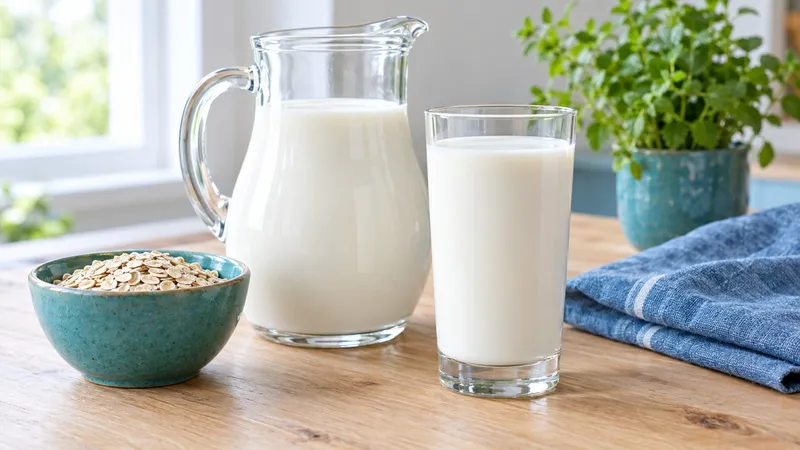
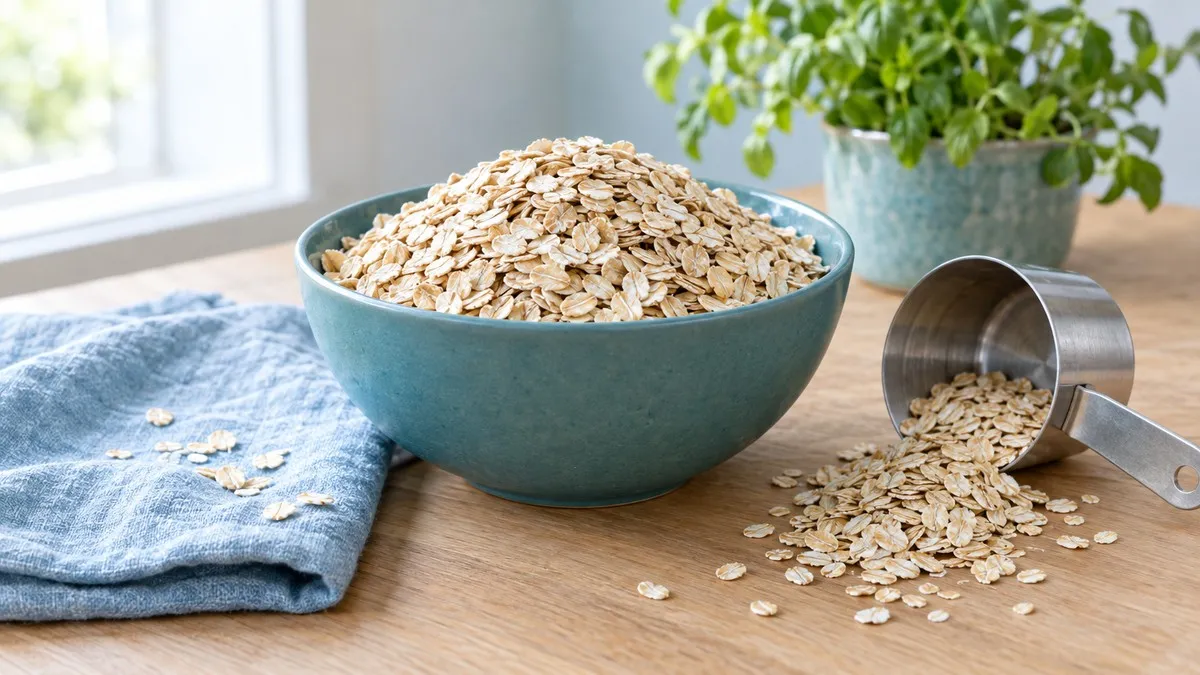
1 cup of oats in grams comes to about 80 to 90 g for rolled or quick oats, and much more for steel cut oats, at 140 to 176 g. The USDA record for dry oats puts a level cup at 81 g, while King Arthur Baking uses 89 g for the same cup. A half cup, the serving on most oat packages, is about 40 g.
If a recipe gives oats in grams and your kitchen only has cups, or the other way around, the gap between those sources is the problem. Below you get the figure for each type of oat, every common cup fraction, grams back to cups, how many cups a bag holds, and the measuring habits that move the number most.
1 Cup of Oats in Grams by Oat Type
Oat packages list a serving by volume and by weight, which makes them the most direct evidence for what a cup holds. Multiply the label serving up to a full cup and the spread between brands and oat types is plain to see.
| Oats | Source | Label measure | Grams per cup |
|---|---|---|---|
| Old fashioned rolled | Quaker | 1/2 cup, 40 g | 80 g |
| Quick 1-Minute | Quaker | 1/2 cup, 40 g | 80 g |
| Regular and quick, dry | USDA | 1 cup, 81 g | 81 g |
| Old fashioned or quick | King Arthur | 1 cup, 89 g | 89 g |
| Quick cooking rolled | Bob's Red Mill | 1/2 cup, 45 g | 90 g |
| Instant rolled | Bob's Red Mill | 1/3 cup, 32 g | 96 g |
| Old fashioned rolled | Bob's Red Mill | 1/2 cup, 49 g | 98 g |
| Steel cut | King Arthur | 1/2 cup, 70 g | 140 g |
| Quick cooking steel cut | Bob's Red Mill | 1/4 cup, 36 g | 144 g |
| Steel cut | Bob's Red Mill | 1/4 cup, 44 g | 176 g |
The Quaker label gives 1/2 cup dry as 40 g for both its Old Fashioned and its Quick 1-Minute oats, so the two pack the same way in a cup. The USDA entry covers regular and quick oats together and lists the full cup at 81 g, which agrees with Quaker almost to the gram.
For everyday rolled or quick oats, 80 to 90 g per cup is the honest answer, and 81 g is the best single figure to plan with. King Arthur's own brand of rolled oats is the outlier in its chart at 113 g a cup, so a heavier flake can sit well above that range.
Why One Cup of Oats Has Several Gram Weights
A cup measures space, and oats are mostly air between the flakes. Anything that changes how tightly the flakes sit changes the grams in the cup.
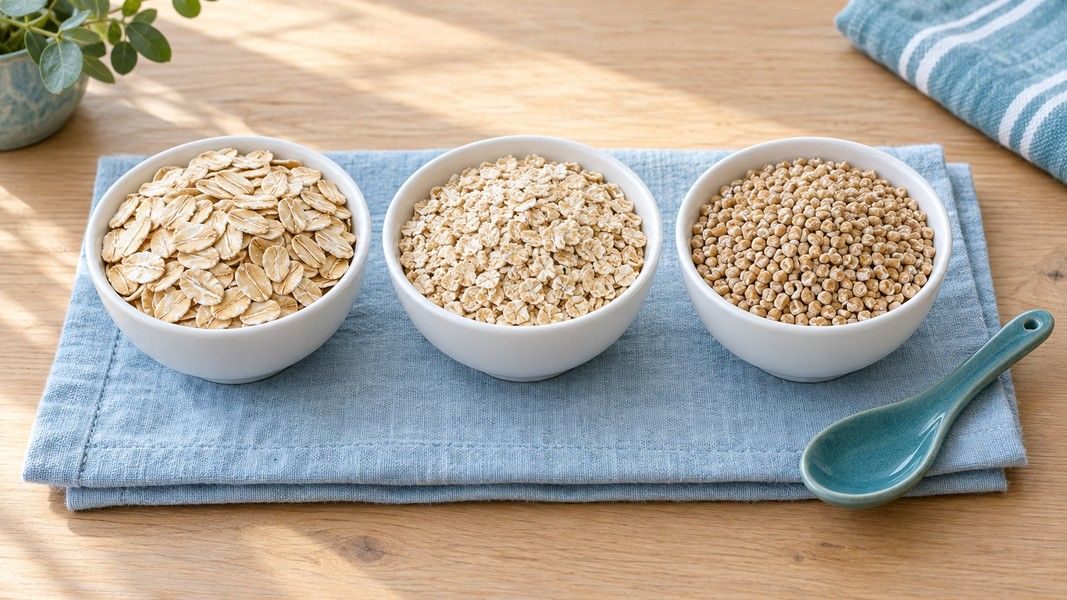
Flake size and cut
Rolled oats are steamed and pressed flat, which leaves gaps between the flakes. Quick oats are rolled thinner or cut smaller, and instant oats smaller again, so the pieces settle closer together. That is why Bob's Red Mill instant oats come to about 96 g a cup while Quaker's quick oats come to 80 g.
Steel cut oats are not flattened at all. Each groat is chopped into a few dense pieces, so they fill a cup with far less air. Bob's Red Mill lists its steel cut oats at 44 g for 1/4 cup, which is about 176 g for a full cup, roughly double a cup of rolled oats.
How the cup was filled
A cup scooped straight from the canister and pressed down holds more than a cup filled with a spoon and leveled. Every figure in the table assumes a level cup that was not packed. A heaped or pressed cup pushes the grams above every figure here, which matters in baking more than in a breakfast bowl.
Brand and batch
Two old fashioned rolled oats can differ by almost 20 g a cup, as Quaker at 80 g and Bob's Red Mill at 98 g show. Thicker flakes, the variety of oat and how much moisture the batch holds all play a part. If the brand you use prints a gram figure on its label, that figure beats any general chart.
Oats in Grams for Every Cup Fraction
Most recipes ask for less than a full cup, and overnight oats and baking often use 1/3 or 3/4 cup. The table works from three published per-cup figures: USDA for rolled and quick oats, King Arthur for the same oats, and King Arthur's 70 g per half cup for steel cut. The fractions are scaled from those and rounded to the nearest gram.
| Cup measure | Rolled or quick, USDA | Rolled or quick, King Arthur | Steel cut, King Arthur |
|---|---|---|---|
| 2 cups | 162 g | 178 g | 280 g |
| 1 cup | 81 g | 89 g | 140 g |
| 3/4 cup | 61 g | 67 g | 105 g |
| 2/3 cup | 54 g | 59 g | 93 g |
| 1/2 cup | 41 g | 45 g | 70 g |
| 1/3 cup | 27 g | 30 g | 47 g |
| 1/4 cup | 20 g | 22 g | 35 g |
The USDA record also lists 1/3 cup directly at 27 g, which matches the scaled figure. For 1/2 cup of oats in grams, the label answer of 40 g is the one most people need, because it is the serving that oatmeal packages and their calorie figures start from.
A tablespoon is 1/16 of a cup, so a tablespoon of dry rolled oats comes to about 5 g on the USDA figure. That is close enough for a sprinkle on yogurt, and too rough for anything you are counting.
How to Measure a Cup of Oats, Step by Step
You will get closest to the published figures by measuring the way the label and the charts assume. You need a dry measuring cup, a large spoon and a straight edge such as a table knife.
- Stir the oats first. Oats at the bottom of a canister settle and pack down over time, so loosen them with the spoon before you measure.
- Spoon the oats into the cup. Fill the cup from the spoon rather than scooping with the cup, which presses the flakes together.
- Overfill slightly. Let the oats mound a little above the rim without tapping or shaking the cup.
- Level the top. Sweep the straight edge across the rim and let the extra fall back into the canister.
- Read the grams from the table. Use your brand's label figure if it has one, or 81 g a cup for rolled and quick oats if it does not.
- Check once with a kitchen scale. If you own one, measure a level cup of your usual oats a single time and note the grams on the canister. That one reading turns every future cup into a known figure.
This is the same spoon and level method that bakers use for flour, which the guide to flour in grams walks through with the gaps between scooped and spooned cups.
Grams to Cups: 40 g, 50 g and 100 g of Oats
Recipes written in grams turn the question around. At Quaker's 80 g a cup, 40 g of rolled or quick oats is exactly 1/2 cup. On King Arthur's 89 g a cup, the same 40 g is a little under half a cup, about 7 level tablespoons.
50 g of rolled oats is about 5/8 cup, which you can measure as 1/2 cup plus 2 tablespoons. 100 g is about 1 1/4 cups on the Quaker and USDA figures, or a generous 1 1/8 cups on King Arthur's.
Steel cut oats run the other way because they are so dense. 40 g of steel cut is close to 1/4 cup on Bob's Red Mill's 44 g label, and a little over 1/4 cup on King Arthur's figure. If a recipe gives grams for steel cut oats and you measure a rolled-oat volume instead, you end up with roughly half the oats it asked for.
Cups of Oats in a Pound, a Kilo and a Canister
Oats are sold by weight, so working out how far a bag goes means converting back to cups. A pound is 454 g, which gives about 5 1/2 cups of rolled oats at 81 g a cup and about 5 cups at 89 g. A kilo holds roughly 11 to 12 1/2 cups.
Quaker's large Old Fashioned canister makes the arithmetic easy to check. It holds 42 oz, 1.19 kg, and the label counts about 30 servings of 1/2 cup, so the canister holds about 15 cups. Its 18 oz Quick 1-Minute canister, 510 g, lists about 13 servings, or about 6 1/2 cups.
A pound of steel cut oats goes much less far by volume, about 2 1/2 to 3 1/4 cups, depending on whether you use the Bob's Red Mill or the King Arthur figure. The bowl of porridge it makes is about the same, because steel cut oats are measured in smaller scoops: Bob's Red Mill sizes a serving at 1/4 cup, not 1/2.
Oat Flour, Oat Bran and Cooked Oats
Ground and cooked oats behave differently in a cup. The King Arthur chart lists oat flour at 92 g a cup, only a little heavier than the rolled oats it is made from, because the fine flour holds its own air. Oat bran comes to 53 g per 1/2 cup, about 106 g a cup.
Oat flour you blend at home from rolled oats measures less consistently than bagged flour, since the grind varies with the blender. If a recipe gives oat flour in grams, grind a little more than you need and measure the flour, not the oats you started with.
Cooked oats are mostly water. King Arthur lists a cup of prepared oats at 147 g, and the USDA record for oatmeal cooked with water puts a cup at 234 g. The difference comes from how thick the porridge is cooked, so a cup of cooked oats is the least fixed measure in this post. The calories follow the dry oats, not the cooked volume, which the post on calories in oats works through cup by cup.
Tips for Better Results
A few habits keep a cup of oats close to the published figure from one batch to the next.
- Use dry measuring cups, not a liquid jug. A jug cannot be leveled, and reading the oats against a printed line adds guesswork.
- Keep one figure per canister. Brands differ by up to 18 g a cup for rolled oats, so note the grams for the oats you actually buy.
- Measure overnight oats dry. Soaking swells the oats, so always portion them before the milk or yogurt goes in.
When the oats are already in a bowl and there is no cup or scale at hand, Primo Scale's Weight Estimator can give a typical figure and a likely range from one photo, with its reasoning shown beside the result. Primo Scale does not weigh objects or use phone sensors. It estimates a likely range from visual analysis and reference data. An exact figure for a recipe still needs a real kitchen scale.
Troubleshooting Common Issues
Most problems with oats measured by the cup trace back to the type of oat or the way the cup was filled.
The porridge came out too thick
The cup was probably packed, or the oats were steel cut measured as if they were rolled. Check the type on the package and spoon the next cup in loosely.
A baked recipe came out dry or crumbly
Oats absorb liquid, so a heaped cup takes moisture from the batter. A recipe written in grams avoids this, so measure to the grams it gives using the tables above.
Two charts disagree
Usually both are right for the oats they measured. USDA and Quaker sit near 80 g a cup, while King Arthur and Bob's Red Mill sit nearer 90 to 98 g, and a recipe tends to follow the figures of whoever wrote it.
You need the calories as well
Count them from the dry oats, then add the milk and toppings. The Calorie Estimator in the same app can give an estimate of calories and macros for a finished bowl from one photo, which helps when a breakfast was not measured at all.
Key Takeaways
A level cup of rolled or quick oats comes to about 80 to 90 g, with 81 g from the USDA as the best single figure, and a half cup is about 40 g. Instant oats and some brands of rolled oats run up to about 98 g a cup.
Steel cut oats are the exception at 140 to 176 g a cup, so never swap them cup for cup with rolled oats in a recipe written in grams. Spoon the oats in and level the cup, prefer your own brand's label figure to any chart, and expect cooked oats to vary the most of all.