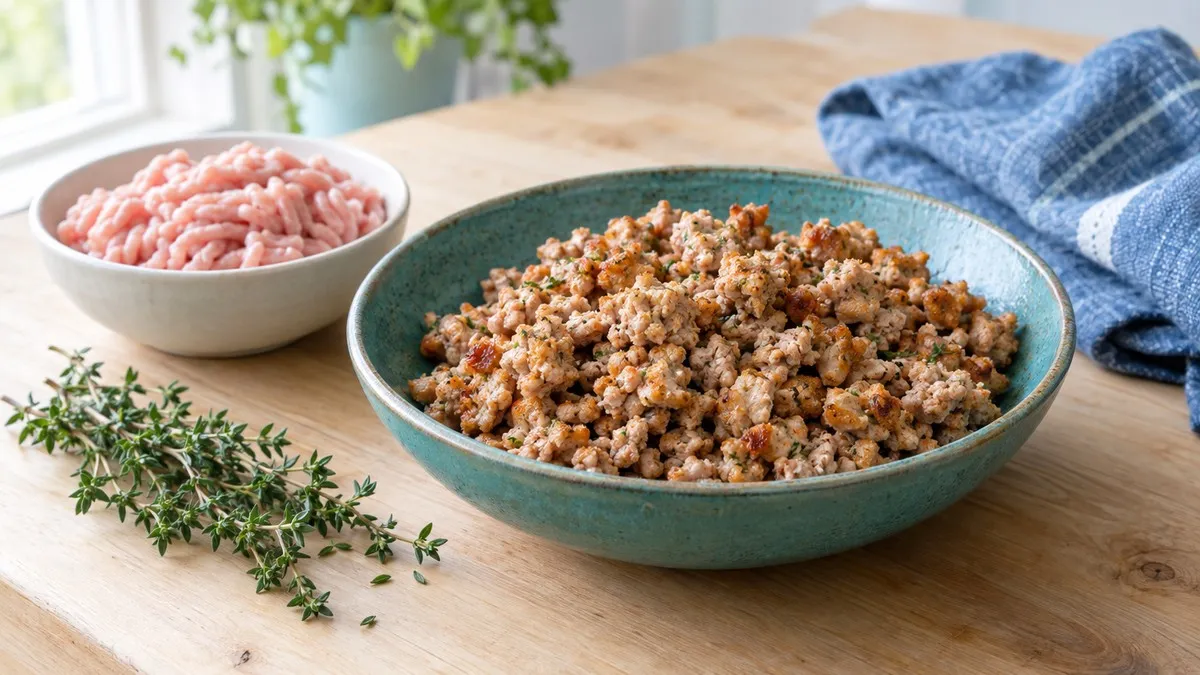
The calories in ground turkey run from 112 to 180 per 100 g raw, depending on the lean ratio on the pack. USDA lists 93% lean, 7% fat ground turkey at 150 calories per 100 g raw, which is about 170 calories for a 4 oz portion. Cook that same meat into crumbles and the figure climbs to 213 calories per 100 g, because water leaves the pan and the calories stay behind.
That second number is where most food logs go wrong. The ratio on the label and the state of the meat when you measure it change the count more than anything else, so this guide gives you both: a table by lean ratio, raw and cooked, and the reasons the two columns differ.
All figures come from USDA FoodData Central, the government's reference database for food composition. Where a number is our own arithmetic from those records, the text says so.
Calories in Ground Turkey per 100 g, by Lean Ratio
USDA publishes separate records for each common lean ratio, measured raw, as pan-broiled crumbles and as broiled patties. The record for 93/7 ground turkey sits in the middle, with 85/15 and the fat-free version on either side of it.
| Ground turkey | Raw | Pan-broiled crumbles | Broiled patties |
|---|---|---|---|
| Fat free | 112 | 151 | 138 |
| 93% lean, 7% fat | 150 | 213 | 207 |
| 85% lean, 15% fat | 180 | 258 | 249 |
| Ground turkey, ratio not stated | 148 | 203 (cooked) | not listed |
Calories per 100 g, USDA FoodData Central, SR Legacy records.
The gap between the leanest and the fattiest pack is 68 calories per 100 g raw, and it grows to 107 once both are cooked. The fat-free row is the nearest USDA match for packs sold as 98 or 99 percent lean, which are not listed as a ratio of their own.
Protein and fat in each ratio
Protein moves the other way. Per 100 g raw, fat-free ground turkey carries 23.6 g of protein and 1.95 g of fat. The 93/7 record carries 18.7 g of protein and 8.34 g of fat, and 85/15 carries 16.9 g of protein and 12.5 g of fat.
Cooked crumbles concentrate both: 31.7 g of protein per 100 g for fat free, 27.1 g for 93/7 and 25.1 g for 85/15. Carbohydrate is zero in every row.
How Many Calories in Ground Turkey per 4 oz, 3 oz and Pound
Recipes and labels rarely work in 100 g steps. A US pack lists its serving as 4 oz raw, a nutrition app often defaults to 3 oz cooked, and recipes call for a pound. Here are the same USDA records scaled to those amounts, our arithmetic from the 100 g figures.
| Ground turkey | 4 oz raw (113 g) | 3 oz cooked crumbles (85 g) | 1 lb raw (454 g) |
|---|---|---|---|
| Fat free | 127 | 128 | 508 |
| 93% lean, 7% fat | 170 | 181 | 680 |
| 85% lean, 15% fat | 203 | 219 | 816 |
| Ratio not stated | 167 | 173 | 671 |
Notice that 4 oz raw and 3 oz cooked land close together. That is no coincidence: 3 oz of cooked crumbles is roughly what 4 oz of raw meat becomes after browning, so both columns describe about the same portion on the plate.
The pack label versus the database
A newer USDA sample of raw 93/7 turkey, from the Foundation Foods dataset, measured 153 calories and 9.6 g of fat per 100 g. The older record says 150 calories and 8.34 g of fat. Both describe the same label, which tells you something useful: a lean ratio is a target for the grind, and two packs with the same ratio can differ by a few calories per serving.
Why 93/7 Ground Turkey Is About Half Fat by Calories
The numbers on the front of the pack are percentages by weight, not by calories. Since a 2010 federal rule on nutrition labeling, a ground product that does not qualify as "low fat" may print a lean percentage only if the fat percentage sits beside it, in the same size and colour. That is why you see "93% lean / 7% fat" as a pair.
Weight and calories tell different stories because fat carries 9 calories per gram while protein carries 4. Using those standard factors on the USDA raw records:
- Fat-free ground turkey: about 16 percent of its calories come from fat and 84 percent from protein.
- 93/7 ground turkey: about 50 percent of its calories come from fat, and the other half from protein.
- 85/15 ground turkey: about 63 percent of its calories come from fat.
So a pack that is 93 percent lean by weight is roughly half fat by calories. That is not a trick on the label; it is just how the arithmetic works when water makes up most of the weight. It also explains why the fat-free version behaves more like chicken breast calories than like the 93/7 pack beside it.
What ground turkey is made of
An FSIS fact sheet on ground poultry rules explains that "ground turkey" can include skin and attached fat in natural proportions, from cuts such as drumsticks, thighs and neck. A pack labeled "ground turkey meat" is ground muscle with no skin. The same fact sheet notes that darker pink usually means more dark meat, and lighter pink more white meat or skin.
That matters when a pack shows no ratio at all. USDA's plain "ground turkey" record, at 148 calories per 100 g raw, sits almost on top of 93/7, but a pack with more skin or dark meat will run higher.
Raw vs Cooked: Why the Calorie Count Climbs
Cooking does not add calories to ground turkey. It removes water. The same calories end up in less meat, so every 100 g of cooked crumbles holds more of them than 100 g of raw.
How much weight leaves the pan? USDA builds cooked values from measured cooking yields, explained in its cooking yields table, where yield is the hot cooked weight divided by the raw weight. Protein barely leaves the meat, so comparing raw and cooked protein gives a rough yield. By that arithmetic, 93/7 crumbles keep about 69 percent of their raw weight and fat-free crumbles about 74 percent.
A pound of raw 93/7 ground turkey becomes roughly 310 g of crumbles, still carrying close to the 680 calories it started with. USDA lists those crumbles at 213 per 100 g, which comes to about 660, the small difference being fat left in the pan.
The mistake that skews a food log
The common error is measuring cooked meat and logging it as raw. Say you brown a pack and spoon 100 g of cooked 93/7 crumbles onto your plate. Logged as raw ground turkey, that reads 150 calories. The cooked record says 213. You have undercounted by about 30 percent.
The opposite happens too: measure 113 g raw, then pick a cooked entry in an app, and the log reads around 240 instead of 170.
The fix is to match the state. Measure raw and use a raw entry, or measure cooked and use a cooked entry. If you cook a full pack for several people, a simple route is to note the raw calories for the whole pack from its label, then divide by the share of the cooked pan you took.
For safety, the USDA chart of safe minimum temperatures lists 165 °F for all ground poultry, so the cooked records describe meat browned all the way through.
How Many Calories in a Turkey Burger Patty
USDA's broiled patty records give a cooked patty its own figures. Per 85 g cooked patty, about 3 oz, our arithmetic from the 100 g values:
| Patty made from | Calories per 85 g cooked patty |
|---|---|
| Fat-free ground turkey | 117 |
| 93% lean, 7% fat | 176 |
| 85% lean, 15% fat | 212 |
A quarter-pound raw patty of 93/7 starts at about 170 calories. Using the same protein arithmetic, it comes off the grill at roughly 80 g, still close to 170 calories. In other words, the raw label count follows the patty to the plate; only the weight changes.
Those figures cover the meat alone. A turkey burger as served adds the bun, cheese, sauce and any oil on the grill, and each of those has its own label.
Oil in the pan
Lean ground turkey sticks, so many recipes start with oil. Whatever oil you add stays partly in the meat and partly in the pan, and the USDA crumble records were cooked without it. If you use a tablespoon of oil for a whole pack, add that tablespoon's label calories to the pack total before you split it between plates.
Estimating a Plate of Ground Turkey Without Measuring
Most ground turkey does not arrive on the plate as plain crumbles. It ends up in tacos, chili, lettuce wraps or a pasta sauce, and nobody weighs the share on their fork. That is where an estimate is the practical answer.
Primo Scale's Calorie Estimator gives estimated calories and macros for a meal from one photo, such as a bowl of turkey chili or a plate of turkey tacos, with the reasoning shown beside each result and USDA reference data behind the food figures. A photo cannot read the lean ratio off a pack, so a 93/7 chili and an 85/15 chili look alike; when the pack is in the bin, its label is still the better source for the meat.
For the meat portion on its own, the app's Weight Estimator returns a typical figure and a likely range in grams, which you can then match to the cooked row in the tables above. Primo Scale does not weigh objects or use phone sensors. It estimates a likely range from visual analysis and reference data. For an exact figure, a kitchen scale is still the tool.
Reading the portion by eye
If you have no scale at hand, use the pack itself as the reference. A 1 lb pack of 93/7 makes roughly 310 g of crumbles, so splitting the pan into four even shares gives about 78 g each, a little under 3 oz and about 165 calories by the cooked record. The same raw-to-cooked shrink applies to other proteins, as the guide to raw and cooked chicken breast sizes shows.
What to Remember
Ground turkey ranges from 112 to 180 calories per 100 g raw, set mostly by the lean ratio. The 93/7 pack most people buy is 150 raw and 213 cooked per 100 g, about 170 for a 4 oz raw serving.
The ratio on the pack is by weight, so 93 percent lean still means about half the calories come from fat. Fat-free ground turkey is the lightest and highest in protein; 85/15 carries the most calories.
Cooking concentrates calories by driving out water, so match your entry to the state of the meat when you measured it. Patties follow the same rule, and the bun, cheese and oil sit on top of the meat count.