

A US large egg averages at least about 57 grams in its shell, and about 50 grams once it is cracked. The size on the carton is a weight class, not a guess: the USDA sorts eggs by how much a dozen of them weighs, so "large" already tells you roughly how many grams you are holding.
This guide gives the weight for each size class with and without the shell, shows why a European "large" is not the same egg as an American one, and explains how to estimate an egg's weight when there is no carton to read.
Egg weight by size
In the US, egg sizes come from the USDA's shell egg standards, which set a minimum net weight for a dozen eggs in each class: 18 ounces for small, 21 for medium, 24 for large, 27 for extra large and 30 for jumbo. Dividing by twelve gives the lowest average weight of one egg across the dozen, shown below as "at least" with the shell on. The weight without the shell comes from USDA FoodData Central, which lists raw whole egg by size.
| Size | Shell on | Shell off |
|---|---|---|
| Small | at least about 43 g | about 38 g |
| Medium | at least about 50 g | about 44 g |
| Large | at least about 57 g | about 50 g |
| Extra large | at least about 64 g | about 56 g |
| Jumbo | at least about 71 g | about 63 g |
For other foods and sizes, the food weight calculator lists every USDA size class with grams and calories.
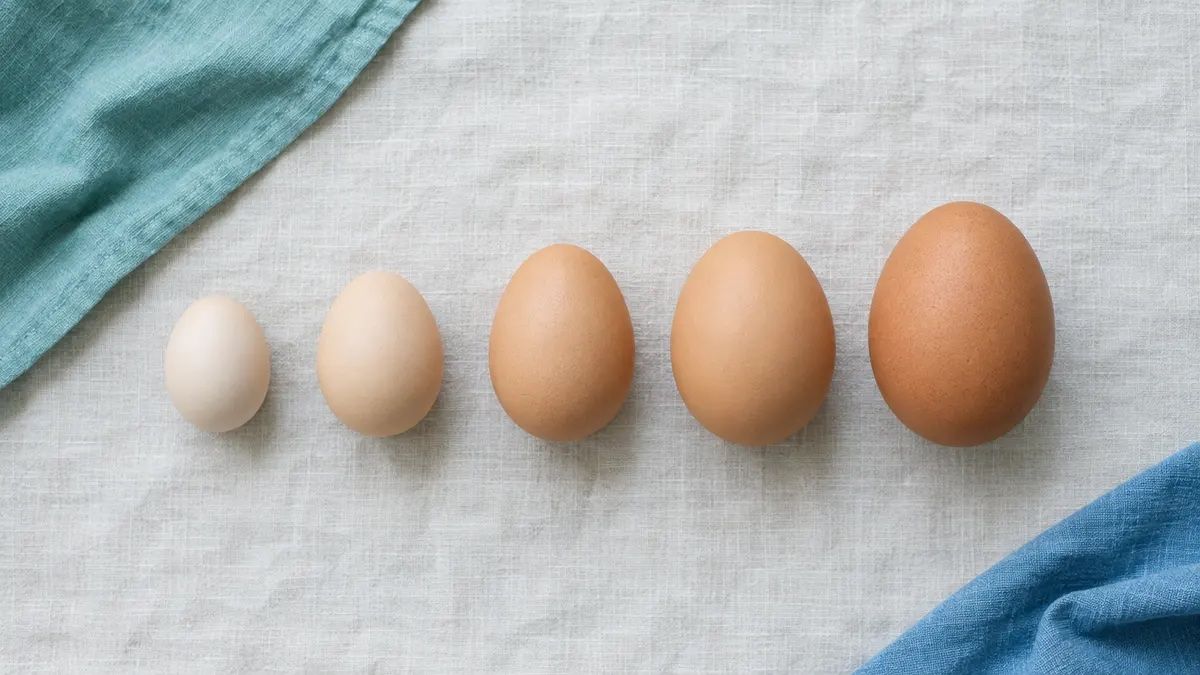
Two things follow from the table. Each class is about 7 grams heavier than the one below it, so the jump from medium to jumbo is around 20 grams per egg. And the shell figures are minimums for the dozen, not for every egg: a carton of large eggs can hold one a little lighter and one a little heavier, as long as no egg falls below about 54 grams and the dozen reaches 24 ounces.
US and EU sizes are not the same
Europe grades every egg on its own weight rather than by the dozen. Under the EU's egg marketing standards, the classes are:
| EU class | Weight per egg, in the shell |
|---|---|
| S (small) | under 53 g |
| M (medium) | 53 g to under 63 g |
| L (large) | 63 g to under 73 g |
| XL (very large) | 73 g or more |
So the names do not line up. A US large egg, at around 57 grams, falls in the EU's medium class, and an EU large starts at 63 grams, which is close to a US extra large. An EU large egg is graded on its own weight at 63 grams or more, while a US large egg only has to reach about 54 grams on its own and about 57 on average across the dozen, so a European recipe that asks for "2 large eggs" usually expects more egg than two US large ones.
Shell, white and yolk
The USDA Egg Grading Manual puts an average chicken egg at about 57 grams and splits it roughly like this:
- Shell: about 11 percent, so around 6 grams.
- White: about 58 percent, so around 33 grams.
- Yolk: about 31 percent, so around 18 grams.
That is why the shell-off figures in the first table sit about 5 to 8 grams below the shell-on ones. A recipe that gives egg in grams means the egg that goes into the bowl, without its shell.
Calories by size
FoodData Central lists raw whole egg at 143 calories per 100 grams. Applied to each size without the shell:
- Small (38 g): about 54 calories.
- Medium (44 g): about 63 calories.
- Large (50 g): about 72 calories.
- Extra large (56 g): about 80 calories.
- Jumbo (63 g): about 90 calories.
Swapping a large egg for a jumbo one adds roughly 18 calories. For a food diary, the size on the carton is usually all the detail you need.
Estimating an egg's weight without the carton
Loose eggs from a farm stand, a bowl on the counter or a mixed tray carry no size class. Two habits help.
Compare it with a known egg. If you know your usual carton is large, an egg that looks clearly longer and fuller is likely extra large or jumbo; one that looks short and narrow is likely medium or small.
Say it as a range. "Probably a large egg, somewhere around 55 to 60 grams in the shell" is honest. A single figure to the gram is more certainty than eyes can give.
Estimating from a photo
Primo Scale takes the same approach with a camera. With the Weight Estimator you take one photo of the egg, and the AI identifies it, estimates its size from the image (with LiDAR depth on iPhones that have it), and compares it with reference data for eggs. The result is a typical weight with a likely range around it, and the reasoning is shown beside it.
The phone does not sense weight, and the app does not put the egg on a scale. The figure is an AI estimate from what the camera sees, which is why it comes as a range.
When an estimate is good enough, and when it is not
An estimate covers most everyday questions: whether a recipe's "3 eggs" is in the right ballpark, roughly how much protein breakfast had, or whether that farm-stand egg is unusually big.
It is not the right tool when the grams have to be right: a baking formula written in grams, portioning for a medical diet set gram by gram, or selling eggs by weight. Primo Scale estimates a likely range from visual analysis and reference data. For an exact weight, use a calibrated scale.
Quick answers
How much does one egg weigh in grams? A US large egg is at least about 57 g in the shell on average, and about 50 g without it.
How much does an egg weigh without the shell? About 38 g for small, 44 g for medium, 50 g for large, 56 g for extra large and 63 g for jumbo.
How much does the shell weigh? Around 6 g on an average egg, about 11 percent of its weight.
Is a large egg the same in the US and the EU? No. A US large is around 57 g; an EU large is 63 to 73 g, closer to a US extra large.
How many calories are in a large egg? About 72 calories for the 50 g of egg inside the shell.