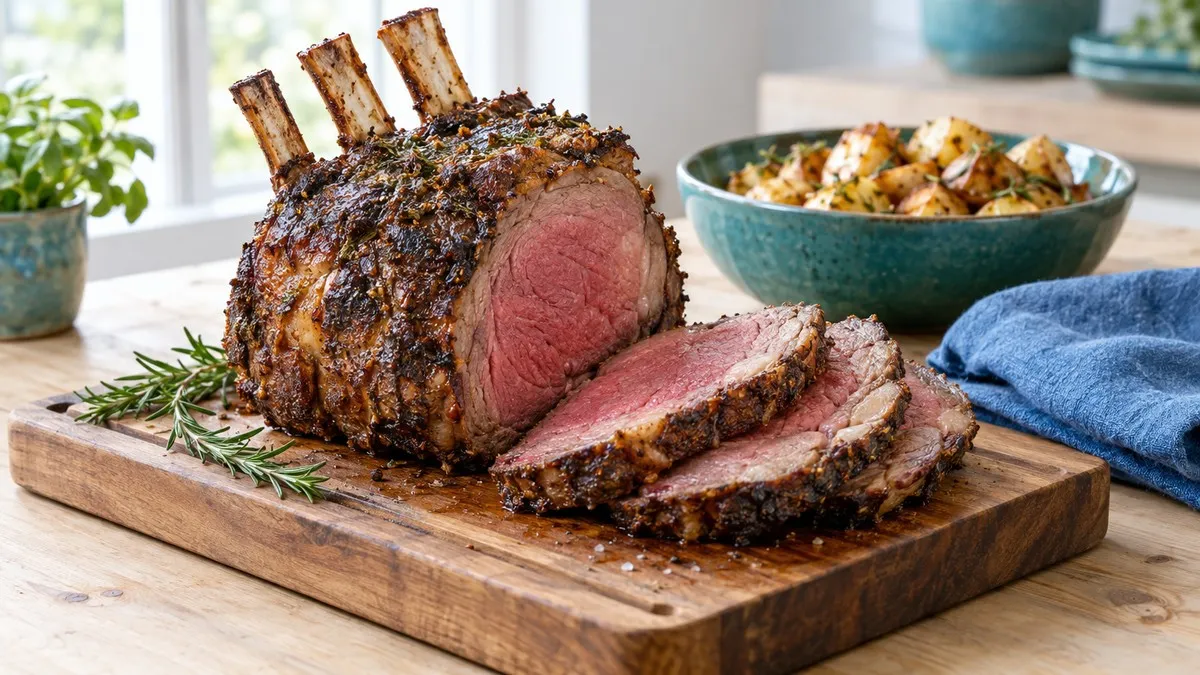
Plan on about 1 pound (454 g) of bone-in prime rib per person, which works out to one rib for every two guests. For a boneless rib roast, 3/4 pound (340 g) per person is a full portion and 1/2 pound (227 g) is enough when the table is crowded with sides. Those are raw buying weights, and the roast gives up a good share of them in the oven and on the carving board.
Prime rib is an expensive roast to get wrong, so how much prime rib per person deserves better than a guess. Below are the buying rules from food writers, a grocer and a beef council side by side, a chart for 2 to 16 guests in pounds and kilograms, what one rib weighs, how much meat survives cooking according to USDA measurements, and the calories in a serving.
Key findings on prime rib per person
- Bone-in: about 1 lb raw per guest, or one rib for every two people. Serious Eats, The Kitchn, Safeway and the Wisconsin Beef Council all use the one-rib-for-two rule.
- Boneless: 1/2 to 3/4 lb raw per guest, with published figures running from 6 ounces to 12 ounces.
- Cooking loss: a rib eye roast comes out of the oven at about 76 to 77 percent of its raw weight in USDA's cooking yield study.
- Edible meat: once bone and trim are off, USDA counts 289 g of cooked meat from each pound of raw bone-in rib, about 10 ounces per guest at the 1 lb rule.
- Calories: roasted rib with its fat runs about 351 kcal per 100 g, or 298 kcal in a 3 ounce serving.
How much prime rib per person, bone-in and boneless
The bone-in rule barely moves from source to source. According to Serious Eats, you should plan on about one pound of bone-in prime rib per guest, which is about one rib section for every two people. The boneless rule moves a lot more.
| Source | Bone-in per person | Boneless per person | Note |
|---|---|---|---|
| Serious Eats | about 1 lb | not stated | one rib for every two people |
| The Kitchn | 1 lb | not stated | a four-bone roast serves eight generously |
| Safeway | about 1 lb | 3/4 lb, or 1/2 lb with many sides | one rib feeds about two |
| Food & Wine, 2025 guide | at least 1 lb, up to 2 lb | 8 to 12 oz | two to three portions per rib |
| Southern Living | not split by bone | not split by bone | 1/2 lb at a buffet, 1 lb at a sit-down dinner |
The bone-in figure is higher for a plain reason: part of every pound you pay for is bone, and nobody eats it. Safeway's buying guide puts it the same way, noting that boneless roasts give you more servings per pound.
Why the boneless numbers spread
Food & Wine gives two answers of its own: 6 to 8 ounces boneless per guest in its 2024 explainer, and 8 to 12 ounces in its 2025 buying guide. Neither is wrong. They describe different dinners.
Safeway drops its boneless figure from 3/4 lb to 1/2 lb when there are lots of sides or children at the table, and Southern Living halves its figure for a buffet. The more food on the table, the less beef each guest takes, so the low end of the range fits a full holiday spread and the high end fits a dinner built around the roast.
Prime rib chart for 2 to 16 guests
This chart applies the rules above: 1 lb of bone-in roast per guest, one rib per two guests rounded up, and boneless at 3/4 lb for a full portion or 1/2 lb with plenty of sides. Kilograms are rounded to one decimal for readers in the UK, Canada and Australia, where roasts are sold by the kilo.
| Guests | Bone-in roast | Ribs | Boneless, full portion | Boneless, many sides |
|---|---|---|---|---|
| 2 | 2 lb (0.9 kg) | 1 | 1.5 lb (0.7 kg) | 1 lb (0.5 kg) |
| 4 | 4 lb (1.8 kg) | 2 | 3 lb (1.4 kg) | 2 lb (0.9 kg) |
| 6 | 6 lb (2.7 kg) | 3 | 4.5 lb (2.0 kg) | 3 lb (1.4 kg) |
| 8 | 8 lb (3.6 kg) | 4 | 6 lb (2.7 kg) | 4 lb (1.8 kg) |
| 10 | 10 lb (4.5 kg) | 5 | 7.5 lb (3.4 kg) | 5 lb (2.3 kg) |
| 12 | 12 lb (5.4 kg) | 6 | 9 lb (4.1 kg) | 6 lb (2.7 kg) |
| 14 | 14 lb (6.4 kg) | 7 | 10.5 lb (4.8 kg) | 7 lb (3.2 kg) |
| 16 | 16 lb (7.3 kg) | 8 | 12 lb (5.4 kg) | 8 lb (3.6 kg) |
Odd numbers, small dinners and big parties
For an odd number of guests, round the ribs up: seven people means a four-rib roast. The Wisconsin Beef Council's roasting chart starts at a two-rib roast, so a dinner for two usually means a two-rib roast with leftovers, or a small boneless piece instead.
At the top of the chart, sixteen guests need eight ribs, one more than a whole rib section holds, so a party that size is two roasts. Check that both fit your oven before you order.
How many ribs per person, and what one rib weighs
A whole rib section runs from rib 6 to rib 12, seven ribs in all. Texas A&M AgriLife Extension puts a full seven-rib roast at 15 to 18 pounds, enough for 16 or more people. Safeway describes a three-rib roast as 6 to 8 pounds serving 6 to 8.
Divide those roasts by their bones and each rib carries roughly 2 to 2.7 pounds of raw roast. That is why the one-rib-for-two rule and the one-pound rule land on the same answer: a rib is about two people's worth of bone-in weight.
Not everyone agrees on the portion behind a rib. Food & Wine's 2025 guide figures two to three portions per rib, and a chef quoted in its 2024 explainer suggests one bone per person when you want every guest to get a slice on the bone. That doubles the rib count in the chart, so treat it as a presentation choice for a small table rather than a buying rule.
Small end or large end
The seven ribs are not alike. Ribs 10 to 12, called the loin end, small end or first cut, have a bigger, more even eye of meat and less fat running through it. Ribs 6 to 9, the shoulder end, large end or second cut, carry more fat between the muscles and a thicker ribeye cap.
The end changes the slices more than the portion count. Ask which end you are getting if the label does not say. And remember that "prime rib" names the dish, not the grade: most supermarket rib roasts are USDA Choice.
How much prime rib shrinks when it cooks
A raw weight is a buying number, not a plate number. The USDA cooking yields table measured bone-in rib eye roasts, trimmed to 1/8 inch of fat, at an average of 77 percent of their raw weight after roasting, across 35 samples ranging from 72 to 84 percent. Boneless rib eye roasts averaged 76 percent, with a wider range of 66 to 85 percent.
So an 8 pound bone-in roast comes out of the oven at about 6.2 pounds before anyone touches a knife. The bones are still in that number.
Take the bones and the trim away and the edible share drops again. USDA's nutrient tables list 289 g of cooked meat, lean and fat together, from each pound (454 g) of raw rib roast weighed with its bone, about 64 percent of what you bought. Serious Eats gives a rounder figure for the same idea: each pound of raw, bone-in prime rib gives about a half pound of edible cooked meat.
From raw pounds to the plate, for eight guests
Here is the chart's eight-guest row followed through to the table:
- Buy an 8 pound (3.6 kg) bone-in roast, four ribs.
- After roasting it weighs about 6.2 pounds (2.8 kg) at the USDA's 77 percent yield.
- After carving off the bones, USDA's 289 g per raw pound gives about 2.3 kg, or 5.1 pounds, of meat.
- Shared by eight, that is about 289 g, a little over 10 ounces, each. At the Serious Eats half-pound rate it is closer to 8 ounces each.
Both figures are far above the 3 ounce cooked serving the Wisconsin Beef Council builds its roast chart on. The Kitchn calls the one-pound rule a good one if you love leftovers, and the numbers show why: the difference is tomorrow's sandwiches.
Calories in a serving of prime rib
USDA's nutrient data for roasted beef rib, ribs 6 to 12, lean and fat, trimmed to 1/8 inch, lists 351 kcal per 100 g across all grades. A 3 ounce (85 g) serving comes to 298 kcal, with 23.9 g of fat and 19.4 g of protein, as the figures on MyFoodData's USDA listing show.
| Portion of roasted prime rib | Weight | Calories, lean and fat |
|---|---|---|
| Standard serving | 3 oz (85 g) | 298 kcal |
| 100 g | 3.5 oz | 351 kcal |
| Thick holiday slice | 6 oz (170 g) | about 600 kcal |
| All the meat from 1 lb raw bone-in | 289 g (10.2 oz) | about 1,014 kcal |
Grade moves the figure. USDA lists Choice rib at 365 kcal per 100 g and Prime at 400 kcal, because Prime carries more marbling.
Lean only, or with the fat
Fat on the plate moves it further. Texas A&M AgriLife gives 205 calories for 3.5 ounces of broiled USDA Choice prime rib, lean only, against 365 kcal for 100 g of roasted Choice rib with its fat. The cooking methods differ, so the gap is a rough guide, but leaving the fat cap and the outer fat on the plate cuts more calories than picking a leaner grade.
The cap, the ribeye cap and how far you trim at the table all vary from slice to slice. So two slices of the same thickness from one roast can carry quite different calories.
Adjusting for sides, children and leftovers
The chart assumes adults at a sit-down dinner where the beef is the main event. Shift it when your dinner differs:
- Many sides or a buffet: drop boneless to 1/2 lb and bone-in toward the buffet half-pound figure Southern Living gives.
- Children at the table: Safeway uses the same 1/2 lb boneless figure, and holiday dinner calculators such as J-Kit's count a child as half a portion.
- Leftovers on purpose: Safeway suggests adding a pound or two, and Food & Wine goes as high as 2 lb per person.
- A second main dish: each guest takes a little of both, so scale the roast down rather than buying full portions of each.
If ham shares the table, our guide to ham per person covers bone-in, boneless and spiral amounts on the same raw-weight basis. For a turkey and prime rib dinner, the turkey per person chart works the same way in pounds and kilograms.
Estimating a roast or a plate from a photo
Sometimes the label is gone. The roast came out of a relative's freezer in plain paper, or the leftovers sit in a container and you want a rough idea of how many sandwiches they hold.
Primo Scale's Weight Estimator identifies the food from one photo and returns a typical figure with a likely range in grams, with its reasoning shown beside the result. Primo Scale does not weigh objects or use phone sensors. It estimates a likely range from visual analysis and reference data. A roasting chart in minutes per pound needs a real number, so for cooking times the butcher's label or a kitchen scale is the one to use.
For a food diary, Primo Scale's Calorie Estimator gives estimated calories and macros for a photographed plate, beef, potatoes and gravy together, using USDA reference data. Fat left on a slice and gravy pooled under it are hard to read from above, so treat the result as an estimate and the table above as the reference for the beef itself.
The short version
Buy about 1 pound of bone-in prime rib per guest, or one rib for every two people, and 1/2 to 3/4 pound per guest for boneless, depending on how many sides share the table. Round ribs up for odd numbers, and split a party of more than fourteen into two roasts.
Expect the roast to lose about a quarter of its weight in the oven and more when the bones come off, leaving around 8 to 10 ounces of cooked meat per guest at the one-pound rule. A 3 ounce serving of roasted rib with its fat carries about 298 kcal, and trimming the fat changes that more than the grade does.