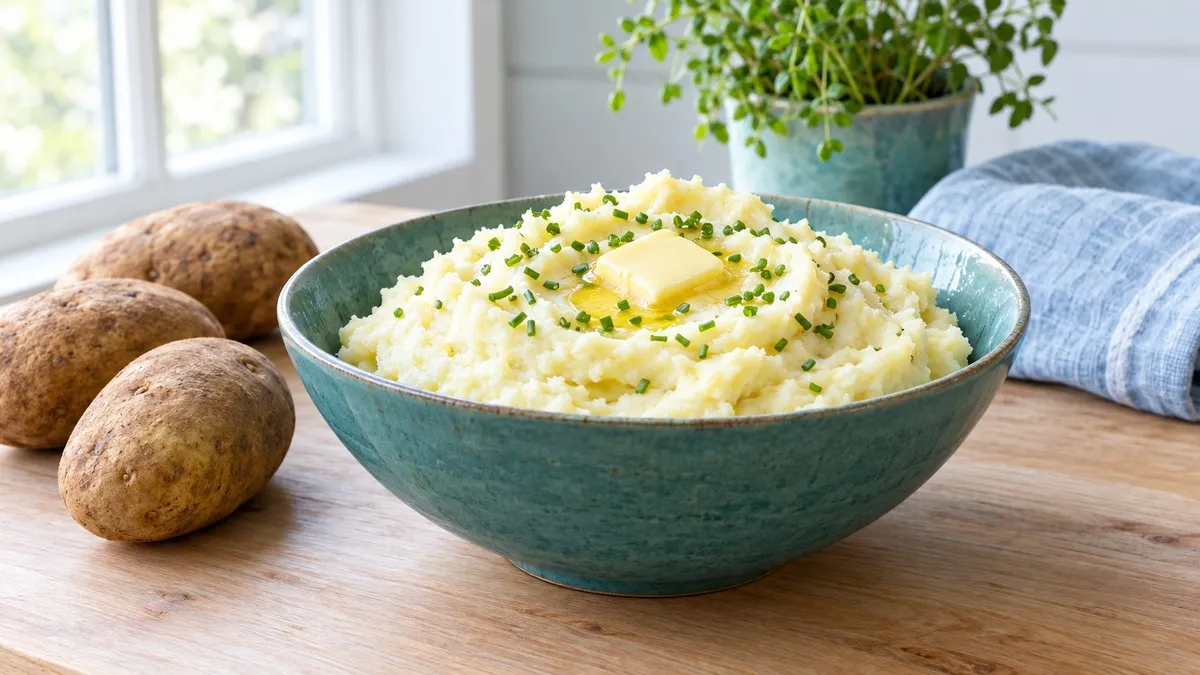
Plan half a pound of raw potatoes per person for mashed potatoes. That is about one medium potato each, and it makes roughly one cup of mash once the milk and butter go in. Go up to three quarters of a pound per person when mashed potatoes are the main starch or you want leftovers, and down toward a third of a pound when the table is crowded with other sides.
Getting mashed potatoes per person right is mostly arithmetic, but it has a few traps: potatoes come in very different sizes, peeling throws away part of what you paid for, and a big pot has to stay hot until everyone has eaten. This guide walks through the whole job in five stages, from setting the portion to storing the leftovers, with a chart for 4 to 25 guests and a worked example for a table of 12.
Step 1: Set the Portion From the Rest of the Menu
The half-pound rule is the most common figure in recipe guides. The Food Network kitchen tells shoppers to plan on half a pound of potatoes per person, and its own recipe uses 2 pounds of russets for 4 to 6 servings.
That figure assumes a normal dinner. Adjust it before you multiply by anything:
- About 1/3 pound per person when the plate also carries stuffing, rolls, sweet potatoes and a casserole. Every extra side shrinks the scoop people take of each one.
- 1/2 pound per person for a regular dinner where mashed potatoes are one of two or three sides.
- 3/4 pound per person when mashed potatoes are the only starch, your guests take seconds, or you want a container of leftovers for the next day.
Children and light eaters pull the average down, so a table with several small children can sit at the low end even when the adults eat well. If you are also sizing the main course, the same thinking applies to turkey per person, where bone weight changes the number.
Write the portion down before you shop. It is the one decision every later stage depends on.
Mashed Potatoes per Person, From 4 to 25 Guests
Multiply the guest count by the portion from Step 1. The chart below does that for the two most common portions, with raw, unpeeled weights as you would buy them.
| Guests | 1/2 lb each | 3/4 lb each | Medium potatoes (1/2 lb each) | Mash, about |
|---|---|---|---|---|
| 4 | 2 lb | 3 lb | 5 | 4 cups |
| 6 | 3 lb | 4.5 lb | 7 | 6 cups |
| 8 | 4 lb | 6 lb | 9 | 8 cups |
| 10 | 5 lb | 7.5 lb | 11 | 10 cups |
| 12 | 6 lb | 9 lb | 13 | 12 cups |
| 16 | 8 lb | 12 lb | 18 | 16 cups |
| 20 | 10 lb | 15 lb | 22 | 20 cups |
| 25 | 12.5 lb | 19 lb | 27 | 25 cups |
The potato count uses the USDA medium potato of 213 grams and is rounded up. The mash column uses the yield of the USDA school recipe described below, about 2 cups of finished mash per pound of unpeeled potatoes, at the half-pound portion.
The quick version: one 5-pound bag feeds about 10 people at half a pound each. For 25 or more guests, multiply your count by the per-person figure and round up to the next whole bag.
Where the yield figure comes from
The USDA school recipe for mashed potatoes, published by the Institute of Child Nutrition, uses 12 pounds of unpeeled Yukon Gold or red potatoes for 50 servings of half a cup. That is 25 cups of mash from 12 pounds, just over 2 cups per raw pound. A half cup is a school portion; an adult at a holiday table usually takes about twice that, which is why the half-pound rule and the one-cup scoop line up.
Step 2: Turn Pounds Into Potatoes
Shops sell potatoes by the bag and recipes count them by the piece, so the next job is translating one into the other. Size matters more than most people expect.
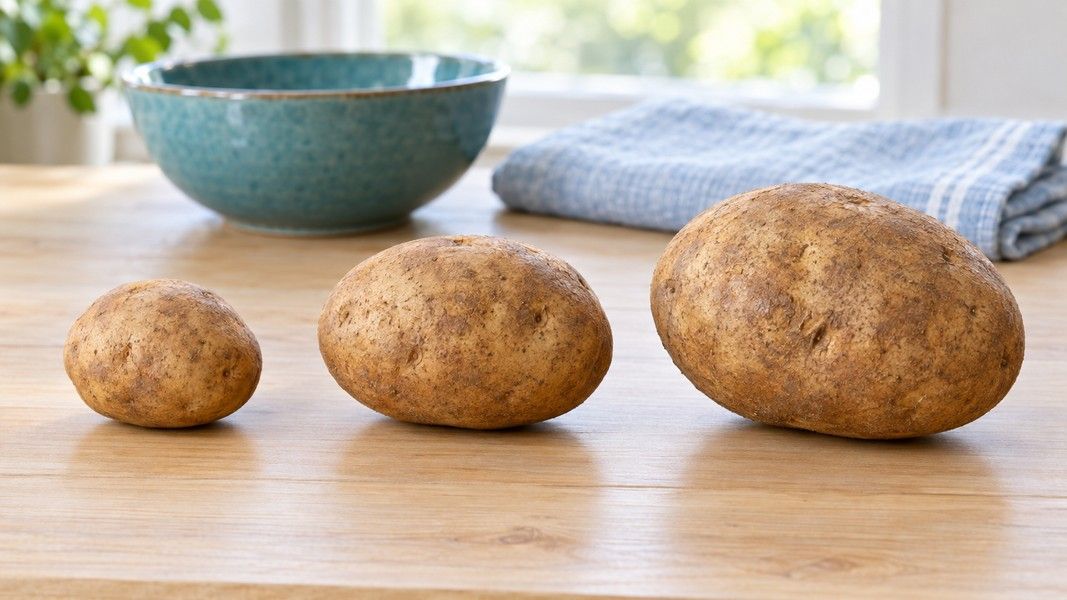
USDA FoodData Central lists reference portions for a raw potato with its skin, defined by diameter:
| Size | Diameter | Raw weight | Potatoes per 1/2 lb portion |
|---|---|---|---|
| Small | 1 3/4 to 2 1/2 in | 170 g (0.37 lb) | about 1 1/3 |
| Medium | 2 1/4 to 3 1/4 in | 213 g (0.47 lb) | about 1 |
| Large | 3 to 4 1/4 in | 369 g (0.81 lb) | about 2/3 |
How many potatoes per person for mashed potatoes
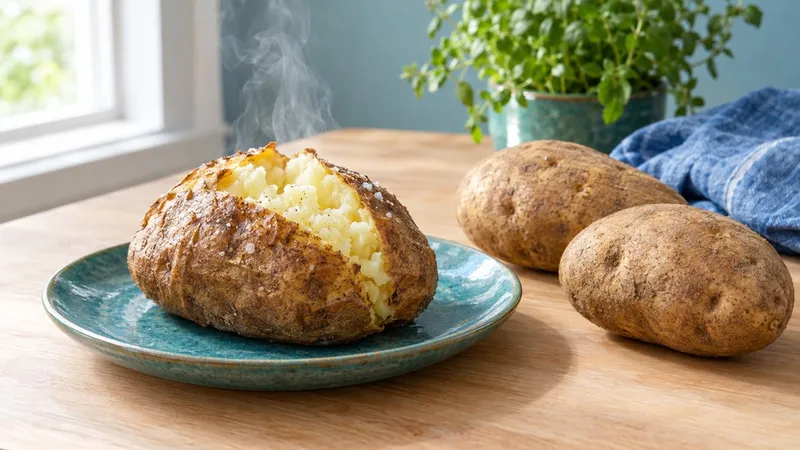
With medium potatoes, plan one per person and add one for every ten guests to cover the shortfall between 213 grams and a full half pound. With large baking russets, two potatoes cover three people. With small potatoes, buy four for every three guests.
A large potato weighs more than twice a small one, so counting potatoes instead of buying by weight can leave you short by a whole bowl. Two potatoes sold as "medium" from different bags can also differ noticeably, which is why weight is the safer unit for any group over about eight.
Variety changes the texture, not the quantity. Food Network recommends starchy russets or Yukon Golds for a fluffy mash and steers away from waxy red or fingerling potatoes, which turn lumpy.
Step 3: Buy by the Bag, Then Allow for Peeling
Most stores sell russets in 5-pound and 10-pound bags, so round your Step 1 total up to whole bags.
Peeling is the loss most hosts forget. The Idaho Potato Commission says peeling drops your yield by about 20 percent compared with leaving the skins on. Its own crowd guideline for 25 people is 6 pounds of unpeeled potatoes or 5 pounds already peeled. If you plan a smooth, peeled mash, take the unpeeled figure from the chart as your minimum and buy toward the next bag.
Skin-on mash avoids most of that loss. Thin-skinned Yukon Golds and red potatoes work best that way, and the USDA school recipe above leaves them unpeeled.
When you are not sure what you already have
Half a sack in the pantry, a farm box or a bag from a neighbor rarely comes with a label. The produce scale at the store settles it for anything you buy, and a kitchen scale settles it at home.
Without either, Primo Scale's Weight Estimator can identify a potato in one photo and return a typical figure with a likely range, which tells you quickly whether you are holding small, medium or large ones before you count them against the chart. Primo Scale does not weigh objects or use phone sensors. It estimates a likely range from visual analysis and reference data, so treat the result as a sizing guide and use a real scale when the exact number matters.
Step 4: Scale the Butter and Milk to the Potatoes
Once the potato weight is fixed, the dairy follows it. Two published large-batch recipes give useful per-pound ratios.
| Source | Potatoes | Milk | Fat | Milk per lb | Fat per lb |
|---|---|---|---|---|---|
| USDA school recipe | 12 lb | 1 quart | 12 oz margarine | 1/3 cup | 1 oz (2 tbsp) |
| Idaho Potato Commission | 5 lb | 1 1/2 to 3 cups | 1/4 to 1/2 cup butter | 1/3 to 2/3 cup | 0.4 to 0.8 oz |
The school recipe is the leaner of the two. The Idaho guide gives a range, with 5 pounds of potatoes making 12 one-cup servings, and notes that most people make larger portions than a cup so there are leftovers. Its 5 pounds also carry about 1 1/2 tablespoons of salt.
Add warm milk gradually and stop when the texture is right. A large batch is easy to turn soupy, and liquid cannot be taken back out. Holiday recipes often go richer than either table, with cream, sour cream or cream cheese, and that changes the calories far more than the potato does.
What one scoop adds up to
FoodData Central lists one cup of home-prepared mashed potatoes made with whole milk and butter at 210 grams and 113 calories per 100 grams, about 237 calories a cup. The full breakdown by cooking method is in our guide to potato calories by size. A holiday plate adds gravy, stuffing and turkey on top, and Primo Scale's Calorie Estimator can give an estimate for the whole plate from one photo, with its reasoning beside the figure. Butter folded into the mash and gravy under it are invisible to any photo, so read that estimate as a rough guide.
Step 5: Hold, Serve and Store It Safely
A big batch of mashed potatoes is often ready an hour before the turkey is carved, and the holding time is where food safety goes wrong.
The USDA Food Safety and Inspection Service says hot food must be kept at 140 °F or above, using a warm oven, a chafing dish, a warming tray or a slow cooker. Bacteria grow fastest between 40 °F and 140 °F, and perishable food left at room temperature for more than 2 hours, or 1 hour above 90 °F, should be thrown away. A buffet bowl that sits on the table through dinner and dessert crosses that line easily.
For the leftovers, the FSIS guide to leftovers and safety gives clear limits: refrigerate within 2 hours in shallow containers so they cool quickly, use them within 3 to 4 days, or freeze them for 3 to 4 months for best quality. Reheat leftovers to 165 °F, covered, with a splash of milk if they look dry.
FSIS names improper cooling of cooked food as one of the most common causes of foodborne illness, which is why the leftovers go into shallow containers rather than back into the deep pot.
The Mashed Potato Workflow at a Glance
The whole job, from menu to leftovers, comes down to five decisions made in order:
- Portion: 1/3, 1/2 or 3/4 pound of raw potatoes per person, set by the number of other sides and whether you want leftovers.
- Total: guests times portion, from the chart, rounded up to whole 5-pound or 10-pound bags.
- Count: about one medium potato per person, two large ones for every three people, and more if you peel.
- Dairy: roughly 1/3 to 2/3 cup of warm milk and 1 to 2 tablespoons of butter per pound of potatoes, added gradually.
- Holding: keep the pot at 140 °F or above, refrigerate leftovers within 2 hours, and reheat them to 165 °F.
Worked Example: Mashed Potatoes for 12
Say you are hosting 12 people. The menu has turkey, stuffing, green beans, rolls and one other side, and you want a container of mashed potatoes left for the next day.
Portion. Leftovers are part of the plan, so use 3/4 pound per person. That is 9 pounds of raw potatoes.
Bags. You plan a smooth, peeled mash with russets, so the 20 percent peeling loss applies. Two 5-pound bags give 10 pounds, which leaves roughly 8 pounds of peeled potato. At the school recipe's yield of about 2 cups per pound, that is in the region of 16 cups of mash: 12 one-cup servings and about 4 cups for the fridge.
Dairy. Using the school recipe's 1/3 cup of milk per pound, 8 pounds of peeled potato takes about 2 2/3 cups of warm milk to start. At 2 tablespoons of butter per pound, that is 16 tablespoons, or two sticks. Hold back a little of each and adjust to taste.
Timing. The mash is done 45 minutes before the turkey comes out. It goes into a covered dish in the oven at its lowest setting with a thermometer checked once, and the leftovers go into two shallow containers as soon as the meal ends.
The same steps work for 6 people or 25. Only the multiplication changes.
Conclusion
Half a pound of raw potatoes per person is the starting point for mashed potatoes, and about one medium potato each. Move to a third of a pound when the table is full of sides and to three quarters when you want seconds and leftovers. Buy by weight rather than by count, because a large potato is more than twice a small one, and allow for the fifth of the weight that peeling removes.
Scale the milk and butter to the potato weight, add the liquid slowly, and keep the finished pot at 140 °F or above until it is served. With the portion written down first, every other number on the shopping list follows from it.